
What's Letter T About?
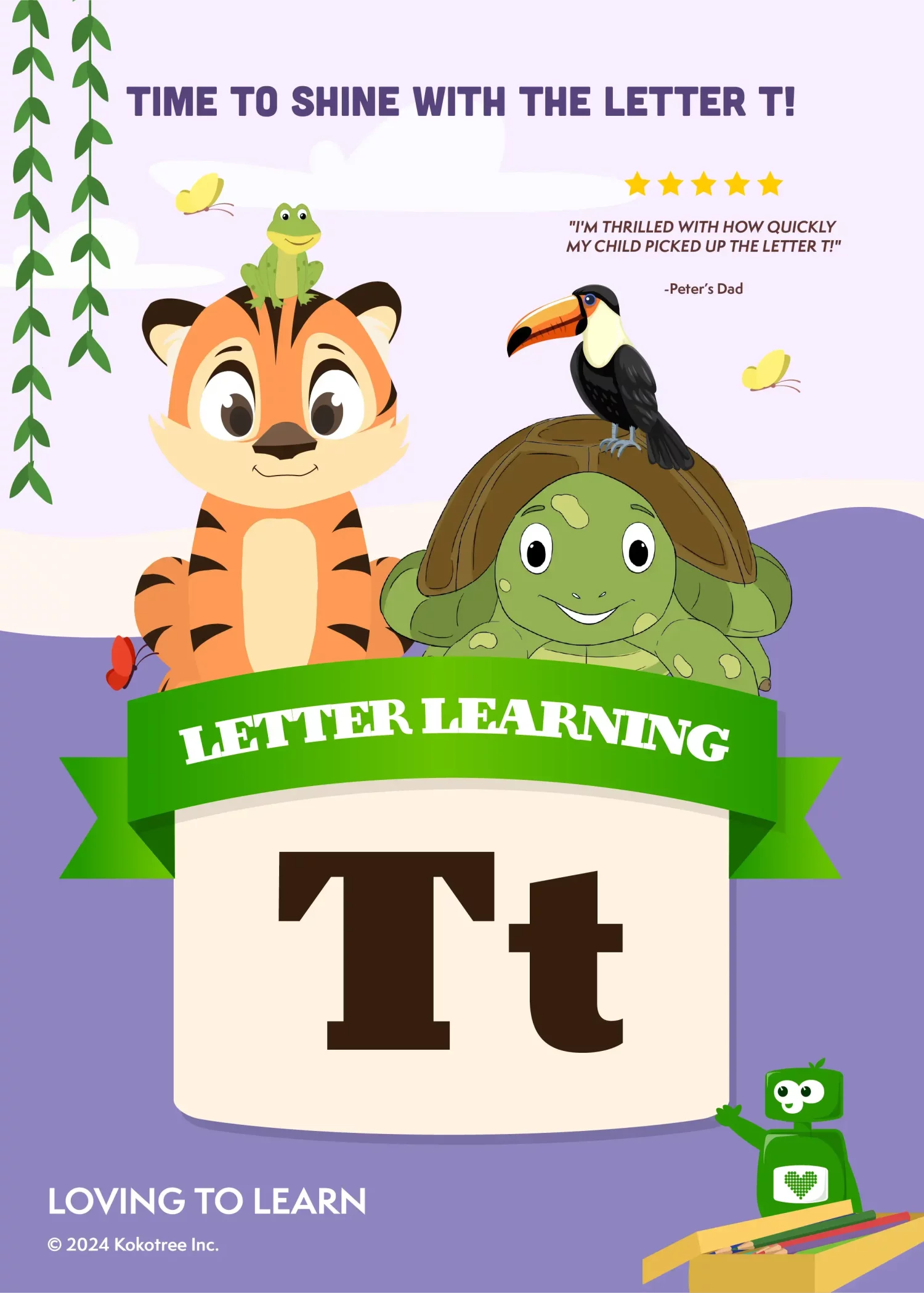
Your little one joins Miss Meera and friends on a magical journey through T-Land, where every tree is shaped like the letter T! They'll master the "tuh" sound, learn to write both uppercase and lowercase T, and meet fascinating animals from toucans to tortoises.
7.5 minutes
Ages 3-5
Skill: Letter recognition and phonics
Your kid watches friendly animals explore a forest full of T-shaped trees. You get 7 minutes to finish that coffee while it's still warm.
The Kokotree Class discovers a mysterious forest where all the trees look different—they're shaped like the letter T! Miss Meera guides them through T-Land, introducing amazing animals whose names start with T, then teaches them exactly how to write the letter.
What your child learns:
This video builds essential pre-reading skills by connecting the letter T to its sound through memorable animal friends. Your child practices the "tuh" sound repeatedly and learns the simple two-stroke technique for writing both uppercase and lowercase T.
- Recognizes the letter T in both uppercase and lowercase forms
- Produces the "tuh" phonetic sound correctly
- Writes uppercase T using two strokes (down, then across)
- Writes lowercase t with the cross in the middle
- Identifies T words: tiger, toucan, tapir, toad, tortoise, turkey, trees
They'll use these skills when:
- Spotting the letter T on street signs, cereal boxes, and book covers
- Sounding out words that start with T during storytime
- Writing their name if it contains the letter T
- Playing alphabet games with friends or siblings
The Story (what keeps them watching)
The Kokotree Class stumbles upon a strange forest where the trees look completely different—thick, thin, with unusual shapes! Curious, they find Miss Meera who reveals they've discovered T-Land, where everything begins with the letter T. She leads them on a safari-style adventure, meeting a colorful toucan, gentle tapirs ("Are they pigs? They look like shrunken elephants!"), a silly toad riding a tortoise, and sleeping turkeys. The magical moment? When the trees reveal they've been shaped like the letter T all along! The adventure ends with everyone learning to write the letter together.
How We Teach It (the clever part)
- First 2 minutes: Discovery and curiosity—the class explores the unusual forest, building anticipation before Miss Meera introduces the letter T and its "tuh" sound
- Minutes 2-5: Sound reinforcement through animal encounters—each new creature (toucan, tapir, toad, tortoise, turkey) gives children another chance to practice "tuh-tuh-[word]"
- Final 2.5 minutes: Writing instruction with clear visual guidance, plus the magical reveal that the trees themselves form the letter shape
Teaching trick: Every animal name is repeated in a rhythm ("Tuh-tuh-toucan!") that children naturally want to echo. This repetition pattern locks in the phonetic sound without feeling like drill work.
After Watching: Quick Wins to Reinforce Learning
Mealtime activity: "Can you find the letter T on this cereal box?" Point to food packaging and let your child hunt for T's. They're practicing letter recognition in real-world contexts.
Car/travel activity: "Let's spot things that start with the 'tuh' sound—trees, trucks, tires!" This turns any drive into phonics practice without any prep needed.
Bedtime activity: "Use your finger to write a T on my back, then I'll guess what letter it is!" This reinforces the stroke pattern through touch and play.
Anytime activity: "Can you walk like a tiger? What sound does tiger start with?" Acting out T animals from the video connects movement to learning.
When Kids Get Stuck. And How to Help.
"My child keeps mixing up T and other letters" - Totally normal! The T shape is actually one of the easier letters because it's made of just straight lines. Practice finding T's in their name or on signs—real-world spotting builds recognition faster than flashcards.
"They can say 'tuh' but forget it starts words like 'tree'" - This connection takes time! Try exaggerating: "Tuh-tuh-tuh-TREE!" The sillier you make it, the more memorable it becomes.
"The lowercase t seems hard for them to write" - The tricky part is remembering where the cross goes (middle, not top). Have them think of it as giving the letter a belt around its tummy!
What Your Child Will Learn
Prerequisites and Building Blocks
Before watching, children benefit from exposure to basic letter concepts and understanding that letters have sounds. This video builds on foundational alphabet awareness from earlier Kokotree lessons. It fits into the phonics progression by introducing a consonant with a clear, distinct sound that's easy for young mouths to produce. The "tuh" sound is a voiceless alveolar stop—one of the first consonants children master developmentally.
Cognitive Development and Teaching Methodology
This video leverages discovery-based learning, letting children explore the mysterious forest before formal instruction begins. The approach works because preschoolers learn best when curiosity is activated first. Visual learners see the letter shape in trees; auditory learners hear the repeated "tuh-tuh" pattern; kinesthetic learners practice writing strokes. The animal encounters provide spaced repetition—each new creature reinforces the sound without monotony.
Alignment with Educational Standards
This lesson aligns with Common Core Foundational Skills RF.K.1d (recognize uppercase and lowercase letters) and RF.K.3a (demonstrate basic knowledge of letter-sound correspondences). It supports kindergarten readiness indicators for letter naming fluency and phonemic awareness. Teachers expect entering kindergarteners to recognize most letters and produce their sounds—this video directly builds those benchmarks.
Extended Learning Opportunities
Pair this video with Kokotree's letter T tracing worksheet for fine motor practice. The app's "Letter Hunt" game reinforces recognition skills. Extend learning by creating a "T Collection" box where children gather small objects starting with T (toy tiger, tape, tissue). Read books featuring T words prominently, pointing out the letter each time it appears.
Transcript Highlights
- Introducing the sound: "The sound of the letter T can be heard in the type of animal that I am... Tuh-tuh-tiger!"
- Reinforcement pattern: "Repeat after me. Tuh-tuh-toucan!" followed by class echo
- Writing instruction: "We start at the topline and pull down straight to the baseline. Then go back to the top and make a line across."
- Lowercase differentiation: "Just like the uppercase T, we start at the topline and pull down straight to the baseline. Then go back in the middle and make a line across."
Character Development and Story Arc
The Kokotree Class models ideal learning behaviors throughout—they express wonder at the unusual forest, ask questions, and celebrate discoveries together. Tiki Tiger shows pride in the letter ("Where the Tiger is king!") demonstrating personal connection to learning. Bobby Bear's humor about tapirs ("shrunken elephants!") shows that learning includes playfulness. Miss Meera models patient teaching, always affirming attempts before moving forward.
Phonics Deep Dive: The Letter T and Early Reading Development
The letter T holds a special place in early phonics instruction. It produces what linguists call a voiceless alveolar plosive—a sound made by briefly stopping airflow with the tongue against the roof of the mouth, then releasing it. This "tuh" sound is among the earliest consonants children can reliably produce, typically mastered by age 3-4.
What makes T particularly valuable for early readers is its consistency. Unlike letters like C (which can sound like "kuh" or "suh"), T almost always makes the same sound in English. This reliability builds confidence—when children see T, they know exactly what to do.
The video's approach of pairing the letter with multiple animal names (tiger, toucan, tapir, toad, tortoise, turkey, trees) exemplifies the research-backed strategy of providing varied examples. Each new word reinforces the same sound in a different context, helping children generalize their learning. Studies show that children need 4-14 exposures to a new concept before it transfers to long-term memory—this video provides seven distinct T-word encounters.
The writing instruction follows proper letter formation sequence: starting at the top, moving downward, then adding cross-strokes. This top-to-bottom approach prevents the reversed letters common when children start from the bottom. The distinction between uppercase T (cross at top) and lowercase t (cross in middle) is explicitly taught, addressing a common confusion point.