
What's Little Letter Lift-Off About?
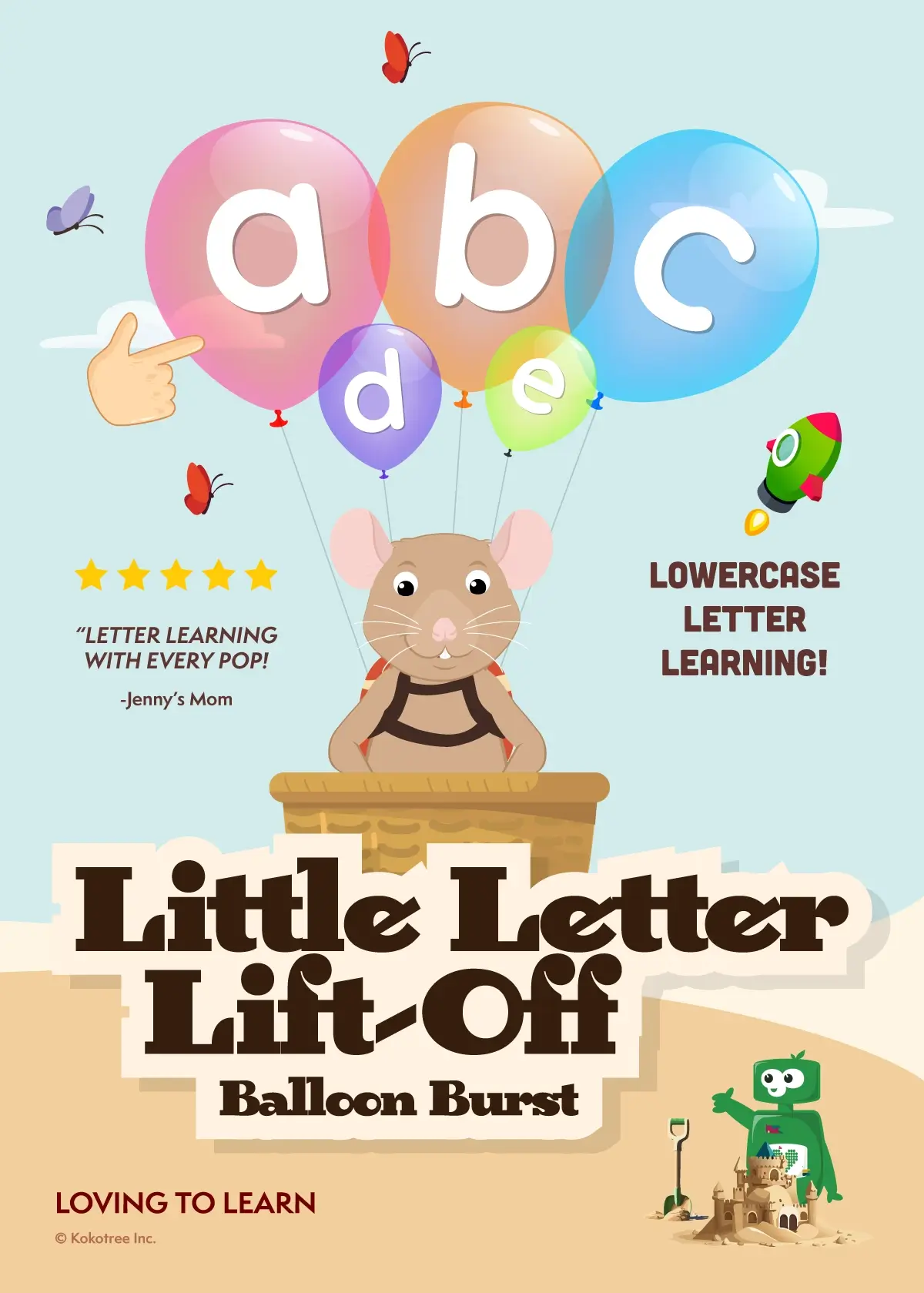
Your child spots and taps balloons carrying lowercase letters as they float across the screen, building instant letter recognition and speedy hand-eye coordination. It's alphabet review that feels like a celebration!
Interactive Game
Ages 3-5
Skill: Lowercase Letter Recognition
Your kid pops letter balloons racing across a breezy sky. You get guilt-free screen time knowing they're learning.
Colorful balloons drift upward, each displaying a lowercase letter. A friendly voice calls out a target letter, and your child taps the matching balloon before it floats away. Cheerful sounds and gentle animations reward every correct pop!
What your child practices:
This game transforms passive letter knowledge into active recall. Children must quickly scan, identify, and respond—building the rapid recognition that powers early reading.
- Identifying all 26 lowercase letters on sight
- Distinguishing between similar-looking letters (like b, d, p, q)
- Processing visual information quickly and accurately
- Coordinating eyes and fingers for precise tapping
- Building confidence through repeated success
They'll use these skills when:
- Spotting familiar letters on cereal boxes, signs, and book covers
- Following along as you read stories together
- Writing their name and recognizing friends' names
- Starting phonics work and sounding out simple words in pre-K
The Gameplay (what keeps them engaged)
Balloons appear in waves, creating gentle urgency without stress. Each correct tap triggers a satisfying pop animation and cheerful sound. Miss a balloon? No worries—it simply floats away and another appears. Stars and encouraging phrases celebrate streaks of correct answers. The pace adjusts naturally, giving little learners time to scan while keeping things lively enough to hold attention. Kids love the "chase" feeling of catching letters before they escape!
How It Teaches (the clever part)
- Immediate feedback: Correct taps create instant pops with happy sounds; wrong taps get a gentle wobble and a "try again" nudge
- Progression: Letters start with commonly recognized ones (a, b, c) and gradually introduce trickier shapes; speed gently increases as accuracy improves
- Repetition: Each letter appears multiple times across sessions, reinforcing recognition without feeling repetitive
Learning trick: The game calls out letters audibly AND shows them visually, connecting the letter's name to its shape—exactly how reading readiness develops!
Beyond the App: Reinforce the Learning
- Mealtime activity: "Letter Hunt on the Table"—Point to items and ask, "Can you find something that starts with the letter 'm'?" (Practices connecting letters to real objects and beginning sounds)
- Car/travel activity: "Balloon Pop Pretend"—Call out letters and have your child "pop" imaginary balloons in the air when they hear one they know. (Practices auditory letter recognition and listening skills)
- Outdoor activity: "Chalk Letter Stomp"—Write lowercase letters on the sidewalk with chalk. Call out letters and let your child jump or stomp on the right one! (Practices letter identification with whole-body movement)
- Anytime activity: "Letter Magnets Match"—Using fridge magnets, hold up a letter and ask your child to find its match. (Practices visual discrimination and lowercase letter recognition)
Common Questions Parents Ask
- "Is tapping balloons really teaching anything?" - Absolutely! Quick-recognition games build "automaticity"—the instant recall that frees up brainpower for harder reading tasks later. Every tap strengthens the letter-shape connection in your child's memory.
- "How long until my child knows all the letters?" - Most children recognize all lowercase letters with consistent practice over several months. Celebrate progress over perfection—recognizing even 10 letters confidently is a huge milestone!
- "What if my child gets frustrated when balloons float away?" - The game is designed to feel forgiving, not punishing. Remind them that missed balloons just mean more chances coming! If frustration builds, take a break and try again tomorrow.
What Your Child Will Learn
Prerequisites and Building Blocks
Children benefit most from this game after gaining familiarity with the alphabet song and some exposure to letter shapes. It builds on foundational letter awareness activities and connects naturally to phonics games that link letters to sounds. Within the Kokotree learning progression, Little Letter Lift-Off serves as a review and reinforcement tool—perfect after initial letter introduction activities. Prior experience with tap-based games helps children focus on letters rather than mechanics.
Cognitive Development and Game Design
This game leverages the rapid visual processing capabilities developing in 3-5 year olds. The tap mechanic suits fine motor development at this stage—requiring precision without complex dragging movements. Floating balloons create gentle time pressure that builds selective attention without overwhelming working memory. The single-task focus (find ONE letter) matches young children's cognitive load capacity, while colorful visuals and movement capitalize on their attraction to dynamic stimuli.
Alignment with Educational Standards
Little Letter Lift-Off directly supports Common Core Foundational Skills for Reading (RF.K.1d: Recognize and name all lower-case letters). It aligns with Head Start Early Learning Outcomes for Literacy Knowledge and Skills. Kindergarten readiness assessments typically expect children to identify most lowercase letters—this game builds exactly that benchmark. The speed component supports processing fluency goals emphasized in early literacy research.
Extended Learning Opportunities
Pair this game with Kokotree's letter tracing activities to connect recognition with formation. Alphabet songs in the app reinforce letter names audibly. For extended learning, create a "letter of the day" routine where your child spots that letter everywhere—on walks, in books, on packaging. Letter-themed art projects (decorating a paper letter shape) add tactile reinforcement to visual recognition skills.
Game Mechanics Summary
- Child listens for a target lowercase letter announced by a friendly voice
- Balloons carrying various lowercase letters float upward across the screen
- Child taps the balloon showing the correct letter before it drifts away
- Correct taps trigger pop animations and celebratory sounds; incorrect taps prompt gentle retry encouragement
Skill Development Progression
Initially, children may hesitate, scanning slowly and missing some balloons—this is normal! With repeated play, recognition becomes automatic: they'll spot target letters almost instantly. Watch for faster response times, fewer errors on commonly confused letters (b/d, p/q), and growing confidence. Mastery looks like quick, accurate tapping across all 26 letters with minimal hesitation. Celebrate when your child starts spontaneously identifying letters outside the app!
Lowercase Letter Recognition: The Foundation of Reading
Lowercase letter recognition is arguably more important than uppercase recognition for reading readiness—over 95% of printed text uses lowercase letters. Yet lowercase letters present unique challenges: many share similar shapes (b, d, p, q are mirror images; n and h differ by one stroke), requiring children to develop keen visual discrimination.
Research shows that letter recognition speed directly predicts later reading fluency. Children who must "think hard" to identify each letter have less cognitive energy for comprehension. Little Letter Lift-Off builds automaticity—the instant, effortless recognition that skilled readers possess.
The game's reaction-time element isn't just for fun; it deliberately pushes children from slow, deliberate recognition toward rapid identification. This mirrors how reading actually works: eyes move quickly across text, requiring split-second letter processing.
For 3-4 year olds, recognizing 10-15 lowercase letters is developmentally appropriate. By age 5, most children can identify all 26 with varying speed. This game meets children wherever they are, providing practice that builds toward kindergarten expectations.
Importantly, this game connects letter shapes to letter names through audio cues—a crucial pairing. When children hear "find the letter m" while scanning for its shape, they strengthen the name-shape association that underlies all phonics instruction. This dual-coding (visual + auditory) creates stronger memory traces than visual practice alone.
School readiness assessments consistently evaluate lowercase letter recognition. Children entering kindergarten with strong letter knowledge show better reading outcomes through elementary school. Every balloon pop is a small investment in your child's literacy future!