
What's Respect Our Surroundings About?
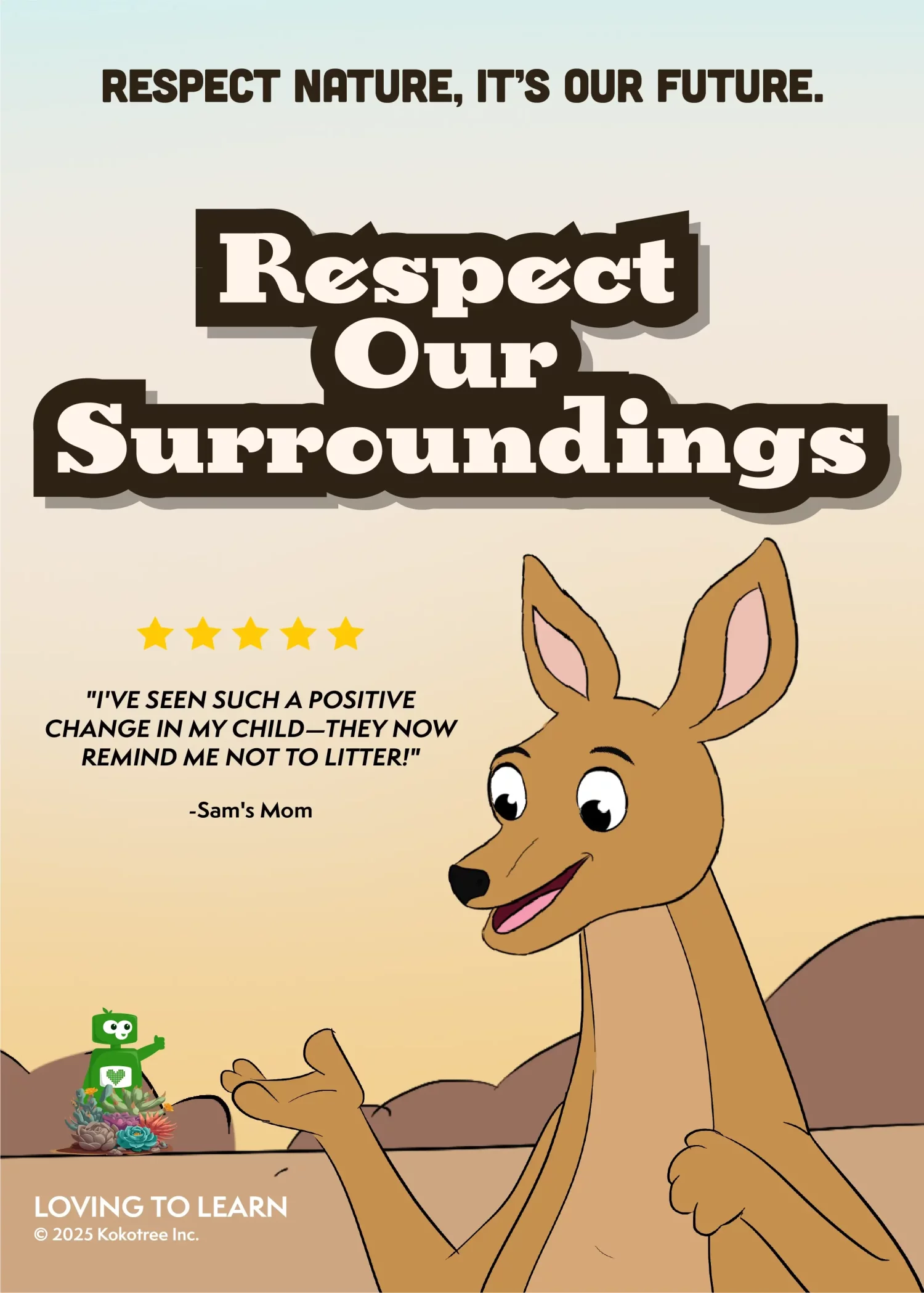
Watch the Kokotree classroom transform from chaos to calm as friendly animal friends learn why cleanliness matters! Your child will understand how picking up after themselves keeps spaces safe and pleasant for everyone.
9 minutes
Ages 3-6
Skill: Responsibility and environmental care
Your kid watches animal friends clean up a messy classroom together. You get 9 minutes to tackle that pile of laundry.
The video opens with the Kokotree classroom in hilarious disarray—banana peels flying, paper balls bouncing, and watermelon seeds everywhere! Miss Elizabeth arrives and gently guides the animal friends to notice the mess they've created. Then comes a heartwarming story about Dally the Armadillo and Kango the Kangaroo that shows exactly why keeping our spaces clean protects everyone.
What your child learns:
Through relatable animal characters making real mistakes, your child discovers that cleaning up isn't just a chore—it's how we show care for ourselves and others. They'll see cause-and-effect in action when Kango steps on his own litter!
- Taking responsibility for messes they create
- Understanding that litter can be dangerous (Kango's hurt foot!)
- Working together as a team to solve problems
- Noticing when spaces need tidying up
- Feeling proud after completing cleanup tasks
They'll use these skills when:
- Putting toys back in bins after playtime without being asked
- Throwing snack wrappers in the trash at the park
- Helping set the table or clear dishes after meals
- Noticing when their room needs tidying and taking action
The Story (what keeps them watching)
Chaos erupts in the Kokotree classroom! Maddy Monkey tosses banana peels at Tiki Tiger, Bobby Bear sprays watermelon seeds everywhere, and Ronnie Rhino knocks over chairs. When Miss Elizabeth arrives, she doesn't scold—she asks the friends to really look at the mess. Together, they tidy up and feel the difference. Then comes the story of Kango the Kangaroo, a litterbug who learns the hard way when he steps on his own discarded can lid. Ouch! His friend Dally the Armadillo shows him that small cleanup actions make a big difference. By the end, everyone—classroom friends and forest creatures alike—discovers that respecting our surroundings keeps everyone safe and happy.
How We Teach It (the clever part)
- First 3 minutes: Children see the natural consequences of messiness through the chaotic classroom scene. Miss Elizabeth models calm problem-solving rather than punishment.
- Minutes 3-7: The Dally and Kango story provides emotional distance—kids learn through characters without feeling lectured. Kango's injury creates a memorable "aha moment."
- Final 2 minutes: The classroom friends reflect on what they learned, making personal commitments. This models self-reflection and goal-setting.
Teaching trick: The video shows Kango hurting himself on his own litter—not someone else's. This powerful cause-and-effect moment helps children understand that their actions directly impact their own safety, making the lesson personal and memorable.
After Watching: Quick Wins to Reinforce Learning
- Mealtime activity: "Can you be like Dally and make sure nothing falls on the floor while we eat?" (Practices awareness of their immediate surroundings and taking responsibility during meals)
- Car/travel activity: "Let's play 'Spot the Litterbug'—look for trash that doesn't belong outside. What could happen if someone stepped on it?" (Reinforces the safety lesson from Kango's experience)
- Bedtime activity: "Before stories, let's do a quick Dally sweep—can you find three things to put away?" (Makes cleanup feel like a fun challenge rather than a chore)
- Anytime activity: "Remember how the Kokotree friends felt after cleaning? Let's tidy one spot together and see how WE feel!" (Connects the emotional reward of a clean space to their own experience)
When Kids Get Stuck. And How to Help.
- "My child makes messes but doesn't seem to notice them." - This is completely normal at this age! Try the "Dally eyes" game—ask them to look around like Dally and spot one thing out of place. Building awareness comes before action.
- "They cleaned up once but won't do it again without reminders." - Consistency takes time! Reference the video: "Remember how Kango had to practice being tidy? Let's practice together." Make it a team effort, not a solo task.
- "The mess feels overwhelming to my child and they shut down." - Break it into tiny pieces, just like Dally did in the forest. "Just find one wrapper" is much easier than "clean your room." Celebrate each small win!
What Your Child Will Learn
Prerequisites and Building Blocks
This video works best for children who can follow a simple narrative and understand basic cause-and-effect relationships. It builds on foundational social skills like following directions and working with others. No prior Kokotree videos are required, though children familiar with the classroom characters will enjoy recognizing their friends. This lesson serves as an excellent introduction to responsibility concepts that expand into more complex topics like caring for plants, animals, and community spaces.
Cognitive Development and Teaching Methodology
The dual-narrative structure (classroom scene + embedded story) leverages how preschoolers learn through observation and emotional connection. The video uses concrete, visual consequences (Kango's hurt foot) rather than abstract reasoning, which aligns with preoperational cognitive development. Multiple learning styles are addressed: visual learners see the messy-to-clean transformation, auditory learners hear the story narration, and kinesthetic concepts are modeled through the characters' cleanup actions that children can mirror at home.
Alignment with Educational Standards
This video addresses key kindergarten readiness indicators including demonstrating responsibility for personal belongings, understanding cause-and-effect relationships, and participating in group activities. It aligns with early childhood standards for social-emotional development, specifically taking responsibility for one's actions and understanding how individual choices affect the community. These foundational life skills appear across preschool curricula internationally.
Extended Learning Opportunities
Pair this video with a simple "cleanup chart" where children place stickers after tidying. Create a "Dally's Helper" badge for consistent cleanup behavior. Practice sorting activities—trash vs. recycling vs. things that belong elsewhere—to extend the concept. Role-play scenarios where stuffed animals make messes and children guide them to clean up. Look for opportunities during outdoor play to notice litter and discuss (without touching) why it doesn't belong there.
Transcript Highlights
- Teaching cause and effect: "Do you see how untidy this place is now? You've left banana peels, watermelon bits, and paper balls all over. It's not safe, nor is it respectful to our surroundings."
- Defining new vocabulary: "A litterbug is someone who throws trash around carelessly, Ruby—someone who doesn't respect their surroundings by cleaning up after themselves."
- Modeling personal responsibility: "I stepped on this can lid—my own trash, I'm sure. I'm sorry, Dally... I never thought it would matter."
- Connecting actions to feelings: "Don't you feel calmer already?" and "A clean space is a happy space!"
Character Development and Story Arc
The video brilliantly uses two parallel character arcs. In the classroom, the ensemble cast moves from chaotic play to collective responsibility—modeling how groups can self-correct with gentle guidance. In the story, Kango transforms from dismissive litterbug to cleanup champion after experiencing direct consequences. Dally models patience and persistence, never giving up on his friend or his forest. Both narratives show that mistakes are learning opportunities, not failures—a core growth mindset principle.
Life Skills Deep Dive: Developing Responsibility in Early Childhood
Responsibility is one of the most important—and challenging—life skills to nurture in children ages 3-6. At this developmental stage, children are naturally egocentric, meaning they genuinely struggle to see how their actions affect others or their environment. This video addresses that challenge through concrete, visual storytelling.
The concept of "respecting our surroundings" introduces environmental stewardship at its most basic level: the spaces we use every day. Research in early childhood development shows that children learn responsibility best through natural consequences (like Kango's hurt foot) rather than punishment or lectures. The video carefully avoids shame while still showing clear cause-and-effect.
Importantly, the video models collaborative cleanup rather than individual burden. When Miss Elizabeth asks "Do you think we can tidy up together?" she's teaching that maintaining shared spaces is a community effort. This prevents the common pitfall of children feeling overwhelmed by mess.
The vocabulary introduction ("litterbug") gives children language to identify and discuss the behavior, which is crucial for self-regulation. When children can name a behavior, they can begin to monitor it in themselves.
The dual setting—indoor classroom and outdoor forest—helps children generalize the concept. Responsibility for surroundings isn't just about their bedroom; it extends to parks, schools, and any space they inhabit. This foundational understanding prepares children for increasingly complex responsibility concepts as they grow.