
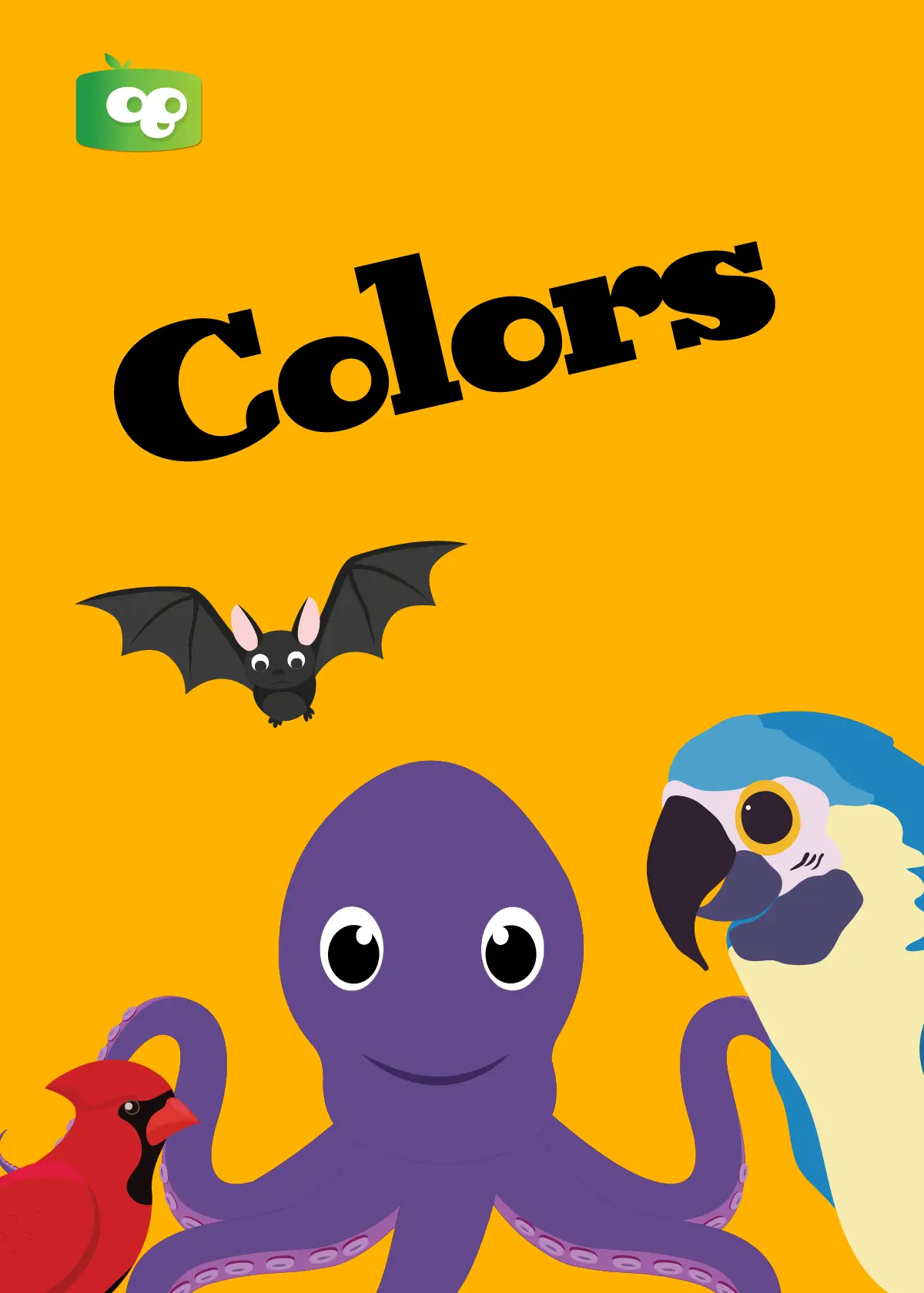
What's Colors About?
Sing, repeat, and master 11 essential colors through catchy musical learning! Your child will confidently identify red, blue, green, yellow, white, grey, black, brown, orange, purple, and pink in the world around them.
3.5 minutes
Ages 1-4
Skill: Color recognition and naming
Your kid watches friendly colors appear with a catchy song. You get 3.5 minutes to finish that cup of coffee.
Each color gets its own musical moment with clear visuals and repetition. The song introduces a color, repeats its name four times, then asks your child to identify it—building recognition through gentle call-and-response patterns.
What your child learns:
This video builds foundational color vocabulary through musical repetition—the same technique teachers use in early classrooms. By hearing each color name multiple times and being prompted to recall it, children move from passive recognition to active identification.
- Names 11 colors correctly (red, blue, green, yellow, white, grey, black, brown, orange, purple, pink)
- Responds to "What color is this?" questions confidently
- Connects color words to visual examples
- Builds vocabulary through musical memory
- Practices call-and-response interaction
They'll use these skills when:
- Picking out clothes: "I want the purple shirt!"
- Drawing and coloring: Reaching for the right crayon without help
- Describing the world: "Look, a yellow butterfly!"
- Following directions: "Please get the green cup from the table"
The Story (what keeps them watching)
This isn't a traditional story—it's a color celebration! Each of the 11 colors gets a starring moment with its own verse. The catchy, repetitive melody makes each color memorable, while the "Do you know what color this is?" questions turn passive watching into active learning. Kids love shouting out the answers, and the consistent pattern helps even the youngest viewers predict what's coming next. By the final pink verse, your little one has practiced each color multiple times!
How We Teach It (the clever part)
- First 1 minute: Introduces primary colors (red, blue, green, yellow) with the signature song pattern—repetition builds instant familiarity
- Minutes 1-2: Moves to neutral colors (white, grey, black, brown)—expanding vocabulary while maintaining the comfortable pattern
- Final 1.5 minutes: Finishes with secondary colors (orange, purple, pink)—by now, kids anticipate the question and answer confidently
Teaching trick: The four-time repetition of each color name ("red, red, red") isn't random—it matches how toddler brains need to hear new words before they stick. Plus, the pause before revealing the answer gives kids time to shout it out first!
After Watching: Quick Wins to Reinforce Learning
Mealtime activity: "Can you find something red on your plate?" Point to foods and name their colors together. Carrots are orange, peas are green, bread is brown—dinner becomes a color hunt!
Car/travel activity: "I spy something blue!" Take turns finding colors outside the window. Start with easy ones like green trees and blue sky, then challenge them with trickier finds.
Bedtime activity: "What color are your pajamas?" Walk through the bedtime routine naming colors—the white pillow, the brown teddy bear, the yellow nightlight.
Anytime activity: Gather toys and sort by color. "Let's put all the red blocks here!" No supplies needed—just whatever's already on the floor.
When Kids Get Stuck. And How to Help.
"My child mixes up blue and green constantly." Totally normal! These colors sit next to each other on the spectrum and look similar to developing eyes. Practice with very different shades first—bright blue sky versus grass green—before introducing teal or turquoise.
"She knows the colors but won't say the words." Recognition comes before production. If she can point to the right color when you ask, she's learning! Keep modeling the words yourself, and the speaking will follow when she's ready.
"He only remembers red and blue, not the others." Start with what he knows! Play games with just those two colors, then add one new color at a time. Mastering a few colors deeply beats rushing through all eleven.
What Your Child Will Learn
Prerequisites and Building Blocks
This video works beautifully as a first introduction to colors—no prerequisites needed! Children benefit from basic attention skills (watching for 30+ seconds) and exposure to simple songs. Colors builds the foundation for future learning about mixing colors, sorting objects, patterns, and art fundamentals. It pairs perfectly with shape recognition videos, as children often learn to describe objects by both color AND shape ("the red circle").
Cognitive Development and Teaching Methodology
The repetitive song structure leverages how toddler brains actually acquire vocabulary—through repeated exposure in engaging contexts. Musical learning activates multiple brain regions simultaneously, strengthening memory formation. The call-and-response format ("Do you know what color this is?") transforms passive viewing into active recall, which research shows dramatically improves retention. Visual learners see the colors, auditory learners hear the names, and kinesthetic learners can point and move along.
Alignment with Educational Standards
Color recognition appears in virtually every early learning framework worldwide. This video addresses kindergarten readiness indicators including: identifying basic colors by name, matching objects by color, and using color words in conversation. Teachers expect entering kindergarteners to name at least 8 colors—this video covers 11. It aligns with early math standards (sorting/classifying) and language development benchmarks (vocabulary acquisition).
Extended Learning Opportunities
Pair this video with color sorting activities using household items, crayons, or building blocks. The Kokotree app offers matching games that reinforce these same 11 colors. Extend learning with color walks (finding colors in nature), color-themed art projects (painting with just one color), or reading books that feature specific colors prominently. Simple color mixing experiments with paint show how colors relate to each other.
Transcript Highlights
- "This is red, the color red, red, red, red." — Clear labeling with strategic repetition for memory encoding
- "Do you know what color this is?" — Direct engagement prompting active recall rather than passive watching
- "This is blue." — Confirmation after the question validates children's answers and reinforces correct identification
- Pattern consistency across all 11 colors creates predictability that builds confidence
Character Development and Story Arc
While this video focuses on direct instruction rather than character narrative, the friendly, encouraging tone models positive learning attitudes. The consistent question-and-answer pattern demonstrates that learning involves both listening AND responding. Children experience the satisfaction of "getting it right" as they anticipate answers, building confidence and a growth mindset around trying new things. The celebratory progression through all 11 colors models persistence in learning.
The Science of Color Learning: A Visual Development Deep Dive
Color recognition is one of the first cognitive categorization skills children develop, and it's more complex than parents often realize. Infants can distinguish between colors from around 4 months old, but naming colors typically emerges between ages 2-3—and full mastery often takes until age 4 or beyond.
Why the gap? Color is abstract. Unlike "ball" or "dog," you can't point to "red" by itself—it's always attached to something else. Children must learn that "red" applies to apples AND firetrucks AND strawberries, despite these objects looking completely different otherwise. This requires sophisticated categorization abilities.
The order colors are learned isn't random either. Research shows children typically master red and blue first (high contrast, frequently named by adults), followed by green and yellow, with purple, pink, orange, grey, and brown coming later. This video's structure—starting with primary colors before moving to neutrals and secondary colors—mirrors natural acquisition patterns.
Repetition matters enormously. Studies suggest toddlers need to hear a new word 50+ times in meaningful contexts before it enters their active vocabulary. This video's four-time repetition per verse, multiplied across multiple viewings, builds toward that threshold efficiently.
The musical element isn't just entertaining—it's strategic. Songs activate the brain's auditory cortex, motor regions (through rhythm), and language centers simultaneously. This multi-channel encoding creates stronger, more retrievable memories than spoken words alone. That's why children often remember song lyrics years later while forgetting spoken instructions immediately.
Color knowledge also predicts later academic success. Children who enter kindergarten naming colors confidently tend to have stronger vocabulary overall, better categorization skills, and more school readiness. This simple video builds genuine cognitive architecture.