
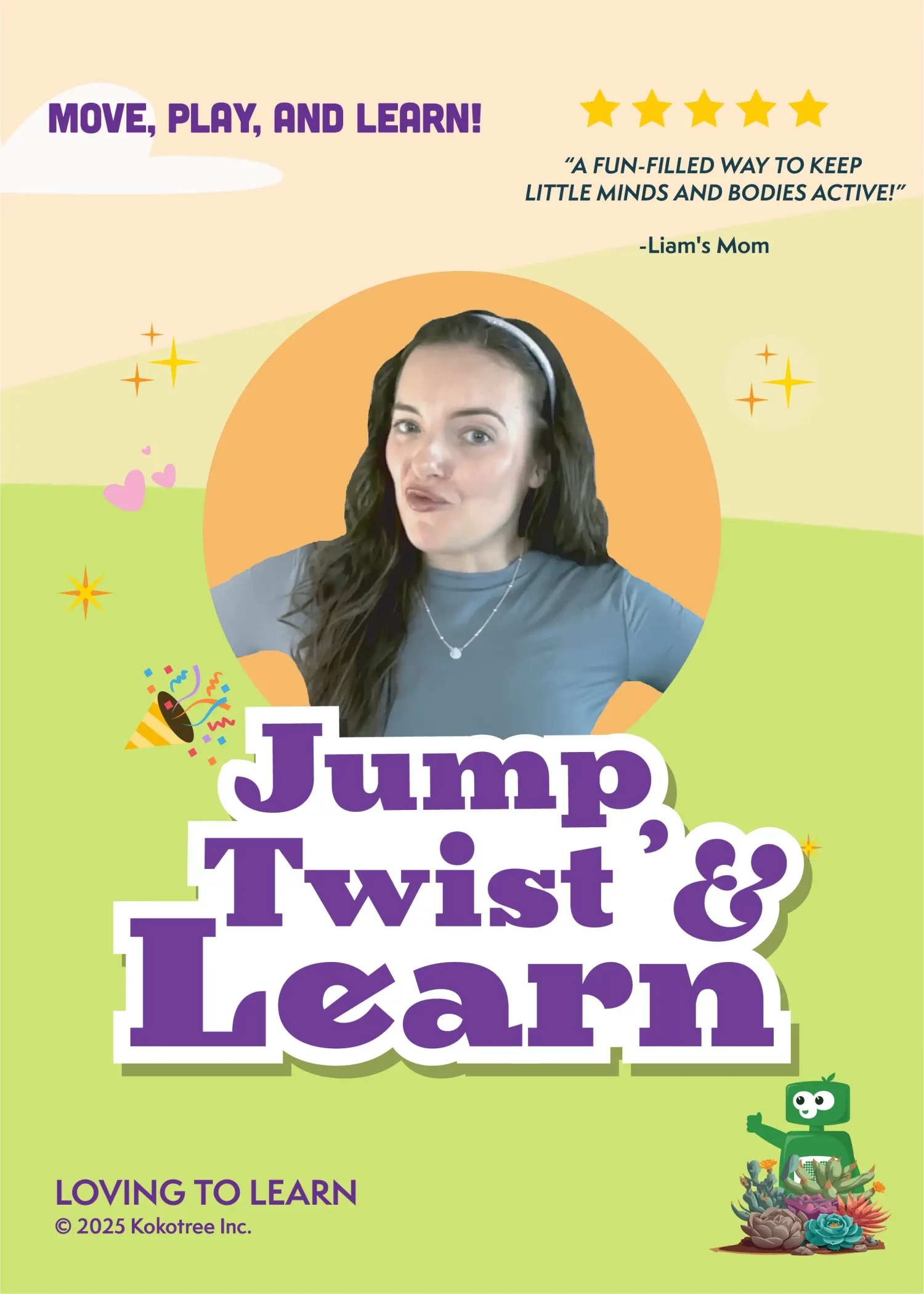
What's Jump, Twist, & Learn About?
Your toddler learns to say and sign important first words while getting wiggles out with fun movement breaks! They'll practice family words, basic needs vocabulary, and classic action songs—all in one engaging session.
6 minutes
Ages 1-3
Skill: First words, sign language basics, and gross motor movement
Your kid watches Miss Terran model words, signs, and silly movements. You get 6 minutes to [drink your coffee while it's still warm].
Miss Terran appears on screen with bright, friendly energy, slowly pronouncing important first words while demonstrating simple sign language. Between vocabulary sections, she leads jumping, twisting, and clapping breaks that get little bodies moving. Visual cues and celebratory animations reinforce each new word.
What your child learns:
This video builds foundational communication skills by pairing spoken words with sign language—giving pre-verbal toddlers a way to express themselves before they can fully talk. The movement breaks aren't just fun; they help cement learning through physical engagement.
- Saying and signing "Mama," "Dada," "Grandma," and "Grandpa"
- Signing and saying basic needs words: "milk," "water," "play"
- Following multi-step movement instructions (jump, twist, clap, stop)
- Mouth formation awareness for early speech development
- The phrase "I love you" in both speech and sign
They'll use these skills when:
- Asking for milk or water at mealtimes instead of pointing and fussing
- Greeting grandparents on video calls with words AND waves
- Following instructions at playgroup or storytime ("clap your hands!")
- Communicating needs before full speech develops—reducing frustration for everyone
The Story (what keeps them watching)
Miss Terran welcomes your child like an old friend, immediately making them feel like a learning partner. She introduces family words one by one, exaggerating mouth shapes so little ones can copy her. Just when attention might wander, she switches gears—"It's time to PLAY!"—and leads a movement break with clapping, jumping, and twisting. A classic spider song adds musical fun, then she wraps up with practical vocabulary for milk and water. Every small success gets celebrated with confetti animations and genuine praise.
How We Teach It (the clever part)
- First 2 minutes: Family vocabulary introduction—"Mama," "Dada," "Grandma," "Grandpa"—with sign language demonstration and exaggerated mouth formations
- Minutes 2-4: Movement and music section with clapping, jumping, twisting, and a familiar action song to release energy and reinforce listening skills
- Final 2 minutes: Practical needs vocabulary ("milk," "water") plus warm goodbye with encouragement
Teaching trick: Miss Terran points directly to her mouth and stretches out beginning sounds ("Mmmmm-AMA!") so toddlers can see exactly how to form each word. This visual modeling is proven to accelerate speech development in young children.
After Watching: Quick Wins to Reinforce Learning
- Mealtime activity: "Can you sign 'milk' or 'water' to show me what you want?" (Reinforces practical communication and gives them agency at the table)
- Car/travel activity: "Let's practice our signs! Show me 'Mama'... now 'Dada'... now 'I love you'!" (No materials needed, perfect for car seats)
- Bedtime activity: "Let's do three big jumps, then three twists, then STOP and get cozy!" (Burns last energy while practicing following instructions)
- Anytime activity: Point to family photos and ask "Who's that?" Wait for them to attempt the word or sign before you say it together. (Connects video learning to real people they love)
When Kids Get Stuck. And How to Help.
- "My child watches but won't copy the signs." - Totally normal! Receptive language (understanding) develops before expressive language (doing). Keep modeling the signs yourself during daily routines—they're absorbing more than you think.
- "The words come out wrong or unclear." - At this age, approximations count as wins! "Muh" for milk or "Wa" for water shows they're connecting sounds to meaning. Celebrate the attempt and model the full word back.
- "My toddler only wants the jumping parts." - Movement IS learning at this age! The stop-and-go games build impulse control and listening skills. Let them jump—those skills transfer to following directions everywhere.
What Your Child Will Learn
Prerequisites and Building Blocks
This video is designed for emerging communicators—children who may have few or no words yet. No prior skills required! It serves as an entry point to Kokotree's language development series. Children who've watched basic cause-and-effect videos or simple songs will find the format familiar. This content builds toward more complex vocabulary videos, action word lessons, and eventually sentence-building activities as language develops.
Cognitive Development and Teaching Methodology
The multi-sensory approach here is intentional: children hear words, see mouth formations, watch sign language, and physically move their bodies. This addresses visual, auditory, and kinesthetic learners simultaneously. The repetition pattern (word → exaggerated sound → sign → celebration → repeat) aligns with how toddler brains encode new information. Movement breaks leverage the documented connection between physical activity and memory consolidation in young children.
Alignment with Educational Standards
This video supports ASHA (American Speech-Language-Hearing Association) milestones for 12-24 month communication development. It addresses Head Start Early Learning Outcomes Framework goals for "Language and Literacy" and "Perceptual, Motor, and Physical Development." The sign language component aligns with research showing baby sign reduces frustration and may accelerate verbal development—a key kindergarten readiness indicator.
Extended Learning Opportunities
Pair this video with Kokotree's printable sign language flashcards for family words. The app's "First Words" game reinforces the same vocabulary in interactive format. Parents can extend learning by creating a simple photo book of family members, practicing names and signs during daily reading time. Mealtime offers natural opportunities to practice "milk" and "water" signs before serving drinks.
Transcript Highlights
- "(Points to mouth and exaggerates M shape) Mmmm--- MAMA!" — Direct modeling of mouth formation for speech development
- "Let's say PLAY and toys will appear on the screen! Ready….? PLAY!" — Connecting words to immediate, magical results
- "-Gasp- STOP! Did you stop? -pause- Good job!" — Building impulse control through playful instruction
- "(points to mouth and exaggerates W) WWWWA—TER!" — Breaking down complex sounds into manageable pieces
Character Development and Story Arc
Miss Terran models enthusiastic learning behavior throughout—she celebrates every attempt, shows genuine excitement at "discoveries" (toys appearing, the train driving by), and demonstrates that learning is joyful. Her exaggerated reactions (gasps, clapping, "You're so smart!") show children that effort deserves celebration. The consistent encouragement builds confidence and models growth mindset: trying is succeeding.
Early Communication and Sign Language Development Deep Dive
The integration of sign language with spoken words in this video leverages a powerful developmental principle: giving pre-verbal children tools to communicate reduces frustration and may actually accelerate speech development. Research from the National Institutes of Health shows that babies who learn simple signs often speak earlier and have larger vocabularies by age two.
The specific words chosen—family members and basic needs—aren't random. These are high-frequency, high-motivation vocabulary items. A toddler desperately wants to communicate "I want milk" or "Where's Mama?" This intrinsic motivation drives engagement and practice.
The exaggerated mouth formations Miss Terran demonstrates ("Mmmm," "Dddd," "Ggggg") support phonological awareness—the understanding that words are made of distinct sounds. This foundational skill predicts later reading success. Children watching learn to attend to how sounds are physically produced, not just what words mean.
The movement integration serves multiple purposes: it maintains attention spans typical for this age (2-3 minutes before needing a break), it provides proprioceptive input that helps regulate arousal levels for learning, and it builds the gross motor control and body awareness that actually supports fine motor development needed for later writing. The "stop" commands specifically build inhibitory control—the ability to stop an action on command—which is a core executive function skill that predicts academic and social success.
By ending with practical vocabulary (milk, water), the video ensures children leave with immediately usable tools, increasing the likelihood parents will see and reinforce the learning at the very next meal.