
What's Addition Fun About?
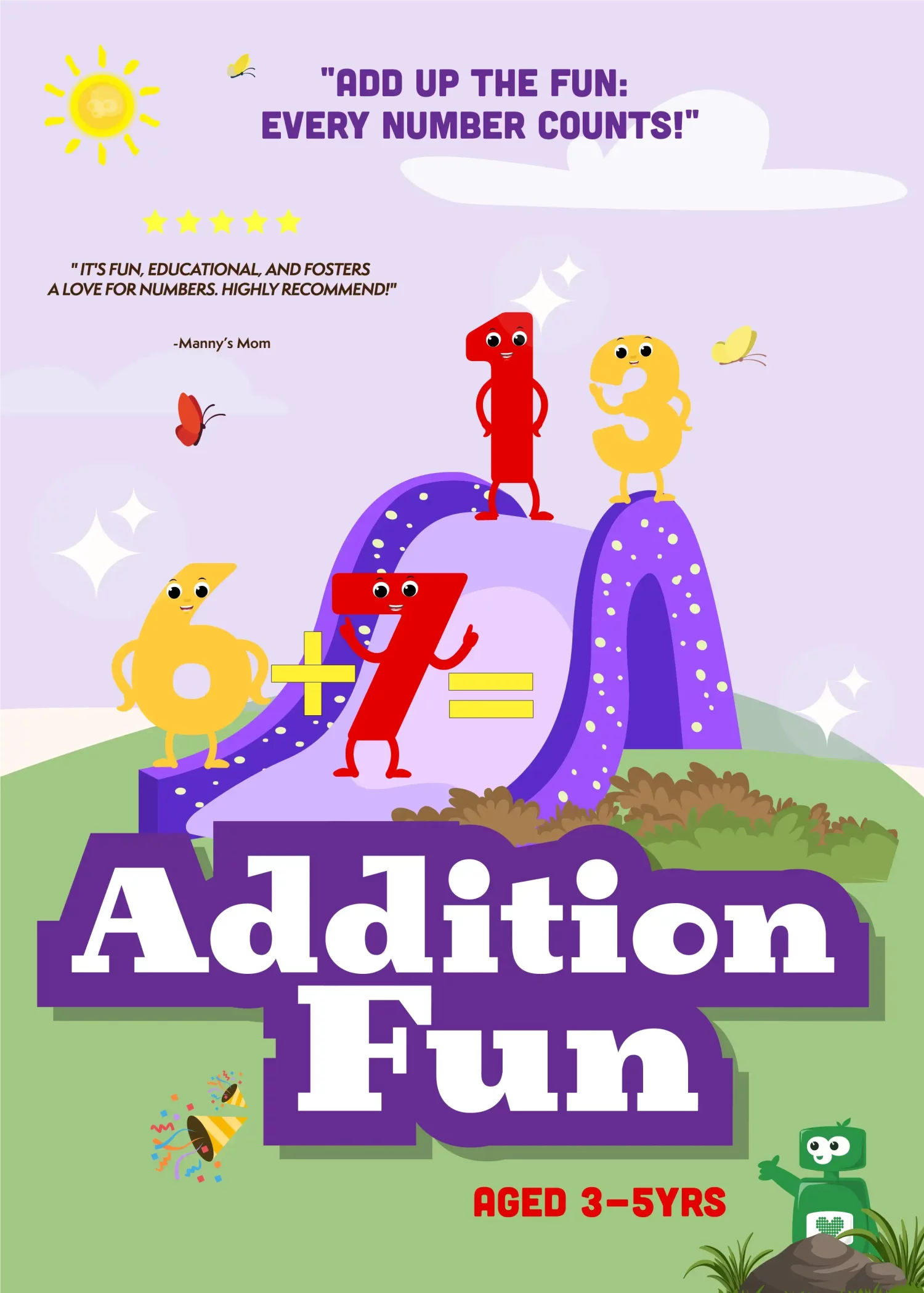
Your child becomes a mini mathematician, solving addition problems by dragging the correct answer into place. They're building essential number sense and early arithmetic skills through hands-on discovery.
Interactive Game
Ages 4-6
Skill: Early Addition & Number Sense
Your kid solves addition problems by dragging answers into place. You get guilt-free screen time knowing they're learning.
Friendly animal characters present simple addition equations on screen. Your child looks at the problem, figures out the sum, then drags the correct number to complete the equation. Visual cues and cheerful feedback make every correct answer feel like a celebration.
What your child practices:
They're actively developing the foundational math skills that prepare them for kindergarten and beyond. Each problem solved strengthens their understanding that numbers can be combined to create new quantities.
- Solving basic addition equations (sums up to 10)
- Recognizing number symbols and their values
- Developing mental math strategies
- Building problem-solving confidence
- Strengthening fine motor control through drag-and-drop
They'll use these skills when:
- Counting out snacks to share with a sibling or friend
- Figuring out how many toys they have altogether
- Understanding "how many more" in everyday situations
- Starting formal math instruction in kindergarten
The Gameplay (what keeps them engaged)
Each round presents a colorful addition problem with friendly animal helpers cheering them on. Your child sees the equation, thinks through the answer, then drags the correct number into place. Correct answers trigger celebratory animations and sounds that make learning feel like winning. Wrong answers get gentle guidance—no harsh buzzers here. Problems gradually introduce larger numbers as confidence builds, keeping the challenge just right. The drag-and-drop mechanic feels like play, not homework, so kids ask for "just one more."
How It Teaches (the clever part)
- Immediate feedback: Correct answers spark instant celebrations with animations and sounds. Incorrect attempts receive gentle visual hints that guide toward the right answer without discouragement.
- Progression: Problems start with simple sums (1+1, 2+1) and gradually introduce larger numbers as your child demonstrates understanding, keeping challenge levels perfectly matched to ability.
- Repetition: Varied problem presentations and rotating animal characters keep practice fresh, so children solve dozens of equations without realizing they're drilling fundamentals.
Learning trick: The drag-and-drop mechanic requires children to commit to an answer physically, engaging motor memory alongside cognitive processing—making the learning literally hands-on.
Beyond the App: Reinforce the Learning
- Mealtime activity: "How many grapes do you have? If I give you two more, how many will you have?" (Practices addition with real objects they can touch and count)
- Car/travel activity: "I see three birds on that sign. Now two more landed—how many birds altogether?" (Builds mental addition skills without materials)
- Outdoor activity: Collect small stones or leaves and create addition problems: "Put two here and three here—how many total?" (Connects abstract numbers to physical quantities)
- Anytime activity: Use fingers for quick addition games: "Show me two fingers, now three more—count them all!" (Reinforces number combinations using built-in manipulatives)
Common Questions Parents Ask
- "Is dragging numbers around really teaching math?" - Absolutely! The physical act of selecting and placing answers requires your child to think through the problem completely. Research shows hands-on interaction deepens understanding far more than passive watching.
- "When will my child start adding in their head?" - Mental math develops gradually between ages 4-6. You'll notice them starting to answer faster and needing to count on fingers less—that's number sense building!
- "What if my child gets frustrated with wrong answers?" - The game uses gentle guidance instead of harsh corrections. If frustration happens, take a break and try the "Beyond the App" activities to build confidence with physical objects first.
What Your Child Will Learn
Prerequisites and Building Blocks
Before playing Addition Fun, children benefit from solid number recognition (0-10) and one-to-one counting correspondence—understanding that each object counted gets exactly one number. This game builds naturally on counting games and number identification activities in the Kokotree app. It bridges the gap between recognizing individual numbers and understanding that numbers can be combined, preparing children for subtraction concepts next.
Cognitive Development and Game Design
The drag-and-drop mechanic perfectly suits preschool development. At ages 4-6, children learn best through active manipulation rather than passive selection. Dragging requires intentional choice-making that engages working memory and executive function. The visual equation format leverages children's growing symbolic understanding while the immediate feedback loop supports the rapid trial-and-learning cycles that young brains thrive on.
Alignment with Educational Standards
Addition Fun aligns with Common Core Math Standard K.OA.A.1 (represent addition with objects, fingers, and equations) and K.OA.A.5 (fluently add within 5). It also supports NAEYC guidelines for early mathematics, specifically the "operations on numbers" domain. Kindergarten teachers expect incoming students to understand that addition means "putting together"—this game builds exactly that foundational concept.
Extended Learning Opportunities
Pair Addition Fun with Kokotree counting videos featuring the same friendly animal characters for concept reinforcement. Extend learning with household "addition hunts"—finding groups of objects to combine and count. Building block play naturally creates addition scenarios. For children showing readiness, introduce simple story problems verbally: "Ollie Owl had two acorns, then found three more..."
Game Mechanics Summary
- Child views a simple addition equation with a missing answer
- Multiple number options appear on screen for selection
- Child drags the correct number to complete the equation
- Immediate animated feedback confirms correct answers or gently redirects incorrect attempts
Skill Development Progression
With repeated play, children progress from counting-all strategies (counting every item from one) to counting-on (starting from the larger number) to eventual fact recall. Early sessions may show finger-counting and lip-moving; this is excellent! Over weeks, watch for faster response times and confident answer selection. Mastery looks like automatic recall of basic facts (2+3=5) without visible counting—a skill that typically emerges after extensive practice.
Early Addition and Number Sense Development
Addition represents a cognitive leap from counting—children must understand that numbers aren't just labels but quantities that can be combined. Research shows this "part-part-whole" understanding typically develops between ages 4-6, making this the perfect window for introduction.
Young children naturally discover addition through play: combining toy collections, gathering more snacks, counting total friends at the playground. Addition Fun formalizes this intuitive understanding by connecting physical combining to symbolic equations.
The progression matters: children first need concrete experiences (combining actual objects), then pictorial representations (seeing groups combined in images), and finally abstract symbols (number equations). This game bridges pictorial and abstract stages, using visual number representations alongside formal equations.
For school readiness, kindergarten curricula expect children to understand addition as "putting together" and to solve simple problems within 10. Children who enter school with basic addition exposure show stronger math confidence and faster skill acquisition throughout elementary years.
Importantly, early addition isn't about memorizing facts—it's about understanding the concept. Watch for your child explaining their thinking ("I put two and two together and got four!") rather than just producing answers. This verbal reasoning indicates deep understanding that will support all future math learning.