
What's Sight Quest About?
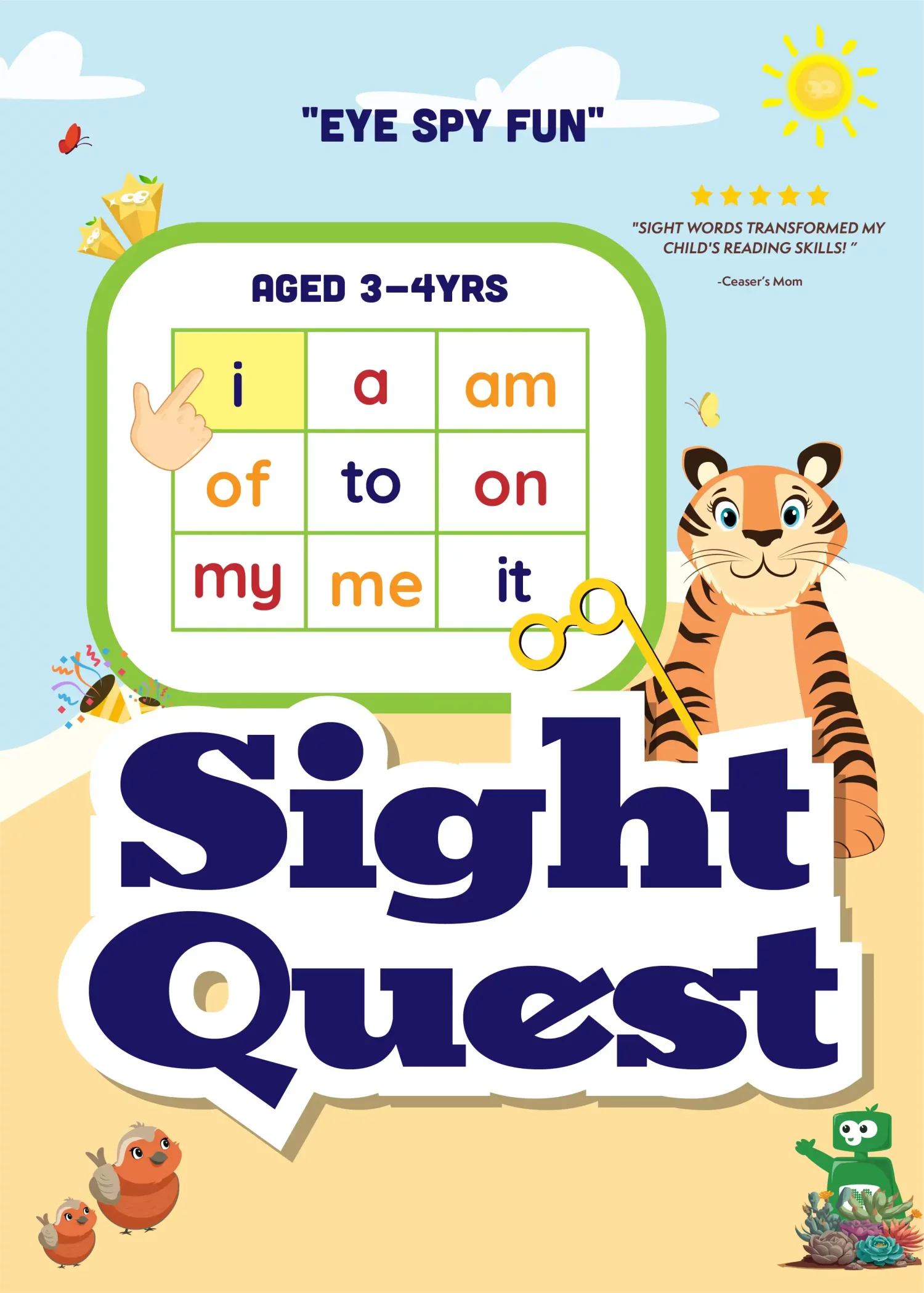
Your child becomes a visual detective, scanning vibrant scenes to spot hidden objects among friendly animal characters and nature settings. Each discovery strengthens the visual scanning and focus skills essential for reading and learning.
Interactive Game
Ages 3-6
Skill: Visual Perception & Attention
Your kid hunts for hidden objects in colorful nature scenes. You get guilt-free screen time knowing they're learning.
Children explore beautifully illustrated environments filled with Kokotree's friendly animal characters. They tap to find specific objects cleverly tucked into each scene, training their eyes to notice details, differences, and patterns—the same skills needed for letter recognition and reading.
What your child practices:
Every search strengthens visual discrimination—the ability to notice small differences that distinguish one letter from another, one number from the next. This focused looking builds the attention stamina young learners need for classroom success.
- Visual scanning and systematic searching strategies
- Attention to detail and sustained focus
- Visual discrimination (noticing differences in shapes, sizes, colors)
- Working memory (remembering what to look for)
- Pattern recognition in complex visual environments
They'll use these skills when:
- Finding their favorite cereal box on a crowded grocery shelf
- Spotting the difference between similar letters like 'b' and 'd'
- Locating their shoes among many pairs by the door
- Following along in a picture book and noticing story details
The Gameplay (what keeps them engaged)
Each level presents a rich, detailed scene from the Kokotree universe—think forest clearings, garden patches, and cozy animal homes. Children receive a target object to find, then scan the scene to locate it. Successful discoveries trigger cheerful animations and sounds, while gentle hints appear if they need help. New scenes unlock as they progress, each slightly more detailed than the last. The variety of environments and objects keeps every session fresh, while the satisfying "found it!" moments create a rewarding loop that motivates continued play.
How It Teaches (the clever part)
- Immediate feedback: Correct taps trigger celebratory animations; incorrect taps receive gentle encouragement to keep looking
- Progression: Scenes gradually increase in visual complexity, with more objects and subtle hiding spots
- Repetition: Multiple objects per scene and unlockable new environments encourage repeated focused searching
Learning trick: Objects are hidden using the same visual principles that make letters tricky—similar shapes in different orientations, overlapping elements, and size variations. Your child practices the exact discrimination skills needed for reading without realizing it!
Beyond the App: Reinforce the Learning
Mealtime activity: "Can you find everything that's round on the table?" Have your child scan and point to all circular items—plates, cups, peas. This practices systematic visual searching in real environments.
Car/travel activity: "Let's play I Spy with colors!" Take turns finding objects of specific colors outside the window. This builds sustained attention and visual scanning while making travel time educational.
Outdoor activity: "Nature detective hunt!" At the park, challenge your child to find specific natural items—a yellow leaf, a smooth rock, something with spots. This extends visual discrimination to three-dimensional real-world searching.
Anytime activity: "What's different?" Make small changes to a room or your appearance and have your child spot what changed. This directly practices the attention to detail needed for letter recognition.
Common Questions Parents Ask
"Is finding hidden objects really educational?" - Absolutely! Visual discrimination is a foundational pre-reading skill. Children who can quickly spot differences in complex images more easily distinguish similar-looking letters and words when learning to read.
"How long before I see improvement in their focus?" - Most children show noticeably longer attention spans within 2-3 weeks of regular play. You might notice them spending more time examining picture books or being quicker to spot things you point out.
"What if my child gets frustrated when they can't find something?" - Sight Quest includes gentle hint systems that guide without giving away answers. Encourage them to scan slowly from one side to the other—this systematic approach builds problem-solving patience they'll use everywhere.
What Your Child Will Learn
Prerequisites and Building Blocks
Children playing Sight Quest should have basic touch-screen familiarity and understand simple instructions like "find" and "tap." This game builds on foundational visual attention developed through picture book exploration and basic matching activities. It serves as an excellent bridge between simple matching games and more complex visual discrimination tasks like letter recognition, fitting naturally into Kokotree's Budding Sprouts progression toward reading readiness.
Cognitive Development and Game Design
Sight Quest leverages the natural development of selective attention in 3-6 year olds. The tap-to-find mechanic suits developing fine motor control while the search-and-discover format aligns with children's innate curiosity. Visual complexity increases gradually, respecting cognitive load limitations. The game's design allows self-paced exploration—crucial for this age when attention spans vary significantly between children and even within the same child across different days.
Alignment with Educational Standards
Sight Quest supports Head Start Early Learning Outcomes Framework domains in Perceptual, Motor, and Physical Development, specifically visual discrimination indicators. It aligns with kindergarten readiness benchmarks for "distinguishes letters from other symbols" and "notices similarities and differences." The game addresses Common Core Foundational Skills prerequisites by developing the visual attention necessary for print awareness and letter recognition that teachers expect entering kindergarteners to demonstrate.
Extended Learning Opportunities
Pair Sight Quest with Kokotree's letter recognition videos to connect visual discrimination practice to actual letter learning. Extend learning with household sorting activities—organizing socks by subtle pattern differences or arranging books by size. Create simple "spot the difference" drawings together, or play "what's missing" games with small toy collections to reinforce visual memory and attention skills developed in the app.
Game Mechanics Summary
- Child views detailed illustrated scenes featuring Kokotree animal characters and nature environments
- Target objects appear as prompts; child taps screen to identify hidden items
- Correct finds trigger positive audio-visual feedback and reveal animations
- Progressive hint system activates after extended searching to prevent frustration
Skill Development Progression
Initially, children search somewhat randomly, tapping anything that catches their eye. With practice, they develop systematic scanning strategies—moving methodically across scenes. Mastery looks like quick, confident identification and the ability to find objects in increasingly complex scenes. Watch for your child applying these skills spontaneously—pointing out small details in books, noticing when something is out of place at home, or quickly finding requested items.
Visual Perception and Pre-Reading Development Deep Dive
Visual discrimination—the ability to notice similarities and differences in visual information—is one of the strongest predictors of early reading success. Research consistently shows that children who struggle to distinguish between similar-looking symbols face greater challenges when learning to read, as the alphabet contains many visually similar letters (b/d, p/q, m/n, u/v).
Sight Quest develops this critical skill through engaging hidden object gameplay. When children search for a specific butterfly among flowers, or locate a particular berry in a bush, they're exercising the exact neural pathways needed for letter discrimination. The game trains both "figure-ground perception" (finding an object against a busy background) and "visual closure" (recognizing partially hidden objects)—both essential for reading fluency.
For 3-4 year olds, expect searching to be somewhat random and slow; this is developmentally appropriate. By ages 5-6, children typically develop more systematic scanning strategies. The sustained attention required—focusing on a visual task for several minutes—builds the concentration stamina needed for classroom learning.
Importantly, this visual training transfers to real-world tasks. Children who practice visual discrimination show improvements in finding items in cluttered spaces, following visual instructions, and noticing important environmental details. These skills support not just reading readiness, but overall academic success and daily independence.