
What's Capital Drift About?
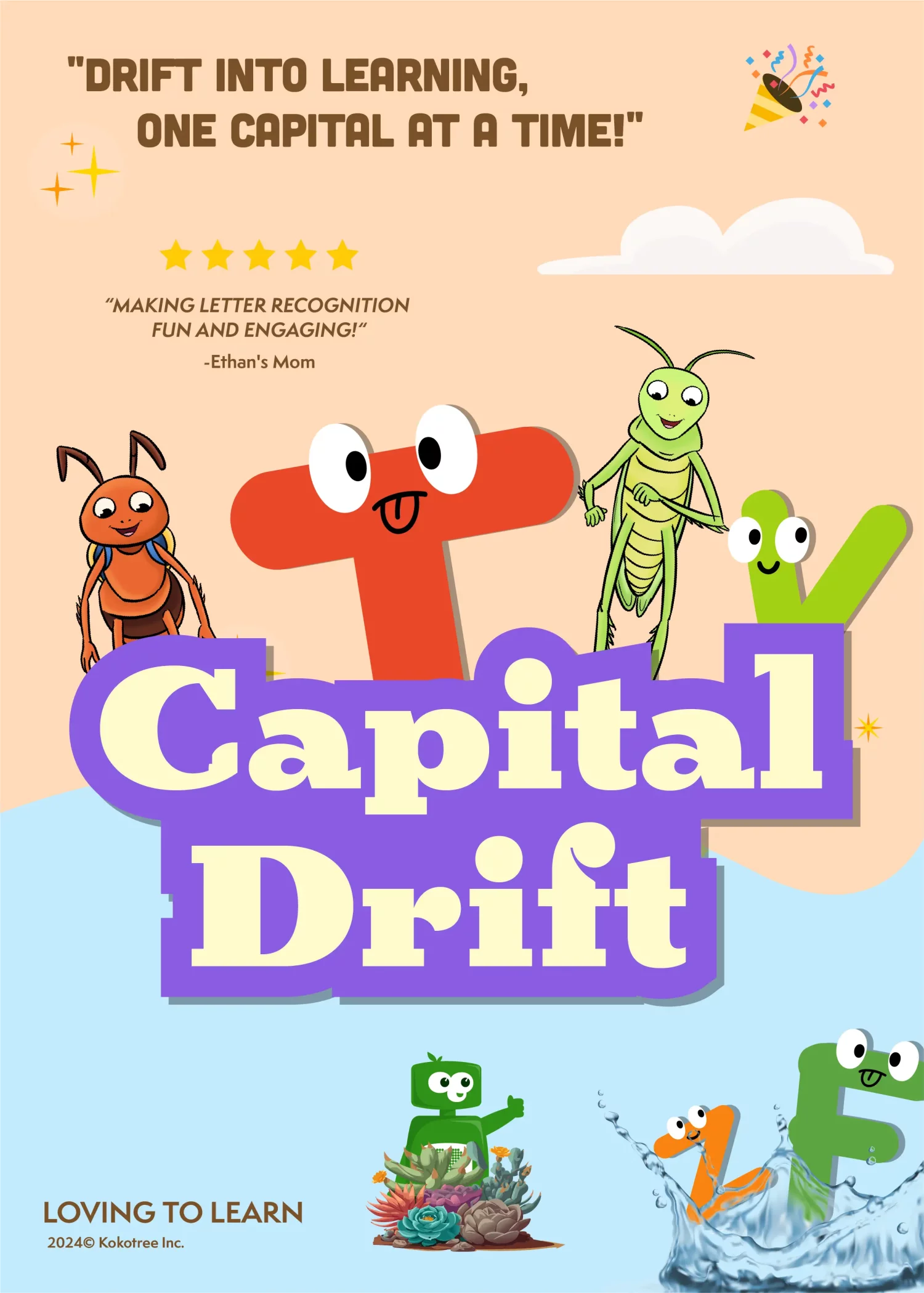
Your little learner listens carefully for letter names, then hunts for and drags the matching uppercase letter to a serene pond. This gentle game builds rock-solid letter recognition skills through audio-visual matching—the foundation for reading success.
Interactive Game
Ages 3-5
Skill: Uppercase Letter Recognition
Your kid matches spoken letters to their written form. You get guilt-free screen time knowing they're learning.
Friendly animal characters call out letter names while uppercase letters float gently on screen. Your child listens, finds the correct letter, and drags it to a calming pond. Each successful match brings cheerful feedback and encouragement to keep exploring the alphabet.
What your child practices:
This game actively builds the connection between how letters sound and how they look—a critical pre-reading skill. Children strengthen their listening attention while developing visual discrimination between similar-looking letters.
- Identifying all 26 uppercase letters by name
- Connecting spoken letter sounds to written symbols
- Fine motor control through drag-and-drop movements
- Focused listening and following audio instructions
- Visual scanning and letter discrimination
They'll use these skills when:
- Spotting letters on cereal boxes, signs, and books during everyday routines
- Writing their name and recognizing friends' names
- Playing alphabet games with siblings or at the playground
- Starting kindergarten reading activities and letter assessments
The Gameplay (what keeps them engaged)
Capital Drift uses a relaxed, rewarding pace that removes pressure while maximizing learning. When a letter is called, children scan the screen, tap and drag their choice to the pond, and receive immediate positive feedback. Correct matches create satisfying visual rewards—think gentle ripples and happy animal celebrations. The calm atmosphere keeps frustration low while the hunt-and-find mechanic maintains engagement. Children naturally want to "catch" more letters, turning repetitive practice into an enjoyable game they'll ask to play again.
How It Teaches (the clever part)
- Immediate feedback: Correct letters create cheerful animations and sounds; incorrect attempts get gentle encouragement to try again without penalty
- Progression: Letters are introduced systematically, with commonly confused letters (like M/W or B/D) spaced apart to build confident recognition
- Repetition: The same letters appear across multiple rounds in different contexts, cementing recognition without feeling repetitive
Learning trick: By requiring children to HEAR the letter name before FINDING it visually, the game builds the audio-visual connection that's essential for phonics and reading—not just passive letter matching.
Beyond the App: Reinforce the Learning
- Mealtime activity: "Letter Hunt on the Table" - Point to items and ask "Can you find something that starts with the letter B?" (Practices connecting letters to real objects and beginning sounds)
- Car/travel activity: "I Spy Letters" - Call out a letter and see who can spot it first on signs, license plates, or buildings. (Builds real-world letter recognition and visual scanning)
- Outdoor activity: "Stick Letters" - Collect sticks or leaves and form uppercase letters together on the ground. (Reinforces letter shapes through hands-on creation)
- Anytime activity: "Letter Delivery" - Write letters on sticky notes and have your child "deliver" each one to the correct letter card or magnet on the fridge. (Mirrors the drag-and-drop matching from the game)
Common Questions Parents Ask
"Is this really teaching, or just playing?" - Every round requires your child to actively listen, visually discriminate between letters, and make a choice—that's three learning processes in one simple interaction. The relaxed pace actually improves retention because stress-free learning sticks better.
"How long until my child knows all the letters?" - Most children need 20-30 exposures to reliably recognize each letter. With regular play sessions, you'll likely see confident recognition of familiar letters within 2-3 weeks, with the full alphabet following over a few months.
"What if my child gets frustrated with letters they don't know?" - Capital Drift is designed with a forgiving pace and encouraging feedback. If your child struggles, the game gently guides them without penalty. Celebrate attempts, not just correct answers—"You're getting so good at looking carefully!"
What Your Child Will Learn
Prerequisites and Building Blocks
Children benefit most from Capital Drift when they have basic touch-screen familiarity and can follow simple verbal instructions. This game builds naturally on earlier alphabet exposure through songs or books. It serves as a bridge between passive letter recognition (seeing letters in the environment) and active identification (naming letters independently). Capital Drift prepares children for phonics activities by establishing strong letter-name knowledge—the essential first step before connecting letters to their sounds.
Cognitive Development and Game Design
The drag-and-drop mechanic perfectly suits developing fine motor skills in 3-5 year olds, requiring intentional finger movement without demanding precision beyond their capabilities. The audio-first design leverages how young children naturally process information—hearing before reading. The relaxed pace respects limited attention spans while the hunt-and-find element activates visual processing centers. This multi-sensory approach (hear it, see it, move it) creates stronger neural pathways than single-sense learning.
Alignment with Educational Standards
Capital Drift directly addresses Common Core Foundational Skills standard RF.K.1d (recognize and name all upper-case letters) and supports Head Start Early Learning Outcomes in Literacy Knowledge. Kindergarten teachers expect incoming students to recognize most uppercase letters by name. This game builds exactly that benchmark skill, preparing children for classroom letter assessments and the transition to lowercase letters and phonics instruction that follows.
Extended Learning Opportunities
Pair Capital Drift with Kokotree videos featuring alphabet songs and letter-focused stories to reinforce recognition through multiple modalities. After mastering uppercase recognition, children can progress to lowercase letter games and beginning phonics activities. Off-screen, create a letter-of-the-week focus: find that letter everywhere, form it with playdough, and trace it in sand or shaving cream for tactile reinforcement.
Game Mechanics Summary
- Child hears an uppercase letter name spoken aloud by a friendly animal character
- Multiple uppercase letters appear on screen for visual scanning
- Child drags the correct letter to the pond target area
- Immediate positive feedback confirms correct matches; gentle encouragement follows incorrect attempts
Skill Development Progression
Early play sessions focus on recognition speed and accuracy for familiar letters (often those in the child's name). With repeated play, children progress from slow, deliberate searching to quick, confident identification. Mastery looks like instant recognition without hesitation and the ability to name letters independently outside the game. Watch for your child spontaneously pointing out letters in books or on signs—that's the skill transferring to real life.
Letter Recognition Development: The Foundation of Reading
Letter recognition is far more than memorization—it's the critical gateway skill that unlocks reading. Research consistently shows that letter-name knowledge in preschool is one of the strongest predictors of later reading success. When children can quickly and automatically identify letters, their brains free up cognitive resources for the harder work of decoding words and comprehending meaning.
The audio-visual matching in Capital Drift builds what educators call "letter-name fluency"—the ability to see a letter and immediately recall its name without conscious effort. This automaticity typically develops between ages 3-5, with most children recognizing 10-20 uppercase letters by age 4 and all 26 by kindergarten entry.
Uppercase letters are intentionally taught first because they're visually distinct from each other (compare B, K, and W) whereas many lowercase letters look similar (b, d, p, q). This reduces confusion during the critical early learning phase.
For school readiness, children who enter kindergarten with strong uppercase letter recognition adapt more quickly to literacy instruction and show greater confidence in early reading activities. Capital Drift builds this foundation through the most effective method: repeated, low-pressure practice that feels like play. The game's calm pace prevents the anxiety that can actually inhibit memory formation, while the immediate feedback loop strengthens correct associations with every successful match.