
What's Croc, Ed, & Mike About?
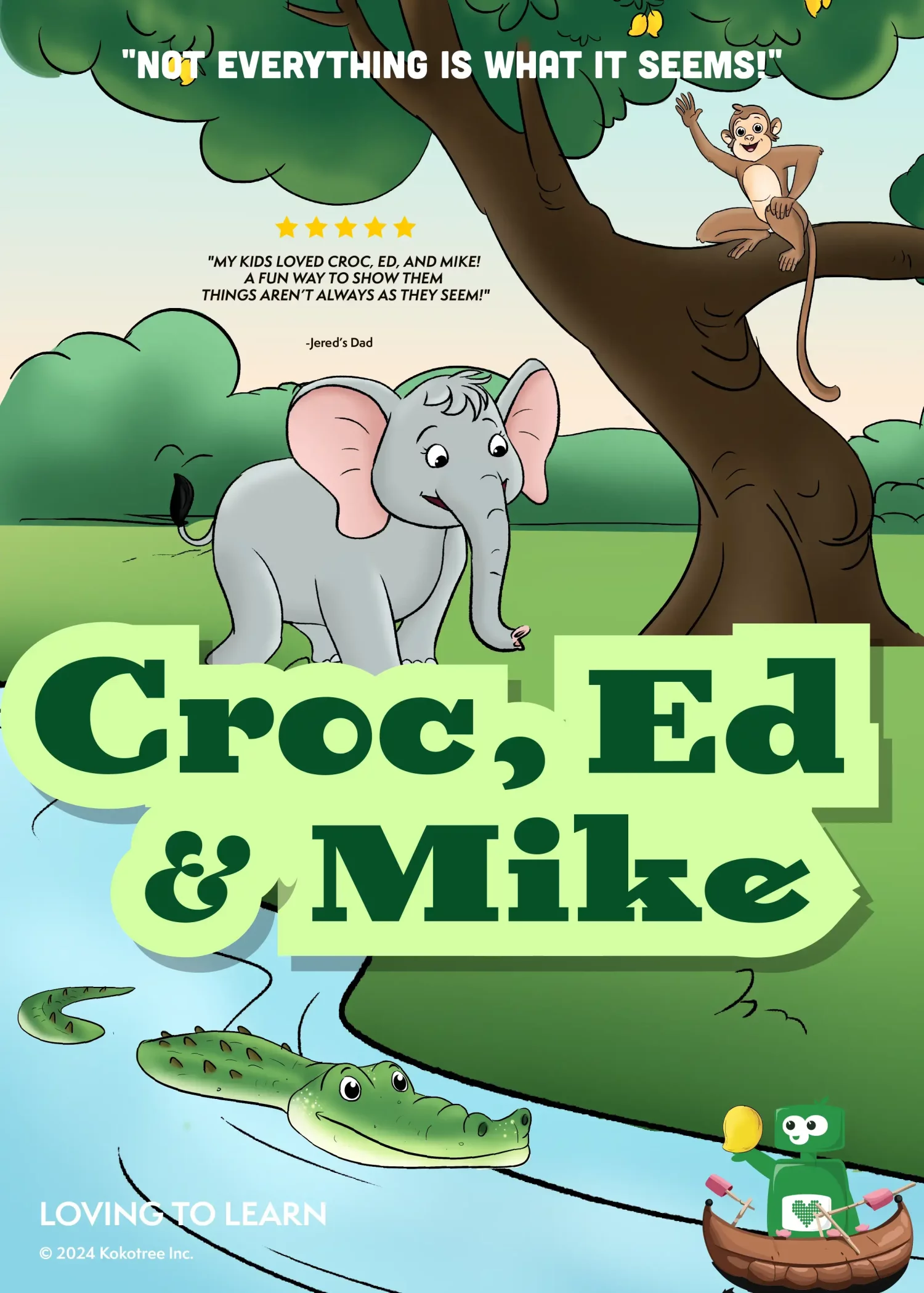
Your little one joins the Kokotree classroom for an engaging jungle story that teaches mindfulness and empathy through lovable animal characters. After watching, they'll understand how to pause and think before acting!
5.5 minutes
Ages 3-6
Skill: Social Awareness & Mindful Actions
Your kid watches a jungle adventure about friendship and understanding. You get 5 minutes to finish that cup of coffee.
Miss Meera gathers the excited Kokotree class for story time, transporting them to a jungle where Croc the crocodile, Ed the elephant, and Mike the monkey learn an important lesson. Bright, friendly animal characters act out a playful misunderstanding that gets resolved through clever thinking and kindness.
What your child learns:
This story introduces the concept that our actions can affect others differently than we intend. Children learn that being aware of how others feel helps us be better friends—all wrapped in an engaging narrative they'll want to watch again.
- Recognizing that playful actions can accidentally hurt others
- Understanding different perspectives in social situations
- Problem-solving through observation (like Mike the monkey!)
- Practicing mindfulness about words and actions
- Building empathy by considering how friends feel
They'll use these skills when:
- Playing with siblings or friends and noticing when someone seems upset
- Stopping to think before grabbing a toy someone else is using
- Helping a friend who looks scared or confused at the playground
- Saying sorry and understanding why gentle play matters
The Story (what keeps them watching)
In a jungle far away, Croc is bored and just wants to play! When he spots Ed the elephant cooling off in the river, he playfully grabs Ed's leg—but Ed gets scared! Enter Mike the monkey, who's watching from his mango tree. This clever observer tosses a juicy mango to distract Croc, freeing Ed and making everyone happy. The story wraps up back in the classroom where Ronnie realizes: sometimes we can hurt friends without meaning to. Miss Meera's solution? Stay aware and mindful!
How We Teach It (the clever part)
- First 2 minutes: The classroom setting establishes excitement and safety, then transports children into an immersive jungle story with three distinct animal characters
- Minutes 2-4: The conflict unfolds—children see the same situation from multiple perspectives (Croc's playfulness, Ed's fear, Mike's observation), building perspective-taking skills
- Final 1.5 minutes: Back in the classroom, characters discuss the lesson explicitly, with Ronnie modeling reflection and Miss Meera providing actionable advice about mindfulness
Teaching trick: The story shows the SAME moment from different viewpoints—Croc thinks he's playing while Ed feels scared. This dual perspective helps young minds grasp that others experience situations differently than we do.
After Watching: Quick Wins to Reinforce Learning
- Mealtime activity: "Remember when Croc didn't know Ed was scared? Can you think of a time someone didn't know how you felt?" (Practices identifying emotions and perspective-taking)
- Car/travel activity: "Let's play the Mike game! Look around and guess how different people might be feeling." (Builds observation skills and empathy)
- Bedtime activity: "What's one thing you did today that made someone smile? What's something you might do differently tomorrow?" (Encourages daily reflection on actions)
- Anytime activity: "Before we do something, let's ask: 'How might this make my friend feel?'" (Practices the pause-and-think habit Miss Meera teaches)
When Kids Get Stuck. And How to Help.
"My child doesn't understand why Croc did anything wrong" - That's actually the point! Croc wasn't being mean—he just didn't realize his play was scary. Help your child see that good intentions still need awareness: "Croc wanted to play, but Ed didn't know that. How could Croc have asked first?"
"My child keeps saying they didn't mean to hurt someone" - This story validates that feeling while teaching responsibility. Acknowledge their intention was good, then practice: "You're right, you didn't mean to! Now let's think about how we can check if our friend is okay."
"This seems too abstract for my toddler" - Focus on the concrete parts first: the animals, the mango, the splash! Younger children absorb the emotional beats before the lesson. They'll catch the deeper meaning with repeated viewings.
What Your Child Will Learn
Prerequisites and Building Blocks
This video works best for children who can follow a simple narrative with multiple characters. It builds on basic emotion recognition (happy, scared, confused) and extends into understanding WHY someone might feel a certain way. Children familiar with Kokotree's classroom format will feel comfortable with Miss Meera's storytelling style. This episode naturally follows content about identifying feelings and precedes more complex social problem-solving scenarios.
Cognitive Development and Teaching Methodology
At ages 3-6, children are developing "theory of mind"—the understanding that others have different thoughts and feelings than their own. This video uses a classic misunderstanding scenario to make abstract social concepts concrete. The visual storytelling addresses visual learners, Miss Meera's narration supports auditory processing, and the clear cause-effect sequences help kinesthetic learners connect actions to outcomes. The classroom bookend provides metacognitive modeling.
Alignment with Educational Standards
This content aligns with social-emotional learning standards found in most early childhood frameworks, including CASEL competencies for self-awareness and social awareness. Kindergarten readiness indicators emphasize understanding that actions have consequences and recognizing others' feelings—both central to this story. Teachers expect entering kindergartners to demonstrate basic empathy and begin resolving conflicts with adult guidance.
Extended Learning Opportunities
Pair this video with emotion flashcards showing different facial expressions. Practice "perspective switching" with stuffed animals acting out simple scenarios. The Kokotree app's feelings identification games reinforce emotion vocabulary. Create a simple "Think Before You Act" poster with three steps: Stop, Think about how my friend might feel, Then act. Role-play alternative endings where Croc asks Ed to play first.
Transcript Highlights
- "Sometimes we can hurt our friends even when we don't intend to." - Ronnie's reflection models thoughtful processing
- "Try to stay aware and mindful of the things you do and say. Your awareness can help you avoid actions that can harm others." - Miss Meera's actionable advice
- "He could see that Ed was frightened and in pain. He also knew that Croc meant no harm. Mike was a smart monkey." - Demonstrates holding two perspectives simultaneously
- "This is the only thing Croc wanted, something sweet to keep him happy." - Mike's insight shows understanding others' needs
Character Development and Story Arc
Each character models different learning behaviors. Croc demonstrates how good intentions without awareness can cause problems—he's not a villain, just unaware. Ed shows appropriate help-seeking when frightened. Mike exemplifies observation, critical thinking, and creative problem-solving—he assesses the situation, understands both perspectives, and finds a solution that helps everyone. In the classroom, Ronnie models reflection and asking questions, while Miss Meera demonstrates how adults can guide without lecturing.
Social-Emotional Development: Understanding Unintended Consequences
Between ages 3-6, children are navigating a crucial developmental phase where they begin to understand that their actions affect others in ways they might not anticipate. This cognitive leap—recognizing that intention and impact can differ—is foundational for developing empathy and prosocial behavior.
The Croc, Ed, and Mike story brilliantly illustrates this concept without villainizing any character. Croc genuinely wants connection and play; his mistake is assuming Ed would interpret his actions the same way he intended them. This mirrors countless preschool scenarios: the enthusiastic hugger who squeezes too tight, the excited child who grabs a toy to share it, the playful push that knocks someone down.
Research in developmental psychology shows that children this age benefit enormously from seeing social situations from multiple viewpoints simultaneously—exactly what this story provides. By showing Croc's playful intention alongside Ed's fearful experience, children practice "perspective coordination," a skill that develops throughout early childhood.
Mike the monkey serves as a model for the observant, thoughtful child—someone who pauses to understand before acting. His solution isn't to punish Croc but to redirect everyone toward happiness. This models restorative rather than punitive approaches to social mishaps.
The classroom discussion afterward is equally important. Ronnie's unprompted reflection shows children that thinking deeply about social situations is normal and valued. Miss Meera's advice—"stay aware and mindful"—gives children a concrete strategy they can actually use. This isn't about being perfect; it's about building the habit of pausing to consider others.