
What's Exploring Lines About?
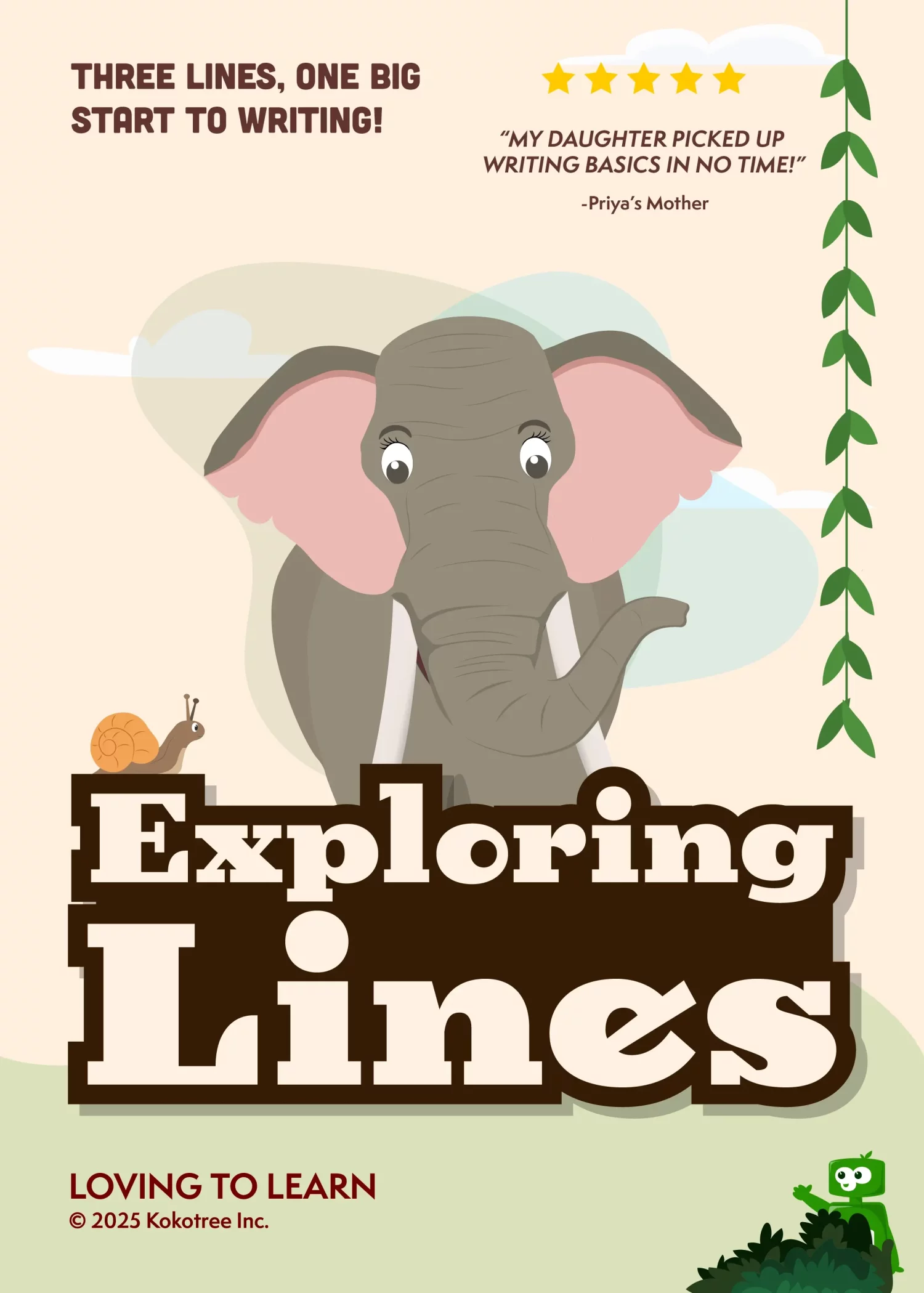
Your little one joins Elizabeth and friends on a jungle expedition to discover three types of lines hiding everywhere—from tree branches to monkey huts! They'll learn to spot standing (vertical), sleeping (horizontal), and slanting (diagonal) lines in the real world.
6 minutes
Ages 3-5
Skill: Line recognition and pre-writing foundations
Your kid watches friendly animals hunt for lines in nature. You get 6 minutes to drink your coffee while it's still warm.
Elizabeth the Elephant guides children through a colorful jungle, pointing out lines in sticks, vines, tree branches, and buildings. Animated highlights trace each line type as characters discover them, making abstract concepts concrete and visual.
What your child learns:
This video builds essential pre-writing skills by teaching children to recognize and differentiate between three fundamental line types. These building blocks are the foundation for forming letters, numbers, and shapes.
- Identifies vertical (standing) lines in everyday objects like sticks and vines
- Recognizes horizontal (sleeping) lines on structures like roofs and branches
- Spots diagonal (slanting) lines on hills, mountains, and rooftops
- Understands that all drawings and letters are made from different line combinations
- Develops visual discrimination skills for shapes and patterns
They'll use these skills when:
- Drawing their first letters and numbers at preschool
- Building with blocks and noticing how pieces stack
- Looking out the car window and spotting lines on buildings and signs
- Playing "I Spy" games and describing what they see
The Story (what keeps them watching)
Elizabeth welcomes kids into her jungle classroom for a line-hunting adventure! First, she introduces standing lines with a catchy rhyme, then discovers them on a stick and a climbing vine (with a cute mouse helper!). Next, the whole Kokotree crew—including Bobby Bear, Maddy Monkey, Eddie Elephant, Ruby Rabbit, and Ronnie Rhino—searches for sleeping lines on tree branches and Maddy's hut. Finally, everyone climbs a grassy hill to learn about slanting lines, spotting them on mountains and rooftops. Elizabeth wraps up by showing how all three line types work together to create everything we see!
How We Teach It (the clever part)
First 2 minutes: Elizabeth introduces standing (vertical) lines with a memorable rhyme and real jungle examples—a stick on the ground and a vine on a tree. Visual overlays trace each line so kids see the concept clearly.
Minutes 2-4: The adventure continues with sleeping (horizontal) lines. Multiple characters take turns finding examples, reinforcing the concept through repetition and peer modeling on branches and building structures.
Final 2 minutes: Slanting (diagonal) lines are introduced using a hill the characters roll down! The lesson connects all three line types by revisiting Maddy's hut, showing how standing, sleeping, and slanting lines work together.
Teaching trick: Each line type gets a relatable nickname (standing, sleeping, slanting) that connects to something kids already understand—standing up straight, lying down to sleep, and sliding down a slope. This anchors abstract geometry in physical experience.
After Watching: Quick Wins to Reinforce Learning
Mealtime activity: "Can you find a standing line on your plate?" Point to carrot sticks, celery, or the edge of a sandwich. (Practices identifying vertical lines in food)
Car/travel activity: "Let's count sleeping lines on that building!" Look for horizontal lines on fences, window frames, and road markings. (Builds observation skills during travel)
Bedtime activity: "Trace a standing line on my back, now a sleeping line!" Take turns drawing lines on each other's backs and guessing which type. (Reinforces learning through touch)
Anytime activity: "Let's build a house with all three lines!" Use craft sticks, straws, or even fingers to create structures with standing, sleeping, and slanting lines. (Applies concepts through hands-on play)
When Kids Get Stuck. And How to Help.
"My child keeps mixing up standing and sleeping lines." Totally normal! Use body movements—stand up tall for standing lines, lie down flat for sleeping lines. Physical connection helps the names stick.
"She can find lines in the video but not in real life." Start with obvious examples like door frames (standing) and table edges (sleeping). Once she gets those, challenge her to find trickier ones. Real-world transfer takes practice!
"Slanting lines seem too hard for my 3-year-old." Focus on standing and sleeping lines first—those are the priority for pre-writing. Slanting lines can wait a few months. Every child moves at their own pace, and that's perfectly okay.
What Your Child Will Learn
Prerequisites and Building Blocks
Children watching this video should have basic shape awareness and the ability to follow simple visual instructions. This lesson builds on foundational concepts of observation and categorization. It prepares learners for more advanced pre-writing skills, letter formation (which combines all three line types), and geometric shape recognition. In the Kokotree learning progression, this video bridges early shape exposure and formal handwriting readiness.
Cognitive Development and Teaching Methodology
This video leverages concrete-to-abstract learning, starting with physical objects children can see before introducing geometric vocabulary. The multi-sensory approach combines visual highlighting, verbal rhymes, and implied movement (mouse climbing, characters rolling). Repetition through multiple examples addresses varied learning styles, while character dialogue models the thinking process of identifying and categorizing visual information—a key cognitive skill for ages 3-5.
Alignment with Educational Standards
This content aligns with kindergarten readiness indicators for fine motor preparation and visual discrimination. It supports Common Core Math standards for geometry (recognizing shapes and spatial relationships) and addresses pre-writing benchmarks requiring children to form basic strokes before letter formation. Teachers expect incoming kindergartners to distinguish between horizontal, vertical, and diagonal lines—exactly what this video teaches.
Extended Learning Opportunities
Pair this video with line-tracing worksheets featuring standing, sleeping, and slanting practice strokes. The Kokotree app includes interactive games where children sort objects by line type and draw lines to complete pictures. Extend learning with outdoor scavenger hunts, building activities with craft materials, and drawing challenges that combine all three line types into simple pictures like houses, trees, and mountains.
Transcript Highlights
- "Standing lines are also called vertical lines. They look like they are standing up straight!"
- "A standing line goes up and down. Standing lines are all around. Standing lines are here and there. Standing lines are everywhere."
- "They call them sleeping lines because they look like they're lying down. So it's also called a horizontal line."
- "Did you know, children, that a slanting line looks like a slope and can go both up and down? It can lean in any direction, both left and right."
- "Please remember children, lines give us the possibility to create anything. We simply need to visualize!"
Character Development and Story Arc
Elizabeth models expert teaching behavior—introducing concepts clearly, using memorable language, and celebrating student discoveries. The supporting characters (Eddie, Ruby, Ronnie, Tiki) demonstrate active learning by raising hands, making observations, and building on each other's answers. This peer-learning dynamic shows children that discovering and sharing knowledge is exciting. Bobby Bear's cameo as a "sleeping line" adds humor while reinforcing the concept through character play.
Understanding Lines: The Foundation of Visual Literacy and Pre-Writing Skills
Lines are the most fundamental building blocks of visual communication. Before children can write the letter "A," they must understand that it's made of two slanting lines and one sleeping line. Before they can draw a house, they need to combine all three line types intentionally. This video teaches what educators call "stroke awareness"—the ability to perceive, categorize, and eventually reproduce basic directional marks.
The three line types introduced here correspond directly to the strokes children will use in handwriting: vertical strokes form letters like "l," "t," and "i"; horizontal strokes appear in "f," "t," and "e"; diagonal strokes are essential for "k," "v," "w," and "x." Research in early literacy shows that children who can identify and trace these basic strokes before formal writing instruction demonstrate stronger letter formation and writing fluency.
Beyond writing, line recognition develops spatial reasoning and geometric thinking. Understanding that a triangle has three slanting lines, a square has standing and sleeping lines, and complex shapes combine multiple line types builds the foundation for mathematical visualization. The video's approach of finding lines in nature and structures also develops observational skills crucial for scientific thinking—noticing patterns, categorizing observations, and understanding how simple elements combine into complex wholes.