
What's Digital Dash About?
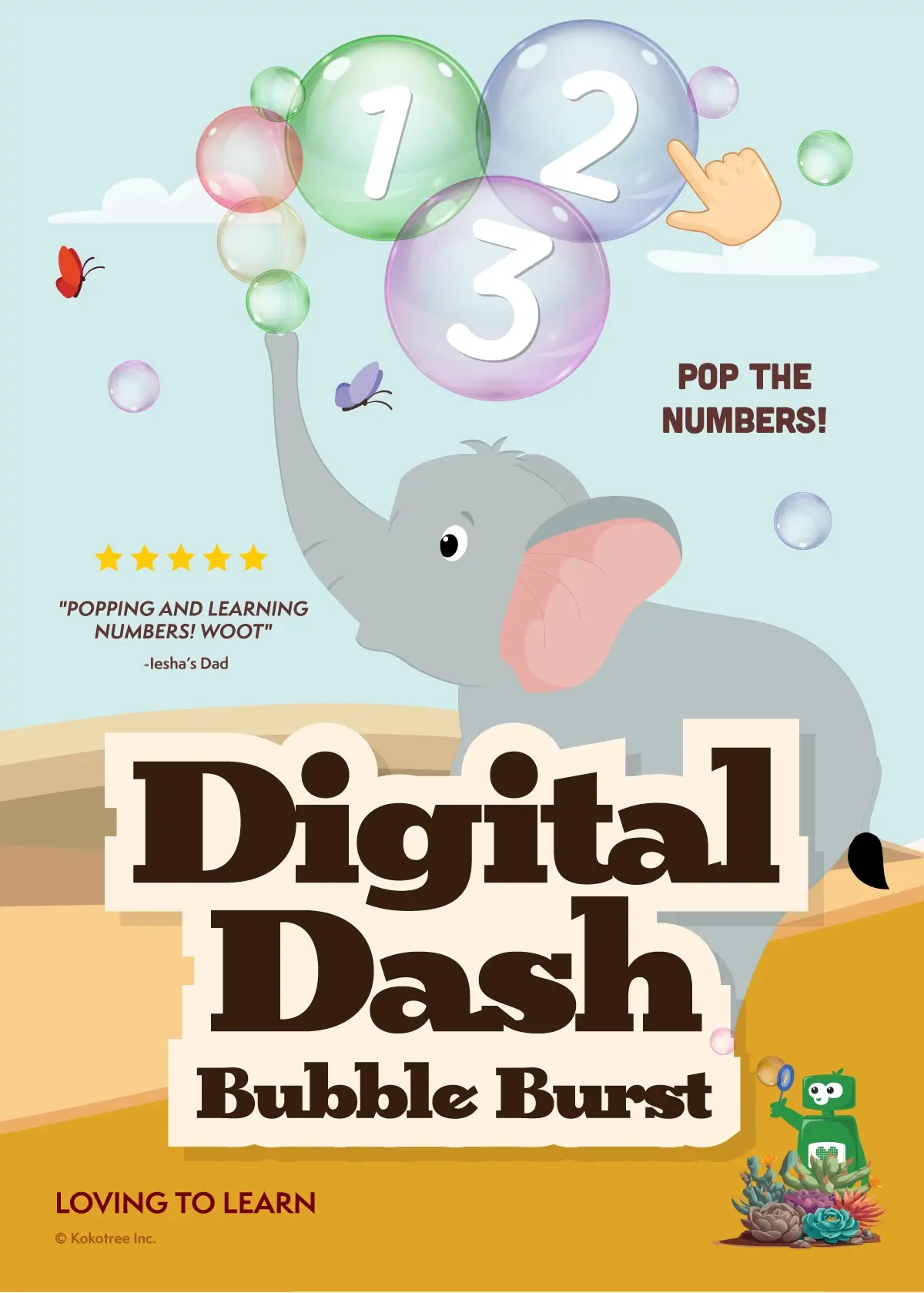
Your child listens for a number, hunts it down among floating bubbles, and pops it with a satisfying tap. They're building rock-solid number recognition from 0-9 while having a blast.
Interactive Game
Ages 2-5
Skill: Number Recognition
Your kid pops bubbles to match numbers they hear. You get guilt-free screen time knowing they're learning.
Bubbles float across the screen, each displaying a number from 0-9. A friendly voice calls out a number, and your child taps the matching bubble to pop it. The satisfying pop and cheerful feedback keep little learners engaged while cementing number recognition.
What your child practices:
Every bubble pop reinforces the connection between hearing a number and recognizing its written form. This audio-visual matching is foundational for counting, early math, and reading numbers in the real world.
- Recognizing numerals 0-9 on sight
- Connecting spoken numbers to written symbols
- Listening skills and auditory processing
- Hand-eye coordination through targeted tapping
- Quick visual scanning and focus
They'll use these skills when:
- Spotting house numbers on a walk or finding the right elevator button
- Counting snacks on their plate or items at the store
- Playing board games that use dice or number spinners
- Starting kindergarten math and number writing activities
The Gameplay (what keeps them engaged)
Bubbles drift across the screen in a gentle, mesmerizing flow. When your child hears "Find the 7!" they scan, spot, and POP—instant satisfaction! The bubble bursts with a rewarding sound and visual celebration. New bubbles appear, a new number is called, and the hunt continues. The pace stays playful (not frantic), so kids feel successful rather than stressed. Each correct pop builds confidence, and the variety of numbers keeps them guessing. It's simple enough for tiny fingers but engaging enough to hold attention.
How It Teaches (the clever part)
- Immediate feedback: Correct pops trigger a cheerful burst animation and sound. Wrong taps get a gentle nudge to try again—no harsh penalties.
- Progression: Numbers appear in varied arrangements and speeds, gradually challenging visual scanning as skills improve.
- Repetition: Each number appears multiple times across sessions, reinforcing recognition without feeling repetitive.
Learning trick: By pairing the spoken number with the visual symbol every single time, Digital Dash builds automatic recognition—so your child doesn't have to "think" about what a 5 looks like, they just know.
Beyond the App: Reinforce the Learning
- Mealtime activity: "Can you find the 3?" Write numbers 0-9 on small paper scraps and hide them under cups. Call out a number and let your child lift cups to find it. (Practices number recognition and listening skills.)
- Car/travel activity: "Number hunt!" Call out a number and challenge your child to spot it on signs, license plates, or buildings. (Practices visual scanning and real-world number recognition.)
- Outdoor activity: "Chalk pop!" Draw large numbers on the sidewalk with chalk. Call out a number and have your child jump on it or stomp it like popping a bubble. (Practices gross motor skills and number-sound connection.)
- Anytime activity: "Bubble wrap pop!" Write numbers on bubble wrap squares with a marker. Call out numbers and let your child pop the matching bubble. (Practices fine motor skills and number recognition with real tactile feedback.)
Common Questions Parents Ask
- "Is popping bubbles really teaching anything?" - Absolutely! Each pop reinforces the link between hearing and seeing a number—exactly how number fluency develops. Research shows multi-sensory learning (hear it + see it + tap it) creates stronger memory pathways than flashcards alone.
- "How long until my child recognizes all the numbers?" - Most children playing regularly will show confident 0-9 recognition within a few weeks. Every child's pace is different, and repeated low-pressure practice is more effective than drilling.
- "What if my child gets frustrated missing bubbles?" - The game is designed to be forgiving—bubbles move gently and there's no timer pressure. If frustration happens, try playing together and celebrating effort, not just correct pops.
What Your Child Will Learn
Prerequisites and Building Blocks
Digital Dash works best for children who have some exposure to numbers through counting songs, books, or everyday conversations. It builds on basic counting awareness and connects naturally to other Kokotree games focusing on number tracing and quantity matching. In the learning progression, this game bridges the gap between hearing numbers in sequence and recognizing individual numerals—a critical step before addition, subtraction, and written math work.
Cognitive Development and Game Design
The tap-to-pop mechanic suits developing fine motor control in ages 2-5. Young children learn best through immediate cause-and-effect feedback, and the instant bubble burst delivers exactly that. The audio prompt followed by visual search engages both auditory processing and visual discrimination—two cognitive skills developing rapidly at this age. Simple, single-tap interactions prevent frustration while building confidence.
Alignment with Educational Standards
Digital Dash supports Common Core Math Standard K.CC.3 (write and recognize numerals 0-9) and Head Start Early Learning Outcomes for Mathematics. Kindergarten readiness assessments typically expect children to identify numerals 0-10 on sight. This game directly practices that benchmark through repeated, low-stakes exposure—exactly what early childhood educators recommend for building number fluency before formal schooling.
Extended Learning Opportunities
Pair Digital Dash with Kokotree's number tracing games to connect recognition with writing. Watch Kokotree videos featuring counting songs and number adventures to reinforce concepts through story. Off-screen, practice with magnetic numbers on the fridge, number puzzles, or counting everyday objects. The goal is surrounding your child with numbers in playful contexts so recognition becomes automatic.
Game Mechanics Summary
- Child hears a number spoken aloud by a friendly voice
- Bubbles displaying various numerals (0-9) float across the screen
- Child taps the bubble showing the called number to pop it
- Correct pops trigger celebratory animations and sounds; incorrect taps prompt a gentle retry
Skill Development Progression
With repeated play, children move from slow, deliberate searching to quick, confident identification. Early sessions may involve scanning every bubble; later, they'll spot the target number almost instantly. Mastery looks like immediate recognition without hesitation and the ability to find numbers even when bubbles move faster or screens get busier. Watch for your child calling out numbers in daily life—that's the skill transferring!
Number Recognition Deep Dive: Why It Matters
Number recognition—the ability to look at a symbol like "7" and instantly know it represents seven—is one of the most important early math skills your child will develop. Research in early numeracy shows that children who recognize numerals fluently by kindergarten entry have stronger math outcomes throughout elementary school.
But here's what many parents don't realize: recognizing numbers is a completely different skill from counting. Your child might count to 20 perfectly but struggle to identify a written "8." That's because counting is a verbal sequence, while number recognition is visual symbol knowledge. Digital Dash specifically targets this visual skill.
The game's listen-then-find mechanic mirrors how the brain builds number knowledge: connecting the auditory label ("five") with the visual symbol (5). Each successful match strengthens neural pathways. The satisfying pop adds emotional engagement, which research shows enhances memory formation.
For ages 2-3, expect recognition of a few familiar numbers (often 1, 2, and the child's age). By ages 4-5, most children can recognize 0-9 with confidence. Digital Dash meets children wherever they are—early learners get exposure, while more advanced players build speed and automaticity.
This foundation matters because kindergarten math assumes number recognition is in place. Teachers move quickly to number writing, counting objects, and simple addition. Children who already "just know" their numbers can focus on new concepts instead of struggling to decode symbols. Digital Dash builds that fluency through play—exactly how young brains learn best.