
What's Little Moments About?
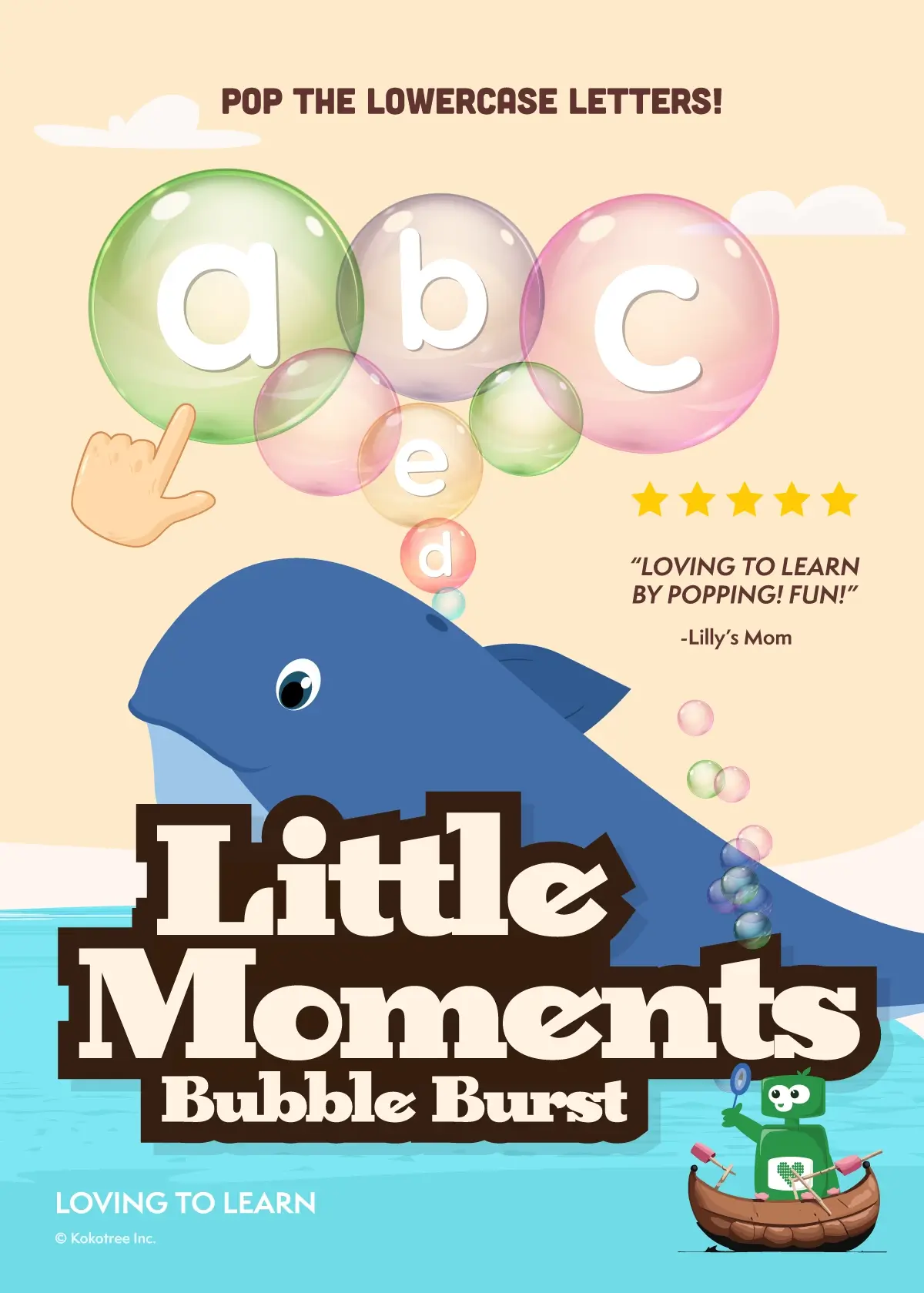
Your child listens to letter sounds and taps bubbles to find the matching lowercase letter, building the essential audio-visual connection that powers early reading. It's phonics practice disguised as bubble-popping fun!
Interactive Game
Ages 3-5
Skill: Letter Recognition & Listening
Your kid pops bubbles matching letters they hear. You get guilt-free screen time knowing they're learning.
Bubbles float across the screen, each containing a different lowercase letter. A friendly voice calls out a letter sound, and your child taps the matching bubble to pop it. The satisfying pop and cheerful celebration make every correct answer feel like a tiny victory.
What your child practices:
This game actively develops the audio-visual connection—linking what children hear to what they see—which is the cornerstone of phonics and reading readiness. Each bubble pop reinforces letter recognition while training their ears to distinguish between similar sounds.
- Recognizing all 26 lowercase letters by sight
- Connecting letter sounds to their written forms
- Developing focused listening skills
- Building quick visual scanning abilities
- Strengthening hand-eye coordination through tapping
They'll use these skills when:
- Spotting familiar letters on cereal boxes and street signs during breakfast or walks
- Following along when you read picture books together at bedtime
- Recognizing their name written on their cubby or artwork at preschool
- Beginning to sound out simple words as they start their reading journey
The Gameplay (what keeps them engaged)
Bubbles drift playfully across the screen while a warm voice calls out letter sounds. Your child scans, spots, and pops—each correct tap bursts into a satisfying celebration with sparkles and cheerful sounds. Wrong taps? The bubble just wobbles gently, encouraging another try without any frustration. The pace stays playful, not pressured. New letters appear in fresh bubble colors and patterns, keeping the visual experience exciting. Kids love the simple joy of popping bubbles, and they don't even realize they're training their brains to connect sounds with symbols—the magic ingredient for reading.
How It Teaches (the clever part)
- Immediate feedback: Correct taps create a satisfying pop with celebration sounds; incorrect taps show a gentle wobble, inviting another attempt without discouragement
- Progression: Letters start with the most distinct sounds and shapes, gradually introducing similar-looking letters (like b/d, p/q) as confidence builds
- Repetition: Each letter appears multiple times across play sessions, but with different bubble colors, positions, and speeds to keep it fresh
Learning trick: By requiring children to HEAR the letter before they SEE it, this game strengthens the phonological pathway—training the brain to automatically connect sounds to symbols, which is exactly how fluent readers process text.
Beyond the App: Reinforce the Learning
Mealtime activity: "Letter Sound Hunt" - Say a letter sound and ask your child to find something on the table that starts with that letter. (Practices connecting sounds to real objects, extending audio-visual learning)
Car/travel activity: "Pop the Sound" - Call out letter sounds and have your child pretend to pop imaginary bubbles in the air while saying the letter name. (Reinforces sound-letter connection with movement)
Outdoor activity: "Bubble Letter Chase" - Blow real bubbles and call out letters—your child pops only the bubbles you name as that letter. (Combines physical play with listening skills)
Anytime activity: "Whisper Letters" - Whisper a letter sound very quietly and see if your child can point to that letter in a book or on a sign. (Sharpens listening attention and letter recognition)
Common Questions Parents Ask
"Is popping bubbles really teaching anything?" - Absolutely! Each pop requires your child to process a sound, scan visually, identify the correct letter, and coordinate their tap—that's four learning steps in one satisfying moment. The game format keeps them practicing far longer than flashcards ever would.
"How long before my child knows all the letters?" - Most children need 15-20 meaningful exposures to reliably recognize each letter. With regular play, you'll likely notice confident recognition of familiar letters within a few weeks, with full alphabet mastery developing over several months.
"What if my child keeps tapping the wrong letters?" - That's completely normal and actually valuable! The gentle wobble feedback helps them self-correct without frustration. If they're struggling with specific letters, try saying the sound together before they tap—this extra support builds confidence.
What Your Child Will Learn
Prerequisites and Building Blocks
Children playing Little Moments benefit from basic familiarity with the concept that letters exist and have names. This game builds beautifully on alphabet songs and letter exposure from books. It bridges the gap between passive letter recognition (seeing letters in the environment) and active phonological awareness (connecting sounds to symbols). Little Moments fits perfectly after basic letter exposure activities and before more complex phonics games that require blending sounds together.
Cognitive Development and Game Design
The bubble-popping mechanic perfectly suits preschool cognitive development. At ages 3-5, children learn best through immediate cause-and-effect interactions—tap a bubble, watch it pop. The floating bubbles naturally draw visual attention without overwhelming, while the single-tap interaction removes fine motor barriers. The audio-first design (hear, then find) strengthens auditory processing pathways that are rapidly developing during these years, making this the ideal window for phonological training.
Alignment with Educational Standards
Little Moments directly supports foundational literacy standards including letter recognition (identifying all 26 lowercase letters) and phonological awareness (connecting sounds to written symbols). These skills align with kindergarten readiness benchmarks across educational frameworks. Teachers expect incoming kindergarteners to recognize most lowercase letters and understand that letters represent sounds—exactly what this game practices through engaging, repeated exposure.
Extended Learning Opportunities
Extend learning by exploring Kokotree videos featuring letter sounds and alphabet songs that reinforce the same audio-visual connections. Try pairing this game with letter tracing activities to add a motor memory component. Create a simple letter sound book together, finding pictures of things that start with each letter. The combination of hearing, seeing, and doing creates multiple neural pathways for lasting letter knowledge.
Game Mechanics Summary
- Child listens to a letter sound spoken by a friendly voice
- Multiple bubbles containing different lowercase letters float on screen
- Child taps the bubble containing the matching letter
- Correct taps trigger a satisfying pop animation and celebration; incorrect taps show a gentle wobble encouraging retry
Skill Development Progression
With repeated play, children progress from slow, deliberate searching to quick, confident identification. Early sessions might show hesitation and some trial-and-error tapping. Over weeks, watch for faster response times, fewer incorrect taps, and your child saying the letter name aloud before tapping. Mastery looks like automatic recognition—your child spots and pops the correct letter almost instantly, showing that the sound-symbol connection has become internalized and effortless.
The Science of Audio-Visual Letter Learning
The connection between hearing a letter sound and recognizing its written form is the fundamental building block of reading. Research in early literacy consistently shows that children who develop strong phonological awareness—the ability to hear, identify, and manipulate letter sounds—become more successful readers.
Little Moments specifically targets the audio-visual integration pathway. When children hear a sound and must find its visual match, they're strengthening neural connections in both the auditory and visual processing centers of the brain, plus the pathways that link them. This cross-modal learning is significantly more powerful than visual-only letter recognition.
For ages 3-5, lowercase letter recognition is developmentally appropriate and practically important—most text children encounter in books uses lowercase letters. While uppercase letters are often learned first (they're visually simpler), lowercase mastery is essential for actual reading.
The bubble-popping format provides something crucial: high-volume, low-pressure practice. Children need many repetitions to solidify letter knowledge, but traditional drilling causes fatigue and resistance. By embedding practice in play, Little Moments allows children to engage with letters dozens of times per session while staying motivated and happy.
This matters enormously for school readiness. Kindergarten teachers report that children who arrive with solid letter-sound knowledge adapt more quickly to reading instruction, experience less frustration, and develop stronger reading confidence. Little Moments builds exactly this foundation—one satisfying pop at a time.