
What's Doodle Noodle About?
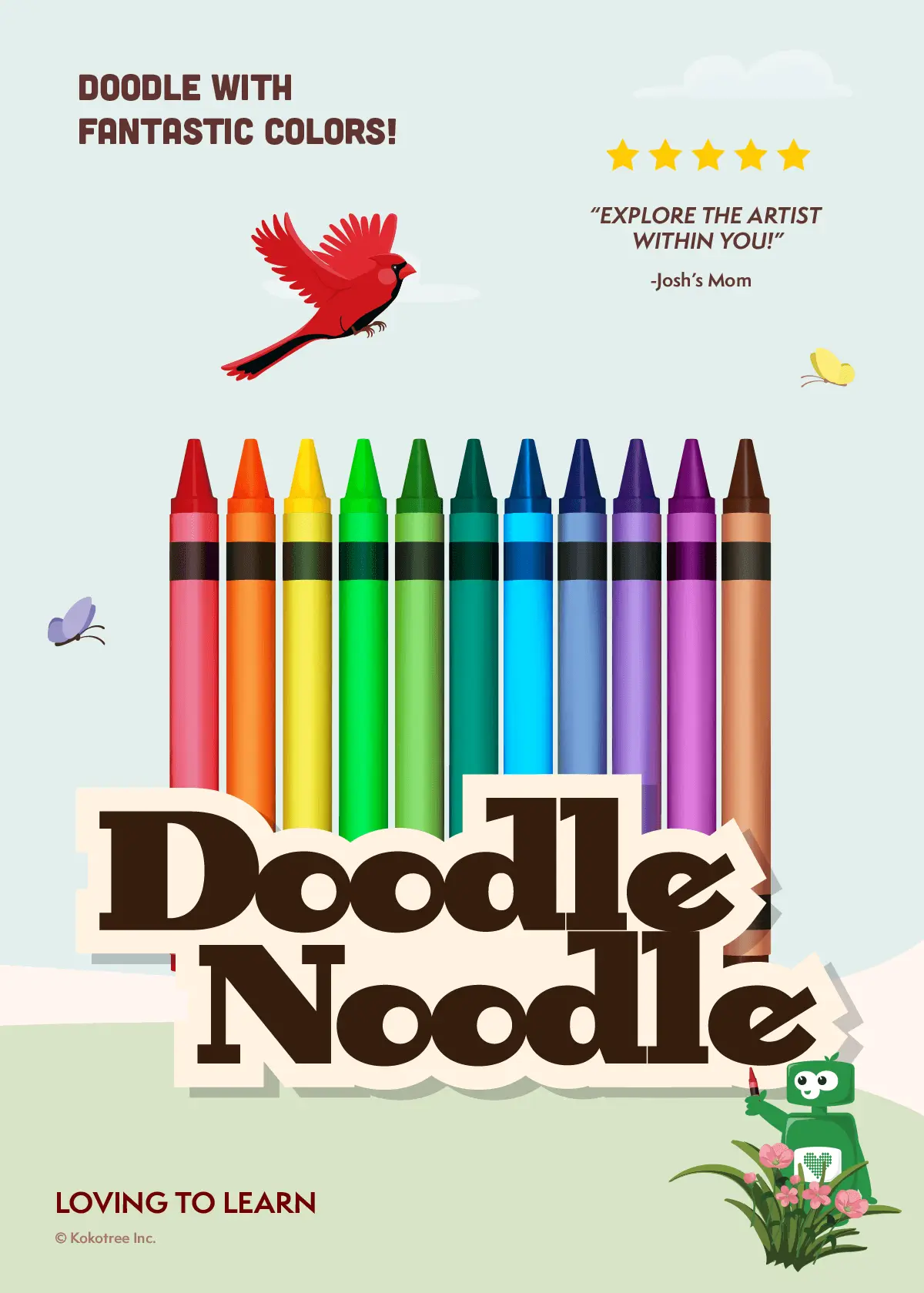
Your child becomes a mini artist, choosing colorful crayons and creating whatever their imagination dreams up on a blank canvas. They're building essential fine motor skills and creative confidence with every stroke.
Interactive Game
Ages 1-6
Skill: Creative Expression & Fine Motor Development
Your kid draws freely with digital crayons on a blank canvas. You get guilt-free screen time knowing they're learning.
Children tap to select from a rainbow of crayon colors, then drag their finger across the screen to create lines, shapes, and pictures. There are no rules, no "wrong" answers—just pure creative exploration that responds instantly to their touch.
What your child practices:
Every swipe and stroke strengthens the small muscles in their hands and fingers—the same muscles they'll need for holding pencils and writing letters. They're also developing hand-eye coordination as they watch their movements create marks on screen.
- Fine motor control through precise finger movements
- Hand-eye coordination by tracking their strokes
- Creative thinking and self-expression
- Color recognition and selection
- Spatial awareness on the canvas
They'll use these skills when:
- Holding crayons and pencils to draw and write at home
- Learning to form letters and numbers in preschool
- Buttoning shirts, zipping jackets, and tying shoes
- Building with blocks and manipulating small toys
The Gameplay (what keeps them engaged)
Doodle Noodle is beautifully simple: pick a crayon, draw anything. The instant visual feedback—seeing colorful lines appear exactly where their finger moves—creates a magical cause-and-effect loop that toddlers and preschoolers find irresistible. There's no timer, no scoring, no "game over." Children stay engaged because they're in complete creative control. The variety of crayon colors invites experimentation, and the blank canvas becomes whatever they imagine—a rainbow, a scribble storm, or their version of a friendly animal. This open-ended play encourages longer, more focused drawing sessions.
How It Teaches (the clever part)
- Immediate feedback: Every finger movement instantly creates a colorful mark, showing children the direct connection between their actions and results on screen.
- Progression: Children naturally progress from random scribbles to intentional shapes as their motor control improves—the game grows with them.
- Repetition: The endless blank canvas and color variety invite children to create again and again without the experience ever feeling repetitive.
Learning trick: The crayon selection requires a deliberate tap before drawing, teaching children to plan and make choices—an early executive function skill—before they create.
Beyond the App: Reinforce the Learning
- Mealtime activity: "Can you draw a circle in your mashed potatoes with your spoon?" (Practices the same circular motions used in drawing and future letter formation)
- Car/travel activity: "Let's draw shapes in the air with our fingers—make a big circle, now a tiny one!" (Builds motor memory and shape recognition without any supplies needed)
- Outdoor activity: "Find a stick and draw in the sand or dirt—what will you create?" (Transfers digital drawing skills to real-world mark-making with different resistance)
- Anytime activity: "Here's paper and one crayon—fill the whole page with lines!" (Encourages sustained drawing practice and grip strength development)
Common Questions Parents Ask
- "Is drawing on a screen really as good as paper and crayons?" - Digital drawing builds the same fine motor pathways as traditional drawing, and the instant color response actually increases engagement and practice time. Think of it as one more tool in their creative toolkit!
- "My child just scribbles randomly—are they actually learning?" - Absolutely! Scribbling is a crucial developmental stage. Those "random" marks are building hand strength, coordination, and the understanding that their movements create results—all foundations for future writing.
- "What if my child gets frustrated that their drawings don't look 'right'?" - Doodle Noodle has no "right" answer by design. Celebrate every creation equally and focus on the process ("Look at all those colors you used!") rather than the result to build creative confidence.
What Your Child Will Learn
Prerequisites and Building Blocks
Doodle Noodle is designed for children at the very beginning of their mark-making journey—no prior skills required. Children who have developed basic touch-screen interaction (tapping, dragging) will engage immediately. This game serves as a foundation for more structured drawing activities and letter tracing games in the Kokotree app. It builds on natural developmental urges to make marks and see results, preparing children for guided drawing and eventually handwriting practice.
Cognitive Development and Game Design
The open-ended design aligns perfectly with how young children learn best: through self-directed exploration without fear of failure. The simple tap-to-select and drag-to-draw mechanics match the motor capabilities of children ages 1-6. Touch-based interaction provides proprioceptive feedback that strengthens the brain-hand connection. The absence of rules reduces cognitive load, allowing children to focus entirely on the physical act of creating—exactly what this age group needs for motor development.
Alignment with Educational Standards
Doodle Noodle supports early learning standards across multiple frameworks. It addresses fine motor development benchmarks found in kindergarten readiness assessments, including controlled mark-making and hand-eye coordination. The game aligns with creative arts standards emphasizing self-expression and experimentation. Teachers expect incoming students to hold writing tools and make intentional marks—skills directly practiced here. It also supports early geometry awareness as children naturally create lines, curves, and enclosed shapes.
Extended Learning Opportunities
Pair Doodle Noodle with Kokotree videos about colors and shapes to inspire drawing subjects. Follow up with letter tracing games once children show controlled line-making. Extend learning with real-world art supplies—chunky crayons, finger paints, and chalk. Create a "gallery wall" at home to display both digital screenshots and physical artwork. Encourage children to tell stories about their drawings to build narrative skills alongside visual creativity.
Game Mechanics Summary
- Child taps to select from multiple crayon colors displayed on screen
- Child drags finger across canvas to create continuous colored lines
- Lines appear instantly in the selected color, providing immediate visual feedback
- Canvas can be cleared to start fresh, encouraging multiple creations per session
Skill Development Progression
Early sessions typically show large, sweeping, uncontrolled movements as children explore cause and effect. With repeated play, marks become more intentional—children may attempt circles, lines, or recognizable shapes. Parents can watch for increased drawing duration, more deliberate color choices, and attempts to create specific images. Mastery looks like controlled strokes, intentional shape creation, and children narrating what they're drawing. This progression typically unfolds over weeks or months of regular practice.
Fine Motor Development Deep Dive: Why Scribbling Matters
The seemingly simple act of drawing involves a complex coordination of over 30 hand and finger muscles working together. When children grip and drag across a screen, they're developing what occupational therapists call "tripod grasp precursors"—the foundational muscle strength and coordination needed to eventually hold a pencil correctly.
Research in early childhood development shows that children progress through predictable drawing stages: random scribbling (ages 1-2), controlled scribbling (ages 2-3), basic shapes (ages 3-4), and representational drawing (ages 4-6). Doodle Noodle supports all these stages by providing a judgment-free space for practice at any level.
The hand-eye coordination developed through drawing directly transfers to handwriting readiness. Children must watch where their hand moves and adjust in real-time—the same skill needed to form letters within lines. Studies show that children with more drawing experience before kindergarten demonstrate better handwriting fluency and letter formation.
Crucially, this type of open-ended creative play also builds intrinsic motivation. Children who enjoy mark-making are more likely to practice willingly, creating a positive cycle of skill development. The creative freedom in Doodle Noodle ensures drawing feels like play, not work—exactly the mindset that produces the most learning at this age.
For ages 1-2, expect full-arm movements and random marks. Ages 3-4 should show wrist control and intentional shapes. By ages 5-6, children typically create recognizable images and may attempt letters or numbers spontaneously.