
What's Memory Munch About?
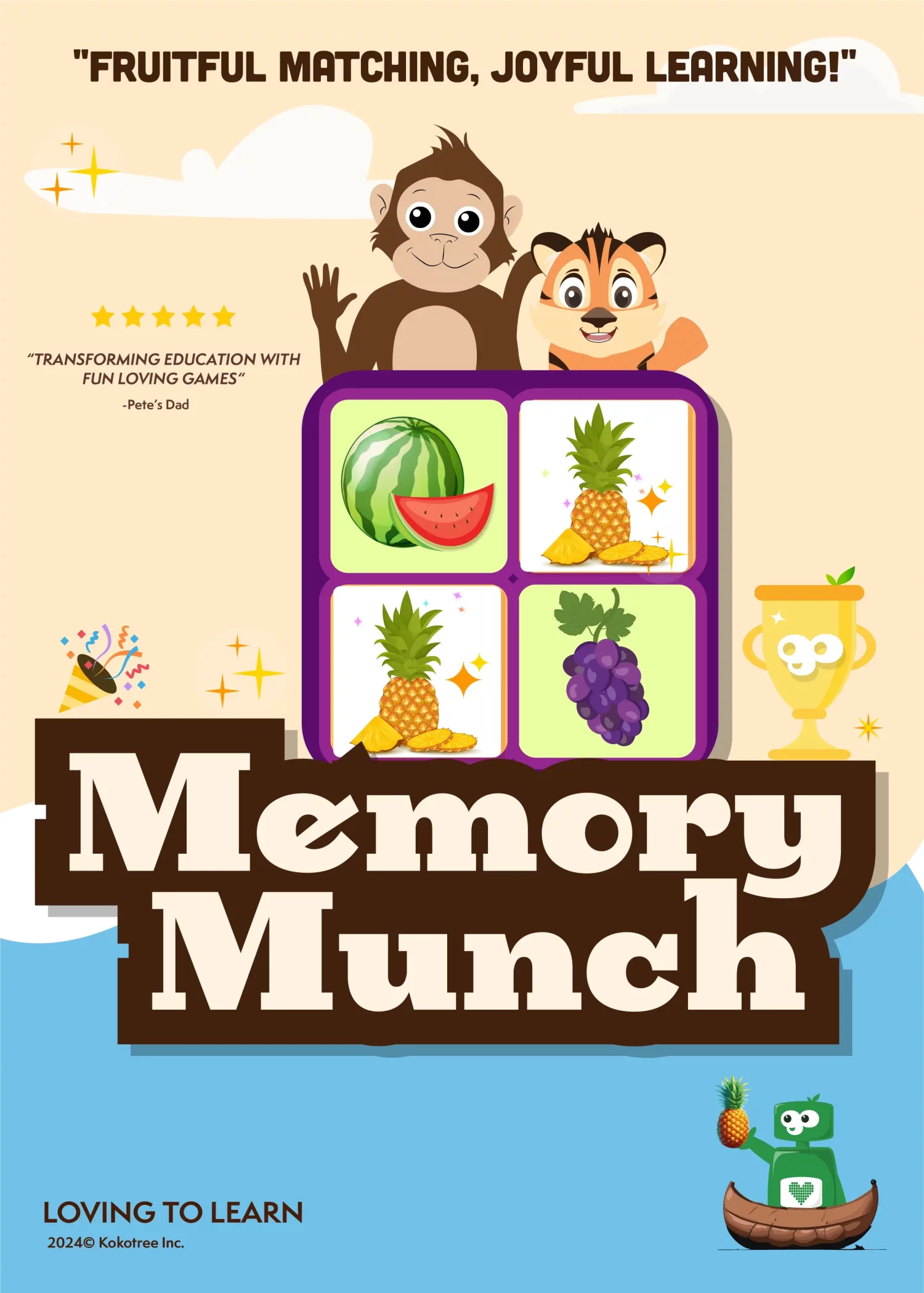
Your little learner flips fruit cards and hunts for matching pairs in this delightful brain-building game. They're strengthening visual memory, focus, and pattern recognition—skills that power everything from reading to math.
Interactive Game
Ages 2-5
Skill: Memory & Concentration
Your kid plays flip-and-match with colorful fruits. You get guilt-free screen time knowing they're learning.
Tap a card to reveal a juicy apple, banana, or strawberry hiding underneath. Remember where it is, then find its match! Cards flip back over if they don't match—challenging little minds to remember and try again.
What your child practices:
Every flip exercises working memory—the brain's "sticky note" that holds information while solving problems. Your child actively builds concentration stamina and learns to recognize visual patterns, skills that directly support reading and math readiness.
- Visual memory (remembering what they saw and where)
- Sustained attention and focus
- Pattern recognition and matching
- Strategic thinking and planning
- Self-regulation when cards don't match
They'll use these skills when:
- Finding their favorite cereal box on a grocery shelf
- Remembering where they put their shoes
- Recognizing letters and sight words while learning to read
- Following multi-step instructions at preschool
The Gameplay (what keeps them engaged)
Cards appear face-down in a grid. Tap to flip—a friendly fruit appears with a satisfying sound! Flip another card to find its match. Matched pairs disappear with cheerful celebration sounds and sparkles. Unmatched cards gently flip back, encouraging kids to try again without frustration. The game starts with fewer cards and gradually adds more as skills grow. Kids love the "I found it!" moment when they remember a card's location, making them eager to play again and again.
How It Teaches (the clever part)
- Immediate feedback: Matching pairs celebrate with happy sounds and animations. Non-matches flip back gently—no harsh buzzers, just a visual cue to keep trying.
- Progression: Starts with 4 cards (2 pairs) and gradually increases to larger grids as your child's memory strengthens.
- Repetition: Each game shuffles card positions, so kids practice the same memory skills with fresh challenges every time.
Learning trick: The brief delay before non-matching cards flip back gives children a crucial moment to actively encode both images into memory—turning a "wrong" answer into a learning opportunity.
Beyond the App: Reinforce the Learning
- Mealtime activity: "What's missing?" Place 3-4 fruits on the table, have your child close their eyes, remove one. "Which fruit did I take?" (Practices visual memory and attention to detail)
- Car/travel activity: "I spy something..." Describe a fruit by color and shape. "I spy something yellow and curved!" Let them guess, then switch roles. (Builds descriptive vocabulary and memory recall)
- Outdoor activity: "Nature match hunt" Collect pairs of matching leaves, rocks, or flowers. Lay them out and play a physical matching game. (Connects digital learning to real-world pattern recognition)
- Anytime activity: "Fruit basket memory" Show 3 fruits, cover them with a cloth. "Can you name all the fruits hiding?" Add more as they improve. (Strengthens working memory capacity)
Common Questions Parents Ask
- "Is a memory game really teaching anything, or just keeping them busy?" - Absolutely teaching! Memory games are used by educators worldwide because they build working memory—the cognitive skill that predicts reading comprehension and math success. Every flip is brain exercise.
- "How long until I see improvement in my child's memory?" - Most children show noticeable progress within 2-3 weeks of regular play. You might notice them remembering where toys are kept or recalling details from stories more easily.
- "What if my child gets frustrated when they can't find matches?" - That gentle challenge is actually beneficial! The game is designed with encouraging feedback. If frustration builds, try playing together and modeling how you remember card positions—"I think the apple was over here!"
What Your Child Will Learn
Prerequisites and Building Blocks
Children benefit most from Memory Munch when they can identify common fruits visually and understand the concept of "same" and "different." This game builds on basic matching activities and prepares children for more complex memory tasks. It fits perfectly after simple sorting games and before multi-step sequencing activities, creating a natural cognitive progression in the Budding Sprouts program.
Cognitive Development and Game Design
Memory Munch uses tap-to-flip mechanics ideal for developing fine motor control in ages 2-5. The game leverages the psychological spacing effect—brief delays between card reveals optimize memory encoding. Large, colorful fruit images accommodate developing visual processing, while the grid layout introduces spatial reasoning naturally. Touch interaction provides immediate sensory feedback essential for this developmental stage.
Alignment with Educational Standards
Memory Munch supports Head Start Early Learning Outcomes Framework domains including Approaches to Learning (attention, persistence) and Cognition (memory, reasoning). It aligns with kindergarten readiness indicators for following directions, sustaining attention, and recognizing patterns. Teachers expect entering kindergarteners to maintain focus for 10-15 minutes—this game builds that stamina progressively.
Extended Learning Opportunities
Pair Memory Munch with Kokotree videos about fruits and healthy eating to reinforce vocabulary. Extend learning with physical matching cards at home, sorting real fruits by color or size, or drawing favorite fruits from memory. These activities bridge digital and hands-on learning while reinforcing the same cognitive skills.
Game Mechanics Summary
- Tap cards to flip and reveal hidden fruit images
- Find and match identical fruit pairs from memory
- Matched pairs disappear with celebratory animations and sounds
- Unmatched cards flip back after a brief viewing window, encouraging memory encoding
Skill Development Progression
Initially, children may flip cards randomly, relying on luck. With practice, they begin deliberately remembering 1-2 card positions. Mastery shows when children systematically scan the grid before flipping, verbalize card locations ("The banana is in the corner!"), and complete games with minimal extra flips. Parents can watch for improved speed, fewer random guesses, and children applying memory strategies independently.
Working Memory and Cognitive Development Deep Dive
Working memory—the ability to hold and manipulate information temporarily—is one of the strongest predictors of academic success in early childhood. Research shows that working memory capacity at age 5 predicts reading and math achievement years later, even more reliably than IQ scores.
Memory Munch specifically targets visuospatial working memory, the cognitive system responsible for remembering what things look like and where they're located. This skill is foundational for letter recognition (remembering what "A" looks like), reading comprehension (holding story details while processing new information), and mathematical reasoning (visualizing number relationships).
For children ages 2-5, working memory is rapidly developing but limited—typically holding 2-3 items. Memory Munch respects this by starting with just 4 cards (2 pairs) and gradually increasing. This scaffolded approach keeps children in their "zone of proximal development," challenged enough to grow but not overwhelmed.
The game's design incorporates retrieval practice, a learning technique proven more effective than passive review. Each time children actively try to remember a card's location, they strengthen that memory trace. Even "failed" attempts benefit learning—the effort of retrieval, regardless of success, builds stronger neural pathways.
By kindergarten entry, children are expected to follow 2-3 step directions and remember classroom routines. Memory Munch builds exactly this capacity through play, preparing children for the cognitive demands of formal schooling while they simply enjoy finding matching fruits.