
What's Dora's Dreamy Adventure About?
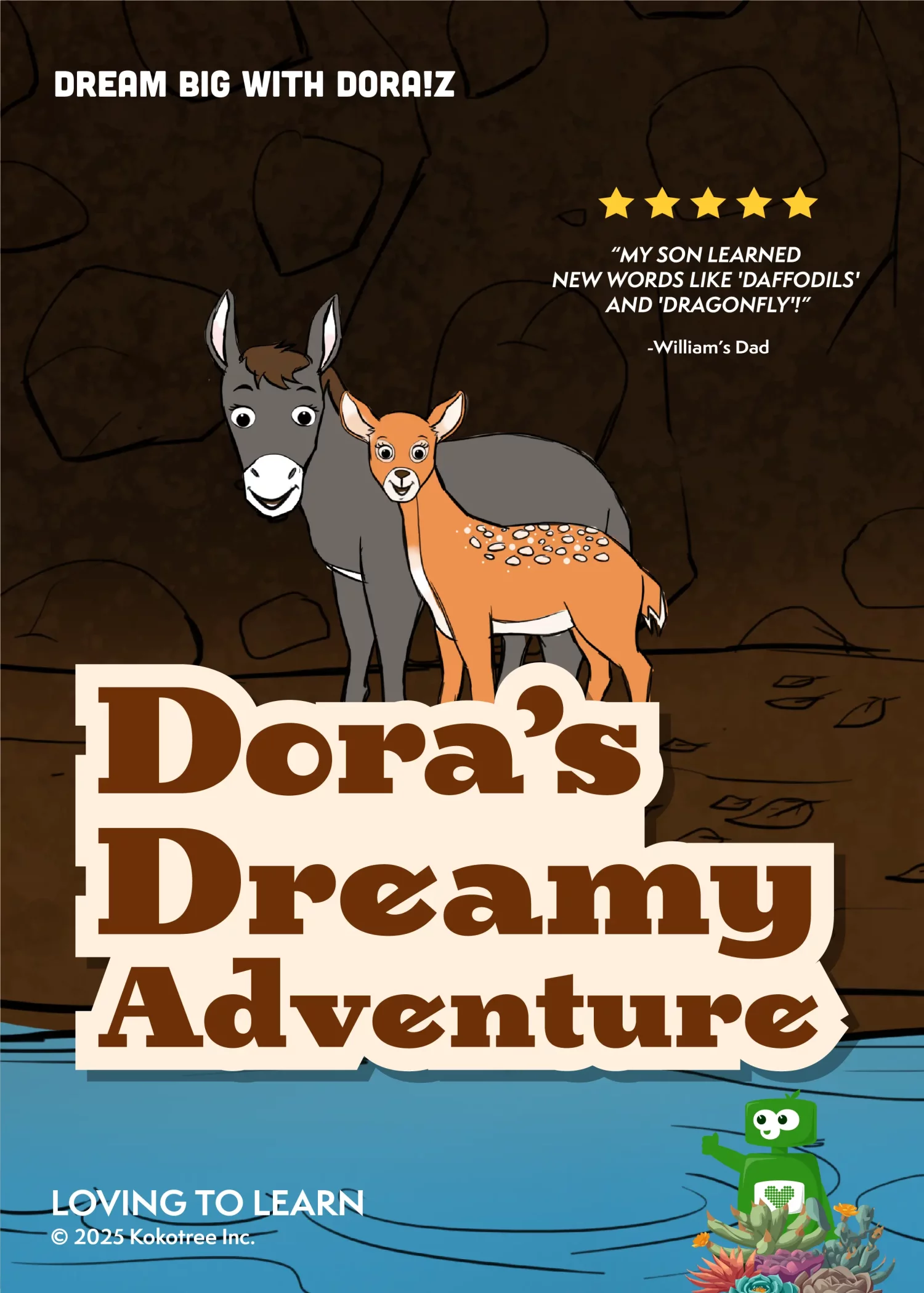
Join Dora the donkey as she explores a fantastical dreamworld filled with doors, dolphins, dinosaurs, and dancing daffodils! Your child will discover the letter D through an enchanting story that makes phonics memorable and fun.
4 minutes
Ages 2-5
Skill: Letter D recognition and phonics
Your kid watches Dora discover magical D-words in a dream adventure. You get 4 minutes to [finish that coffee/fold some laundry/take a breath].
Dora the donkey wakes from a mysterious dream about a red door deep in the forest. She and her friend Diana Deer venture through a dark den, push through the secret door, and discover a magical world bursting with D-words—dancing daffodils, dolphins offering drinks, ducklings swimming by, a diamond dragonfly, and even a dinosaur playing drums!
What your child learns:
This adventure is secretly a letter D immersion experience. Every scene introduces new D-words in context, helping your child connect the letter sound to real objects and animals they can visualize.
- Recognizes the letter D and its sound in multiple words
- Builds vocabulary with 20+ D-words (door, den, daffodils, dolphin, duck, dinosaur, drums, dog, dates)
- Practices alliteration awareness ("dancing daffodils," "dull and dark")
- Develops narrative comprehension through story sequencing
- Strengthens listening skills for beginning sounds
They'll use these skills when:
- Spotting the letter D on signs, books, and cereal boxes at the store
- Playing "I spy something that starts with D" during car rides
- Recognizing their friends' names that start with D
- Writing or tracing the letter D in preschool activities
The Story (what keeps them watching)
Dora the donkey has the coolest dream ever—she sees a mysterious red door! Her brave friend Diana Deer convinces her to find it for real. They trek through a dark, dense forest, squeeze through a spooky den, and push open the magical door. What's inside? A wonderland! Dancing flowers, friendly dolphins, adorable ducklings, a sparkly dragonfly, and—wait for it—a dinosaur playing drums! Just when things get extra wild, Dora's mom wakes her up. It was all a dream... or was it?
How We Teach It (the clever part)
First 1.5 minutes: The letter D is introduced through character names (Dora, Diana, Deer, Donkey) and setting words (dream, door, dark, dense, den). Kids hear the D-sound repeatedly in natural storytelling.
Minutes 1.5-3: D-vocabulary explodes as Dora discovers the magical world—daffodils, dolphin, drink, duck, ducklings, diamond, dragonfly, drums, dinosaur, dog, dates, dinner. Each word appears with clear visuals.
Final minute: The story wraps with "dream" and "darling," reinforcing that everything circled back to D-words. Miss Meera closes the lesson, cementing the experience.
Teaching trick: The video uses alliterative phrases like "dull and dark den" and "dancing daffodils" so children hear multiple D-sounds clustered together—this repetition helps the letter sound stick in memory far better than isolated words.
After Watching: Quick Wins to Reinforce Learning
Mealtime activity: "Can you find something on your plate that starts with D?" (Think: drink, dip, or describe dinner items—practices connecting the D-sound to real objects)
Car/travel activity: "Let's spot things outside that start with D—like dogs, doors, or dirt!" (Builds environmental letter awareness and keeps little eyes busy)
Bedtime activity: "What would YOU see if you walked through a magic door? Let's only pick D-things!" (Encourages creative thinking while reinforcing the letter sound)
Anytime activity: Do a silly "D dance" together—stomp like a dinosaur, waddle like a duck, or sway like a daffodil! (Kinesthetic learning locks in vocabulary through movement)
When Kids Get Stuck. And How to Help.
"My child can't hear the D-sound at the beginning of words." - Totally normal! Exaggerate the sound when you say D-words: "Duh-duh-DINOSAUR!" Point to your mouth so they can see how the tongue touches the roof of your mouth.
"They loved the story but don't remember any D-words." - That's okay—learning is layered! Watch it again and pause to point out D-words together. Repetition is how little brains build connections.
"This seems too easy/hard for my child." - This video works on multiple levels. Younger kids absorb the sounds through repetition; older kids can try counting D-words or predicting what comes next. Meet them where they are!
What Your Child Will Learn
Prerequisites and Building Blocks
This video is ideal for children who have basic story comprehension and can sit for short narratives. It builds beautifully on general alphabet exposure—children don't need to know the letter D yet, but familiarity with the concept of "letters making sounds" helps. This episode fits into the early phonics progression, preparing children for letter-sound correspondence activities and eventually blending sounds to read simple words.
Cognitive Development and Teaching Methodology
The immersive storytelling approach leverages narrative transportation—children are so engaged in the adventure that learning happens almost unconsciously. The video addresses visual learners through vivid imagery (dinosaurs, daffodils), auditory learners through repeated D-sounds and alliteration, and kinesthetic connections by inspiring movement (dancing, drumming). This multi-sensory saturation aligns with how 2-5 year olds naturally process new information.
Alignment with Educational Standards
This video supports Common Core Foundational Skills for Reading (RF.K.1d, RF.K.2d) focusing on letter recognition and isolating initial sounds. It aligns with Head Start Early Learning Outcomes for phonological awareness and vocabulary development. Kindergarten teachers expect incoming students to recognize most letters and their sounds—this video builds exactly that foundation through engaging, repeated exposure.
Extended Learning Opportunities
Pair this video with letter D tracing worksheets or playdough letter-forming activities. Explore related Kokotree videos featuring other letters to build the complete alphabet. Extend learning with a "D scavenger hunt" around your home, or create a simple "D collage" by cutting pictures from magazines. The Kokotree app offers interactive letter games that reinforce these same phonics concepts.
Transcript Highlights
- "I'll tell you a story about a donkey named Dora" — Immediately establishes the target letter through character introduction
- "They found themselves in a dense forest where they saw a den. The den was dull and dark." — Clusters multiple D-words in alliterative phrases for sound reinforcement
- "Dora and Diana saw dancing daffodils" — Memorable imagery paired with alliteration creates sticky vocabulary
- "A dinosaur was the one playing the drums!" — Peak excitement moment tied to two strong D-words
Character Development and Story Arc
Dora demonstrates curiosity and courage—she's initially frightened by her dream but chooses to explore it anyway. Diana Deer models supportive friendship, encouraging Dora with enthusiasm ("Sounds like it could be quite the discovery!"). Together, they show persistence ("We can't go back now") and wonder at new experiences. These behaviors model growth mindset for young viewers: the unknown can be exciting, not just scary.
Phonics and Letter Recognition Deep Dive
Letter D is one of the earlier consonants children typically master because its sound is distinct and its formation is visually simple. This video employs a research-backed technique called "phoneme flooding"—surrounding children with a single letter sound across varied vocabulary so the brain naturally extracts the pattern.
The video introduces approximately 25 D-words across 4 minutes, including nouns (door, den, daffodils, dolphin, duck, ducklings, dragonfly, dinosaur, dog, dates, dinner, drums, diamond), verbs (danced, drove), adjectives (dark, dense, dull, dingy, dry, dreamlike), and character names (Dora, Diana, Deer, Donkey). This variety is crucial—children learn that the D-sound appears in all types of words, not just object names.
Alliterative phrases like "dull and dark" and "dancing daffodils" create phonological awareness by clustering the target sound. Research shows alliteration helps children isolate beginning sounds, a critical pre-reading skill. The narrative structure ensures children stay engaged long enough for repetition to work its magic—they're not drilling flashcards, they're following a story where D-words happen to appear constantly.
The dream framework is particularly clever: it gives permission for fantastical D-words (dinosaur, diamond dragonfly) alongside everyday ones (dog, door), maximizing vocabulary exposure while keeping the story cohesive.