
What's The Kind King About?
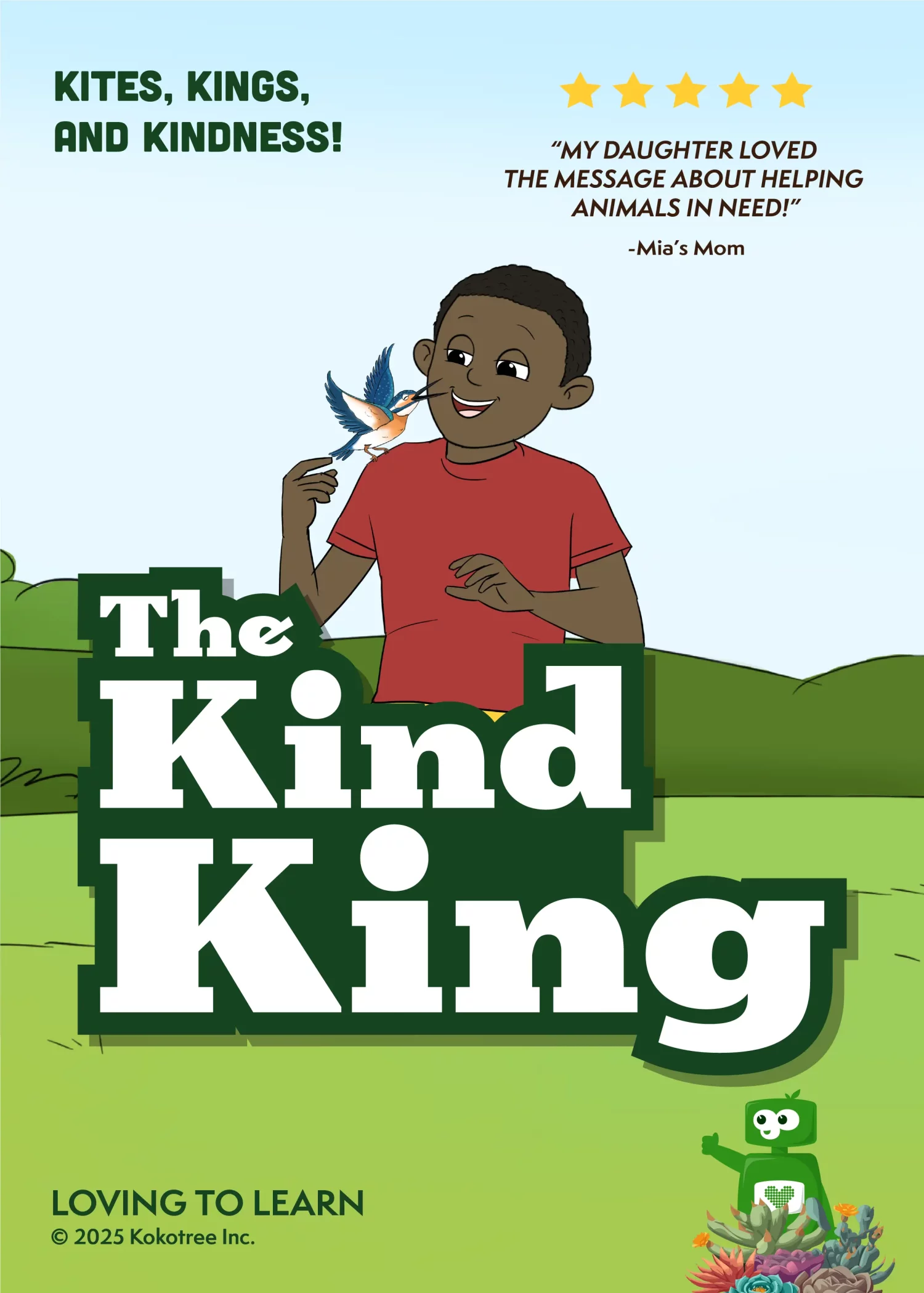
Your little one joins Miss Meera for a cozy storytime that's packed with K words—from kites to kingfishers to kindness itself! They'll practice recognizing the K sound while learning that helping others feels wonderful.
4 minutes
Ages 3-6
Skill: Letter K recognition and phonics
Your kid watches a story about a boy who helps an injured bird. You get 4 minutes to [finish that cup of coffee while it's still warm].
The video opens with the Kokotree animal friends working together to rescue a kite stuck in a tree. Then Miss Meera gathers everyone for a story about King, a kind kid from Kenya who helps a kingfisher bird that gets hurt by his kite string. The story unfolds with gentle pacing and lots of K words woven naturally throughout.
What your child learns:
This video introduces the letter K through meaningful repetition in context. Your child hears K words like kite, king, kingfisher, kookaburra, Kenya, kiwi, kind, and kindled—all within a memorable story that makes the sound stick.
- Recognizes the letter K sound at the beginning of words
- Identifies multiple K words in context (kite, king, kookaburra, kiwi)
- Understands that kindness means helping others when they're hurt
- Practices listening comprehension through storytelling
- Connects letter sounds to real objects and actions
They'll use these skills when:
- Spotting K words on signs, books, and food packages at the store
- Sounding out new words during reading time
- Deciding to help a friend or sibling who needs assistance
- Playing word games and rhyming activities
The Story (what keeps them watching)
The episode starts with teamwork! Gina Giraffe uses her long neck to rescue a kite stuck in a tree while all her friends cheer her on. Then Miss Meera shares a story about King, a boy flying his kite when—oh no!—a kingfisher bird accidentally gets scraped by the kite string. King gently cares for the injured bird overnight, and by morning, the kingfisher is ready to fly again! The bird and his kookaburra friend wave goodbye with their wings. It's a gentle reminder that small acts of kindness matter—and it's absolutely packed with K sounds!
How We Teach It (the clever part)
- First 1 minute: The Kokotree friends model teamwork and problem-solving while introducing the word "kite"—setting up the K theme naturally through play.
- Minutes 1-3: Miss Meera's story immerses children in K words (king, kingfisher, kookaburra, Kenya, kiwi, kindled, kind) repeated in context so the sound becomes familiar without feeling like a drill.
- Final 1 minute: The story wraps up with the word "kindness" emphasized, and Miss Meera invites children to imagine flying a kite themselves—connecting learning to real experience.
Teaching trick: The video uses alliteration naturally within the story ("King was a kind kid") so children hear the K sound multiple times in memorable phrases rather than isolated word lists.
After Watching: Quick Wins to Reinforce Learning
- Mealtime activity: "Can you find something on your plate that starts with K?" (Think ketchup, kiwi, or even pretend the carrots are for a kangaroo! Practices connecting the K sound to everyday objects.)
- Car/travel activity: "Let's spot things that start with K—like that kid on the sidewalk or keys in my hand!" (Builds phonemic awareness through real-world observation.)
- Bedtime activity: "What's one kind thing you did today?" (Reinforces both the K sound and the social-emotional lesson about helping others.)
- Anytime activity: If you have a kite, fly it together! No kite? Make a simple paper one and toss it gently. Say "K-k-kite!" as it floats. (Kinesthetic learning connects the sound to joyful movement.)
When Kids Get Stuck. And How to Help.
- "My child mixes up K and C sounds" - That's completely normal! K and C often make the same sound, which is actually confusing in English. For now, celebrate when they hear the sound correctly—letter names can come later.
- "They can't remember all the K words from the story" - No need to memorize! Hearing words in context builds recognition over time. Try asking "What bird was in the story?" rather than quizzing on all K words.
- "The story seems too long for my toddler's attention" - Younger viewers might drift during the story portion. That's okay! Even partial exposure to the K sounds builds familiarity. Try watching just the beginning teamwork scene with very young ones.
What Your Child Will Learn
Prerequisites and Building Blocks
This video works best for children who have basic listening skills and can follow a simple narrative. It builds on earlier letter recognition concepts and pairs well with other phonics-focused episodes in the Budding Sprouts program. No prior knowledge of the letter K is required—the story format introduces the sound naturally. Children who have watched other letter-focused episodes will recognize the teaching pattern of embedding target sounds within engaging stories.
Cognitive Development and Teaching Methodology
The embedded phonics approach aligns with how 3-6 year olds naturally acquire language—through meaningful context rather than isolated drills. The story format engages narrative thinking while the repeated K words create phonemic awareness through natural exposure. Visual storytelling supports visual learners, Miss Meera's clear narration helps auditory processors, and the opening kite-rescue scene provides kinesthetic connection. This multi-modal approach ensures different learning styles can access the content.
Alignment with Educational Standards
This episode supports Common Core Foundational Skills for Kindergarten (RF.K.2, RF.K.3) focusing on phonemic awareness and phonics. The letter K recognition aligns with typical pre-K curriculum goals where children identify beginning sounds in words. Head Start Early Learning Outcomes Framework connections include literacy knowledge and social-emotional development. The kindness theme supports kindergarten readiness indicators for prosocial behavior that teachers look for in incoming students.
Extended Learning Opportunities
Pair this video with letter K tracing worksheets or the Kokotree letter recognition games in the app. Create a "K collection" by gathering household items starting with K (keys, toy koala, kitchen items). Read picture books featuring kings, kites, or kangaroos to extend the K exposure. The kindness theme can extend to a simple "kindness jar" where children add a cotton ball each time they help someone—making abstract concepts concrete and visual.
Transcript Highlights
- "Two birds, a kingfisher and a kookaburra were flying high through the air" — Natural introduction of two K words in descriptive context
- "King tendered to the injured blue bird. Kookaburra flew down and perched itself on a kiwi tree" — Multiple K words modeled in a caring scenario
- "His heart kindled with joy upon finding the Kingfisher flapping his wings. King was a kind kid." — Alliterative phrase reinforcing the K sound memorably
- "The birds waved back with their wings to thank him for his kindness" — Closing emphasis on the key vocabulary word
Character Development and Story Arc
The Kokotree animal friends demonstrate excellent collaborative problem-solving in the opening scene—Maddy Monkey tries despite difficulty, Gina Giraffe offers her unique strength, and everyone encourages each other. This models growth mindset and teamwork. Within Miss Meera's story, King demonstrates empathy and follow-through by caring for the kingfisher overnight rather than giving up. The birds modeling gratitude (waving their wings) shows children that kindness creates positive connections. Miss Meera praises the class's teamwork, reinforcing that helping others is noticed and valued.
Phonics and Early Literacy Deep Dive
The letter K presents unique challenges in English phonics instruction because it shares its primary sound (/k/) with the letter C and the digraph CK. This video wisely focuses on K at the beginning of words where it's most consistent, using high-frequency vocabulary that children encounter regularly: kite, king, kid, kind.
The embedded phonics methodology used here—weaving target sounds into meaningful narrative—reflects research showing that contextual learning produces stronger retention than isolated phoneme drilling for this age group. When children hear "King was a kind kid," they're processing the K sound three times within a memorable, emotionally resonant sentence. This creates what literacy researchers call "phonemic anchoring"—connecting sounds to meaning and emotion.
The selection of words is developmentally strategic. "Kite" connects to the hands-on opening scene. "King" and "kid" are high-utility words children encounter in books. "Kingfisher" and "kookaburra" introduce vocabulary expansion while maintaining the K focus. "Kiwi" adds a concrete, familiar object. "Kindled" stretches vocabulary for older viewers while younger ones simply absorb the sound pattern.
For children progressing toward reading readiness, this exposure builds the phonemic awareness foundation necessary for decoding. They're learning that the /k/ sound at the beginning of words often corresponds to the letter K—a crucial insight for future blending and segmenting work. The story format also builds narrative comprehension skills that support reading fluency later, as children learn to follow character arcs and predict outcomes.