
What's Early Reader: Exploring Single Words About?
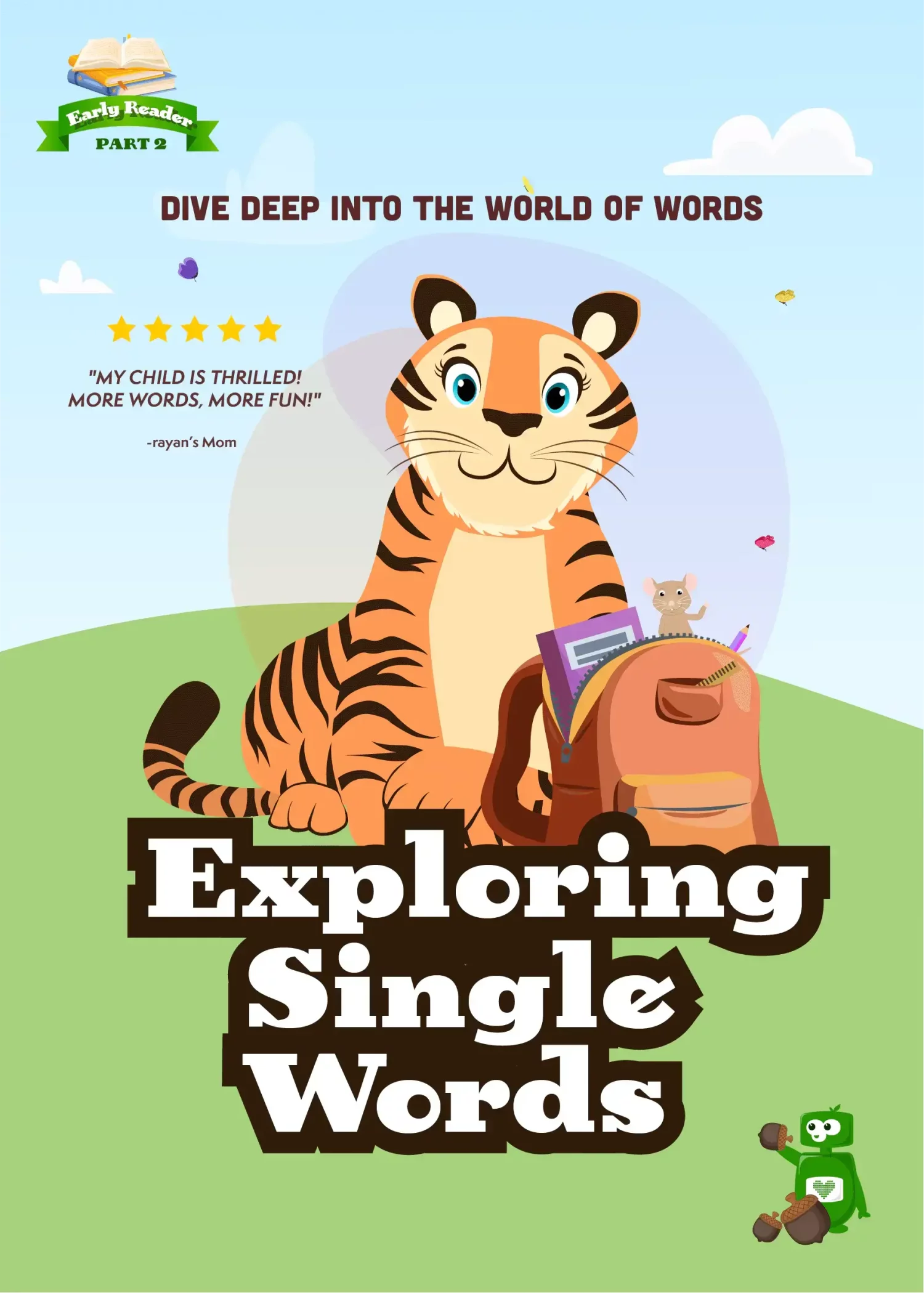
Your little one follows along with Meera in a beautiful jungle setting, practicing 24 simple words through fun repetition. After watching, they'll confidently recognize and say common three-letter words they'll see everywhere!
9 minutes
Ages 3-6
Skill: Reading simple CVC (consonant-vowel-consonant) words
Your kid watches Meera teach words in a peaceful jungle scene. You get 9 minutes to finish that cup of coffee while it's still warm.
Meera sits in a colorful jungle with butterflies floating by and friendly caterpillars wiggling around. She introduces simple words one at a time—map, nap, hat, bag—with clear pauses so your child can repeat each word out loud. Birds chirp softly in the background as your little one practices becoming a reader.
What your child learns:
This video builds essential phonics skills by introducing 24 CVC words organized by vowel sounds. Your child practices the connection between letters, sounds, and complete words—the magic moment when reading "clicks."
- Recognizing and reading three-letter CVC words
- Identifying short vowel sounds (a, i, o, u, e)
- Building confidence through repetition and practice
- Understanding that letters combine to make words with meaning
- Developing clear pronunciation and speaking skills
They'll use these skills when:
- Spotting familiar words on signs, books, and food packages at the store
- Sounding out simple words in their favorite picture books
- Playing word games and puzzles with friends or siblings
- Writing their first words and short messages
The Story (what keeps them watching)
Meera welcomes young learners to Part 2 of the Early Reader Program from her peaceful jungle home. Surrounded by fluttering butterflies and friendly critters, she guides children through six sets of rhyming words—starting with "map, nap, hat, bag" and building through different vowel sounds. Each word appears on screen while Meera speaks it clearly, then pauses so kids can say it back. She celebrates their progress with encouraging phrases like "Fantastic work!" and "You're becoming a reading expert!" The session ends with a reminder to practice every day.
How We Teach It (the clever part)
- First 2 minutes: Meera introduces herself and explains the simple repeat-after-me format, setting kids up for success with clear expectations.
- Minutes 2-7: Children practice 24 words grouped by vowel sounds (short a, i, o, u, e), with built-in pauses for active participation and encouragement between each set.
- Final 2 minutes: Meera celebrates their progress, reinforces that reading is a valuable skill, and motivates continued daily practice.
Teaching trick: Words are grouped by rhyming patterns (map/nap, big/dig, mop/top), helping children notice how changing just one letter creates a new word—a foundational phonics insight!
After Watching: Quick Wins to Reinforce Learning
- Mealtime activity: "Can you find something on the table that rhymes with 'cup'?" Point to items and practice rhyming words from the video like sun/fun or hat/bat. (Reinforces word families and rhyming patterns)
- Car/travel activity: "I spy something that starts with the same sound as 'map'!" Take turns finding objects that share beginning sounds with words from the lesson. (Practices initial consonant recognition)
- Bedtime activity: "Let's think of words that rhyme with 'bed' before we sleep!" Red, fed, said—see how many you can name together. (Builds word family awareness in a cozy setting)
- Anytime activity: Write 3-4 words from the video on sticky notes and hide them around the room. "Can you find and read all the hidden words?" (Turns reading practice into a treasure hunt)
When Kids Get Stuck. And How to Help.
- "My child just repeats without really reading the word" - Totally normal at this stage! Point to each letter as you sound it out together: "m-a-p... map!" The connection between letters and sounds builds gradually with practice.
- "They mix up similar words like 'big' and 'bag'" - Great noticing! This means they're paying attention to the letters. Emphasize the middle vowel sound and compare: "big has an 'i' sound, bag has an 'a' sound. Hear the difference?"
- "Some words seem too hard for my child" - Start with just one word family (like the -at words: hat, bat, cat). Mastering a few words builds confidence before tackling the full list. There's no rush!
What Your Child Will Learn
Prerequisites and Building Blocks
Children benefit most from this video after developing letter recognition and basic phonemic awareness—understanding that words are made of individual sounds. This is Part 2 of Kokotree's Early Reader Program, building on initial letter-sound introduction. It bridges the gap between knowing letters and reading complete words, preparing children for blending longer words and simple sentences in future lessons.
Cognitive Development and Teaching Methodology
The repeat-after-me format leverages echoic memory and active recall, proven techniques for language acquisition in early childhood. Visual word display paired with auditory modeling addresses both visual and auditory learners. The built-in pauses engage kinesthetic learners through verbal participation. Grouping words by rhyme patterns supports pattern recognition, a key cognitive skill developing rapidly at ages 3-6.
Alignment with Educational Standards
This video aligns with Common Core Foundational Skills RF.K.2 (demonstrating understanding of spoken words and sounds) and RF.K.3 (knowing letter-sound correspondences). It supports kindergarten readiness benchmarks for phonics and word recognition. Teachers expect entering kindergarteners to recognize simple CVC words—this video builds exactly that competency through structured practice.
Extended Learning Opportunities
Pair this video with Kokotree's printable CVC word cards for hands-on matching games. The app's "Word Builder" interactive game reinforces these same word families. Extend learning with magnetic letters on the refrigerator, building words from the video. Create a simple word wall in your child's room featuring their favorite words from each lesson.
Transcript Highlights
- "I'm going to show you some words with their letters and sounds. Just repeat after me. Got it? Great!" — Clear, simple instructions that set expectations
- "Map. Nap. Hat. Bag." — Words grouped by rhyme pattern for pattern recognition
- "Fantastic work! Reading is such a great skill to have." — Positive reinforcement connecting effort to valuable outcomes
- "You're becoming a reading expert! Isn't it fun? Make sure you practice every day." — Growth mindset language and habit-building encouragement
Character Development and Story Arc
Meera models the role of a patient, encouraging teacher. She celebrates effort ("Fantastic work!") rather than perfection, demonstrating growth mindset principles. Her calm jungle setting and gentle pacing show that learning happens best in a relaxed, supportive environment. By ending with "practice every day," Meera models the persistence and routine that successful learners develop.
Phonics and Early Literacy Deep Dive
CVC (consonant-vowel-consonant) words are the building blocks of English reading instruction. This video strategically introduces 24 CVC words organized by their medial vowel sound—a technique called "word family" instruction that research consistently shows accelerates reading development.
When children learn "map, nap, hat, bag" together, they unconsciously absorb the short 'a' sound pattern. This phonological awareness—recognizing that words sharing sounds often share spelling patterns—is a powerful predictor of reading success. The video progresses through all five short vowel sounds (a, i, o, u, e), giving children a complete foundation.
The repeat-after-me methodology serves multiple purposes: it builds phonological memory, develops clear articulation, and creates active engagement rather than passive viewing. The 2-second pauses are carefully designed based on research showing young children need processing time to formulate verbal responses.
Rhyming word groups (mop/top/dot/cot) also prepare children for "onset-rime" blending—a decoding strategy where readers recognize the word ending (-op) and attach different beginning sounds. This skill transfers directly to independent reading, where children encounter unfamiliar words and need strategies to decode them.
By framing reading as "such a great skill to have" and "fun," Meera builds intrinsic motivation—children who believe reading is enjoyable and valuable practice more frequently and develop stronger literacy skills long-term.