
What's Square & Red About?
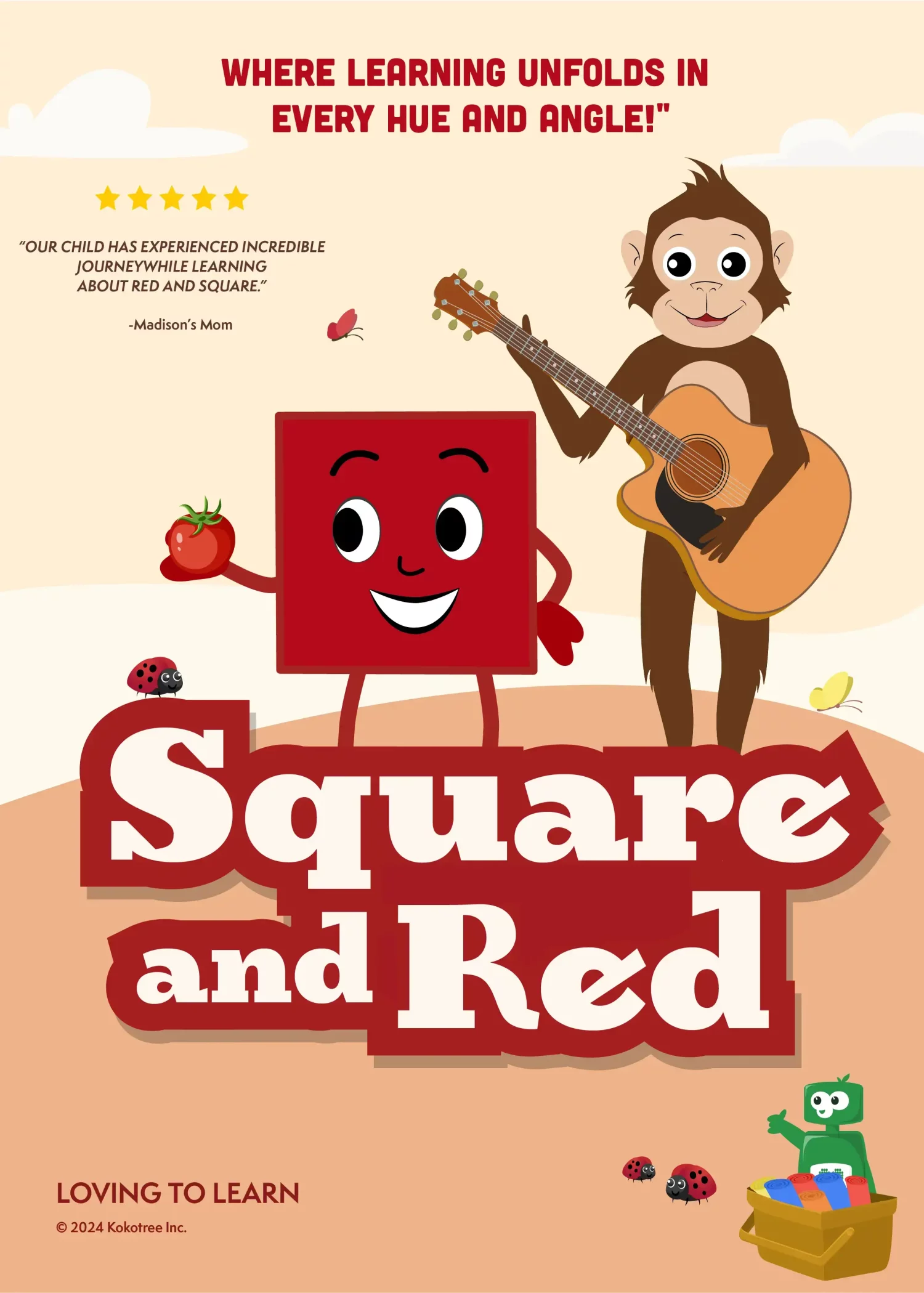
Your little one joins a cheerful lakeside picnic where squares pop up in the most delicious places—bread slices, cheese, napkins, and even a singing square character! Then it's time to explore nature and discover all the red things hiding in plain sight.
8 minutes
Ages 1-6
Skill: Shape recognition & color identification
Your kid watches animal friends make sandwiches and explore nature. You get 8 minutes to enjoy your coffee while it's still warm.
Miss Meera guides her class through a hands-on sandwich-making activity where every ingredient happens to be square-shaped. The friendly animals notice squares in their lunch boxes, bread, cheese, and napkins. Then a cheerful Red Square character bounces in with a catchy song! After snack time, the class goes on a red color hunt, spotting tomatoes, mushrooms, roses, apples, and autumn leaves.
What your child learns:
This video builds foundational geometry skills by helping children identify squares through their defining feature: four equal sides. The color exploration segment strengthens visual discrimination as kids learn to categorize objects by the color red.
- Identifies squares by counting four equal sides
- Recognizes the color red in nature and everyday objects
- Connects abstract shapes to real-world items (bread, napkins, lunch boxes)
- Practices observation skills through guided discovery
- Follows simple multi-step instructions
They'll use these skills when:
- Setting the table and noticing square napkins, placemats, or coasters
- Eating snacks and identifying square crackers, cheese slices, or sandwich bread
- Playing with blocks and sorting by shape
- Walking outside and spotting red flowers, cars, or signs
The Story (what keeps them watching)
Miss Meera takes her animal students—Tiki Tiger, Ruby Rabbit, Eddie Elephant, Maddy Monkey, Bobby Bear, Gina Giraffe, and Ronnie Rhino—on a peaceful lakeside picnic. When everyone pulls out their mats, Miss Meera notices they're all the same shape. Squares! The class makes yummy sandwiches using square bread, square cheese, and square napkins. A bouncy Red Square character even drops by to sing about four equal sides! After lunch, Eddie spots the red tomatoes and suggests a color hunt. The friends explore nature together, finding red mushrooms, roses, apples, strawberries, autumn leaves, and even Miss Meera's cozy scarf.
How We Teach It (the clever part)
- First 3 minutes: Miss Meera introduces squares naturally through the picnic mats, highlighting the four equal sides. Kids see the shape in familiar objects like Tiki's lunch box and Maddy's bread slice.
- Minutes 3-5: The Red Square song reinforces the concept with catchy lyrics and visual examples. Children follow along as the class builds sandwiches step-by-step, seeing squares in napkins and cheese.
- Final 3 minutes: The focus shifts to color red through Eddie's curiosity. A lively song names red objects in nature while showing each one on screen, ending with Gina spotting Miss Meera's red scarf.
Teaching trick: The video uses "discovery moments" where characters notice shapes and colors themselves, modeling the observation skills kids should practice. When Bobby says "This napkin is also a square!" children learn to make those connections too.
After Watching: Quick Wins to Reinforce Learning
Mealtime activity: "Can you find anything square on your plate?" Hand them a square cracker or cheese slice and count the four sides together. They're practicing shape identification with something they can touch and eat!
Car/travel activity: "Let's play the red game—who can spot something red first?" Take turns pointing out red cars, signs, or flowers you pass. This builds observation skills and color vocabulary.
Bedtime activity: "What square things did we see today?" Recap the day by remembering square books, windows, or pillows in their room. This strengthens memory and shape recognition.
Anytime activity: "Can you make a square with your fingers?" Use pointer fingers and thumbs to form a square shape together. Touch each side and count to four—instant geometry practice with zero supplies!
When Kids Get Stuck. And How to Help.
"My child keeps calling rectangles squares." Totally normal! Both have four sides, so it's actually smart pattern recognition. Gently show how squares have four EQUAL sides by measuring with your finger—"See? This side is the same as this side."
"She can't find squares on her own yet." Finding shapes in the real world is harder than identifying them on a screen. Start by pointing to a square and asking "Is this a square?" Yes/no questions build confidence before "find the square" challenges.
"He mixes up red with orange." Color boundaries are genuinely tricky—red and orange sit right next to each other! Compare a clearly red object (like a tomato) with an orange one (like a carrot) side by side. The contrast helps their brain build separate categories.
What Your Child Will Learn
Prerequisites and Building Blocks
Children benefit from basic exposure to simple shapes and primary colors before this video, though no mastery is required. This episode builds on foundational visual discrimination skills—the ability to notice differences and similarities between objects. It pairs well with other Kokotree shape videos (circles, triangles) and color episodes, creating a comprehensive early geometry and color recognition foundation. The sandwich-making sequence also reinforces following sequential instructions, a key pre-academic skill.
Cognitive Development and Teaching Methodology
This video leverages concrete-to-abstract learning, perfect for preoperational stage development (ages 2-7). Children first see real objects (bread, napkins), then learn the abstract label "square." The multi-sensory approach addresses diverse learning styles: visual learners see highlighted sides, auditory learners hear the catchy songs, and the cooking activity engages kinesthetic imagination. Repetition through varied examples (mats, lunch box, bread, cheese, napkins) builds neural pathways without feeling repetitive.
Alignment with Educational Standards
This video addresses multiple kindergarten readiness indicators including shape recognition (CCSS.Math.K.G.A.2—correctly naming shapes regardless of size or orientation) and color identification. The observation prompts align with early science standards emphasizing descriptive skills. Following multi-step sandwich instructions supports listening comprehension benchmarks. Teachers expect entering kindergarteners to identify basic shapes and primary colors—this video builds exactly those competencies.
Extended Learning Opportunities
Pair this video with printable shape sorting worksheets or a "square hunt" checklist for your home. The Kokotree app includes shape-matching games that reinforce square recognition through interactive play. Extend learning by making real square sandwiches together, or create a "red collection" by gathering safe red objects from around the house. Drawing squares with sidewalk chalk or finger paint adds tactile reinforcement.
Transcript Highlights
- Teaching the defining feature: "Can you observe and share what features make squares special?" followed by "Four equal sides make a square."
- Real-world connection: "It is all the shape of the front window of my house." (Maddy connecting squares to familiar objects)
- Reinforcement through song: "Square square my name is square, I have four sides be aware"
- Color discovery prompt: "Do you notice what color the tomatoes are, Eddie?" (Guiding observation rather than telling)
Character Development and Story Arc
The characters model excellent learning behaviors throughout. Maddy demonstrates making real-world connections (comparing squares to his window). Eddie shows curiosity by asking to explore for more red objects. Bobby practices confirming his observations ("This napkin is also a square!"). Gina exhibits careful observation by noticing Miss Meera's scarf when others had stopped looking. Miss Meera models positive reinforcement, celebrating each discovery with specific praise like "That is such an acute observation, Eddie."
Shape Recognition and Color Learning: A Deep Dive into Early Mathematical and Scientific Thinking
Shape recognition is one of the earliest forms of mathematical thinking, and this video approaches it with developmental precision. By age 3-4, children typically move from simply matching identical shapes to identifying shapes in varied contexts—exactly what this episode practices. The progression from picnic mats (obvious squares) to bread slices to cheese (squares in unexpected places) scaffolds this skill beautifully.
The emphasis on "four equal sides" teaches children to identify shapes by their properties rather than just visual matching. This attribute-based thinking is foundational for later geometry. When Maddy compares the square to his window, he's demonstrating spatial reasoning—understanding that the same shape appears at different sizes and orientations.
Color identification, while seemingly simple, involves complex visual processing. The brain must categorize continuous light wavelengths into discrete categories (red vs. orange vs. pink). This video supports this development by showing multiple examples of red in varied contexts: natural objects (tomatoes, mushrooms, roses, apples, strawberries, autumn leaves), animals (beetle), and manufactured items (Miss Meera's scarf). This variety helps children build a robust mental category for "red" that transfers beyond the specific examples shown.
The song format serves a specific cognitive purpose: musical memory is processed differently than spoken memory, creating additional neural pathways for recall. Children who struggle to remember "four equal sides" may easily recall "I have four sides be aware"—and both lead to the same understanding.
The observation-based approach ("Can you find...") rather than direct instruction ("This is...") builds scientific thinking habits. Children learn to look carefully, notice patterns, and categorize—skills that extend far beyond shapes and colors into all future STEAM learning.