
What's Happy and Sad About?
Your little one joins Miss Elizabeth's classroom to explore big feelings through music, movement, and meaningful conversation! They'll learn to recognize happy and sad emotions—and discover that sharing can transform how we feel.
7 minutes
Ages 1-6
Skill: Recognizing and expressing basic emotions
Your kid watches friendly animals sing about feelings and play emotion games. You get 7 minutes to [enjoy your coffee in peace].
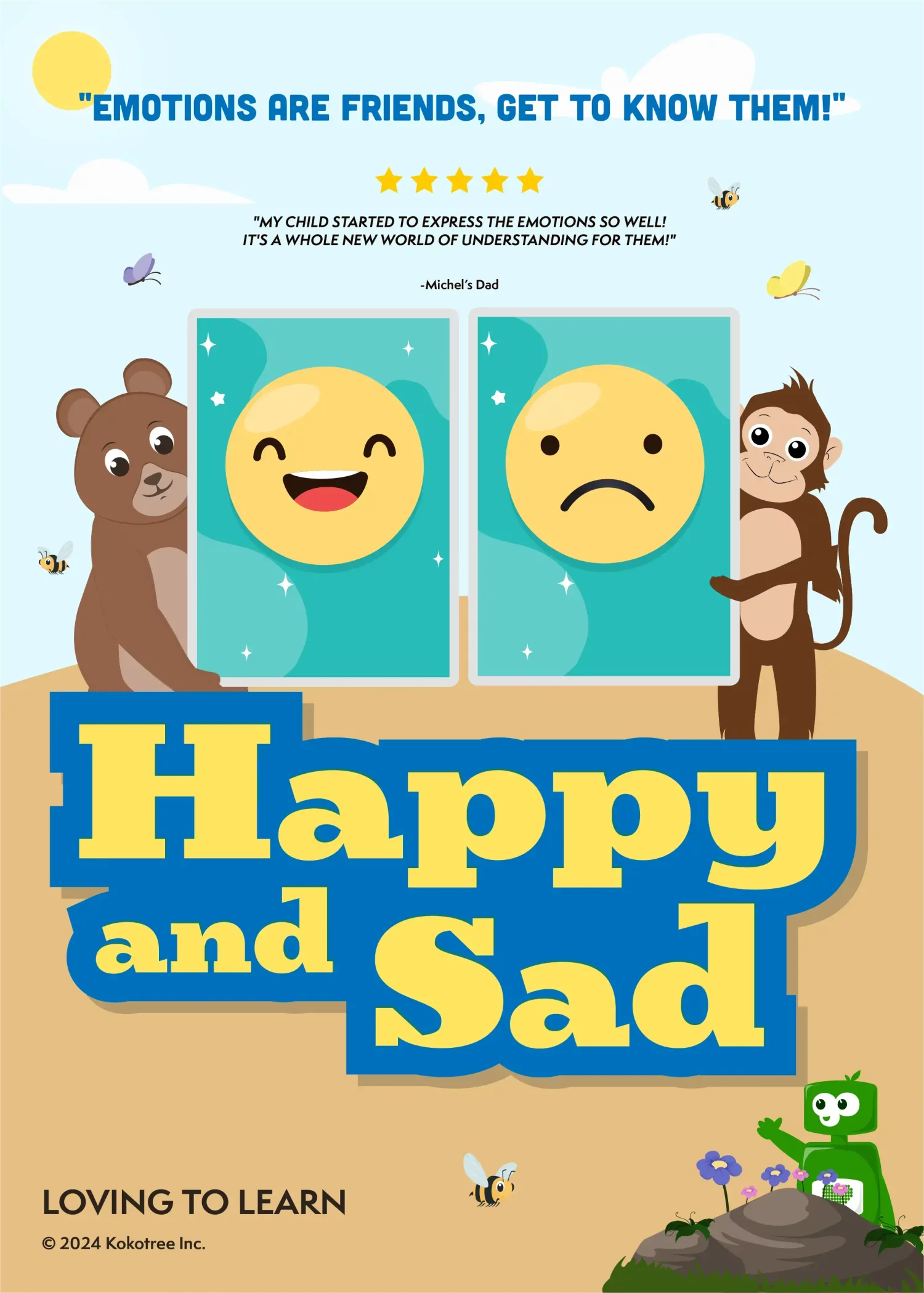
Bobby Bear arrives at school feeling upset, and his classmates rally around him with a cheerful song. Through clapping, nose-tapping, and belly-rubbing, the whole class helps Bobby work through his feelings. Then everyone plays a fun card game matching situations to happy or sad faces.
What your child learns:
This video introduces emotional literacy in the most approachable way—through catchy music and relatable scenarios. Children discover that feelings are normal, nameable, and manageable.
- Identifying happy and sad facial expressions
- Connecting actions (clapping, tapping) to emotional expression
- Understanding that sharing can create positive feelings
- Recognizing situations that typically cause happiness or sadness
- Learning that expressing feelings helps us feel better
They'll use these skills when:
- A sibling takes their toy and they need to name how they feel
- They see a friend looking upset at the playground
- They're asked to share something and feel conflicted about it
- They experience disappointment and need words to express it
The Story (what keeps them watching)
Bobby Bear arrives at Miss Elizabeth's classroom looking glum—his mom gave away his old toys to his baby cousin! The Kokotree friends jump into action, singing "If You're Happy and You Know It" with fun actions like clapping, nose-tapping, and belly-rubbing. As Bobby joins in, he starts to smile. Miss Elizabeth helps him realize that making his cousin happy can make him happy too. The class then plays a placard game, holding up happy or sad faces for different situations—like riding a bike without training wheels (happy!) or getting hurt (sad). Bobby learns that sharing feelings helps everyone feel better.
How We Teach It (the clever part)
- First 2 minutes: Miss Elizabeth notices Bobby's sadness and introduces the concept that we can help friends feel better. The familiar song begins, immediately engaging children.
- Minutes 2-5: Through four verses of the song with different actions, children practice physical expressions of happiness while watching Bobby's mood gradually shift. The conversation about sharing toys introduces perspective-taking.
- Final 2 minutes: The happy/sad placard game reinforces emotion recognition through interactive scenarios children can relate to—new toys, getting hurt, family dinners.
Teaching trick: The video uses physical movement (clapping, tapping nose, rubbing belly) to connect body sensations with emotions—helping young children understand that feelings live in our bodies, not just our heads.
After Watching: Quick Wins to Reinforce Learning
- Mealtime activity: "Let's play the placard game! How do you feel when you eat your favorite food?" Use thumbs up or thumbs down to practice identifying emotions with everyday moments.
- Car/travel activity: "Can you show me a happy face? Now a sad face?" Practice making facial expressions together and naming what might cause each feeling.
- Bedtime activity: "What made you feel happy today? Was there anything that made you feel sad?" This builds the habit of reflecting on and naming emotions.
- Anytime activity: Sing "If You're Happy and You Know It" together with all the actions from the video—clap hands, tap nose, rub belly, shout hooray!
When Kids Get Stuck. And How to Help.
- "My child says they're 'fine' but clearly isn't" - This is totally normal! Keep modeling emotion words yourself: "I feel frustrated when I drop things." Children learn emotional vocabulary by hearing it used naturally.
- "They don't want to share anything after watching" - The video shows sharing as a choice that can feel good, not a requirement. Start small with turn-taking games rather than giving things away permanently.
- "My child gets upset during the sad parts" - Some children are highly empathetic! Reassure them that Bobby feels better by the end, and that it's okay to feel sad sometimes—that's what the video teaches.
What Your Child Will Learn
Prerequisites and Building Blocks
This video works beautifully as an introduction to emotional literacy—no prior knowledge needed! Children benefit from basic vocabulary comprehension and the ability to follow simple instructions. "Happy and Sad" builds foundational skills that support future social-emotional learning about more complex feelings like frustration, excitement, or disappointment. It pairs perfectly with videos about friendship, sharing, and kindness.
Cognitive Development and Teaching Methodology
At ages 1-6, children are developing theory of mind—the understanding that others have feelings different from their own. This video uses multiple modalities: visual (facial expressions on placards), auditory (the familiar song), and kinesthetic (clapping, tapping, rubbing). The call-and-response format activates mirror neurons, helping children internalize emotional expressions through imitation.
Alignment with Educational Standards
This video supports social-emotional learning standards found in most early childhood frameworks, including recognizing and labeling emotions, understanding cause-and-effect relationships between events and feelings, and developing empathy. These skills are kindergarten readiness indicators, as teachers expect children to identify basic emotions and begin regulating their responses.
Extended Learning Opportunities
Create simple happy/sad face cards at home for your own placard game. Draw faces on paper plates and act out scenarios. Practice the song during transitions—cleanup time, getting dressed. Look for emotion faces in picture books together. The Kokotree app offers additional videos on friendship and sharing that complement this emotional foundation.
Transcript Highlights
- "Sharing our true feelings helps us heal better, don't you think?" - Miss Elizabeth connects emotional expression to wellbeing
- "Someone is taking care of your toys and is happy. You brought a smile to someone's face and it is a big reason for you to be super happy." - Introduces perspective-taking
- "Being teased feels bad and teasing should feel bad too. We can't be happy hurting or being hurt by others." - Clear boundary-setting about unkind behavior
- "If sharing my old toys, that I don't even use anymore, can make someone else happy then I can feel happy about it too!" - Bobby models cognitive reframing
Character Development and Story Arc
Bobby Bear demonstrates authentic emotional processing—he doesn't instantly feel better, but gradually shifts through music, movement, and conversation. His friends model supportive behavior without forcing him to cheer up. Miss Elizabeth shows how adults can guide children through difficult feelings without dismissing them. Maddy's offer to share toys shows friendship in action, and Bobby's response ("We can play together") models collaborative problem-solving.
Understanding Emotions: A Deep Dive into Social-Emotional Development
Emotional literacy—the ability to recognize, name, and appropriately express feelings—is one of the most critical skills children develop in early childhood. Research consistently shows that children who can identify their emotions have better self-regulation, stronger friendships, and greater academic success.
For children ages 1-6, happy and sad are the foundational emotions to master. These are the most visually distinct (smiling versus frowning) and the most frequently experienced. Before children can understand complex emotions like jealousy or embarrassment, they need solid footing with these basics.
This video employs several evidence-based strategies. First, it uses music and movement to create emotional memory—children are more likely to remember concepts learned through song. Second, it presents a relatable scenario (having toys given away) that validates children's feelings while gently introducing perspective-taking. Third, the placard game provides concrete, visual representations of abstract concepts.
The progression from Bobby's sadness to his understanding demonstrates cognitive reframing in age-appropriate terms. Rather than telling children they "shouldn't" feel sad, Miss Elizabeth helps Bobby discover a new way to think about his situation. This models healthy emotional processing.
Importantly, the video acknowledges that some situations appropriately cause sadness—getting hurt, losing something dear, being teased. This teaches children that all feelings are valid, while also helping them understand that certain actions (like teasing) are not acceptable. This balanced approach builds emotional intelligence without suppressing authentic feelings.