
What's Letter X About?
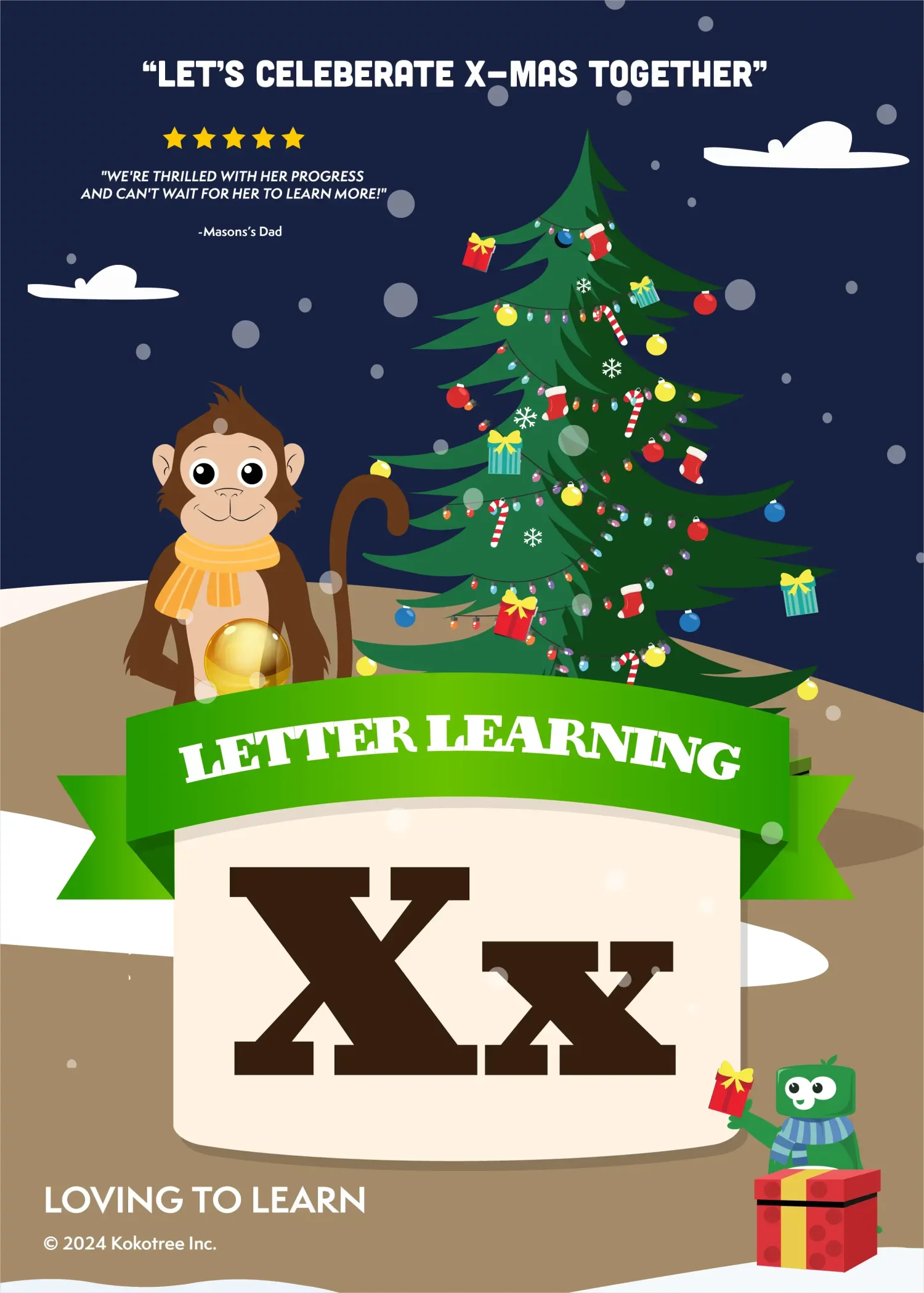
Your little learner joins a cozy classroom adventure where the letter X comes to life through games, songs, and hands-on discovery! They'll master the unique "ksss" sound, spot X in everyday words, and practice writing both uppercase and lowercase X.
7 minutes
Ages 3-5
Skill: Letter recognition, phonics, and handwriting
Your kid watches friendly animal friends discover X through games. You get 7 minutes to enjoy your coffee while it's still warm.
The Kokotree classroom is buzzing with a tic-tac-toe tournament when Miss Meera notices something special—the X marks on the game board are the perfect introduction to today's letter! The class crosses their arms, fingers, and even pencils to form the shape before diving into words, sounds, and writing practice.
What your child learns:
This video builds foundational literacy skills by connecting the abstract letter X to concrete shapes and sounds your child already knows. Through repetition and real-world examples, they'll internalize both the visual form and the distinctive "ksss" phonics sound.
- Recognizes uppercase X and lowercase x by sight
- Produces the "ksss" sound that X makes at the end of words
- Identifies X in common words: box, fox, mix, six, ox, wax
- Writes both uppercase and lowercase X with proper stroke order
- Connects letter shapes to objects in the real world
They'll use these skills when:
- Spotting the letter X on cereal boxes, exit signs, and toy packaging
- Sounding out simple words during storytime
- Writing their name if it contains an X
- Playing alphabet games and completing letter worksheets
The Story (what keeps them watching)
It's a cozy day in Miss Meera's classroom, and everyone's bundled up for a tic-tac-toe tournament! When Tiki wins a round, Miss Meera spots the perfect teaching moment—those X marks on the game board are actually today's letter lesson. The class gets creative, making X shapes with their arms, fingers, and pencils. They discover that X has a special "ksss" sound and loves hiding at the end of words. Together, they build a word collection: box, fox, mix, six, ox, and wax. After learning to write both big and little X, they even decorate a tree while finding more X words like "explore" and "relax."
How We Teach It (the clever part)
- First 2 minutes: The letter X is introduced through the familiar tic-tac-toe game, connecting an abstract symbol to something kids already know and love
- Minutes 2-5: Phonics practice begins with the unique "ksss" sound, reinforced through multiple word examples that kids repeat aloud
- Final 2 minutes: Handwriting instruction breaks down stroke order for both uppercase and lowercase, followed by playful word discovery
Teaching trick: Miss Meera has kids form the X shape with their own bodies—arms crossed, fingers crossed, even pencils crossed—before introducing the letter. This kinesthetic approach helps the shape stick in memory before any writing begins.
After Watching: Quick Wins to Reinforce Learning
- Mealtime activity: "Can you find any X shapes in our kitchen?" (Look for crossed utensils, the bottom of egg cartons, or waffle patterns—practices visual recognition)
- Car/travel activity: "Let's play the X sound game—box, fox, what rhymes next?" (Building phonemic awareness through rhyming word chains)
- Bedtime activity: "Use your finger to draw an X on my back, then I'll draw one on yours!" (Reinforces letter formation through tactile practice)
- Anytime activity: "How many ways can we make an X with our bodies?" (Cross arms, cross fingers, cross legs—connects letter shape to physical movement)
When Kids Get Stuck. And How to Help.
- "My child keeps mixing up X with other letters" - This is completely normal! X has a unique crossed shape that takes time to distinguish. Practice pointing out X in different fonts and sizes around your home.
- "The 'ksss' sound seems hard for them" - The X sound is tricky because it combines two sounds (k+s). Try saying "box" slowly and stretching out that ending sound together.
- "They can't write X neatly yet" - Letter X requires two separate strokes that cross in the middle—that's advanced coordination! Start big with sidewalk chalk or finger painting before moving to paper.
What Your Child Will Learn
Prerequisites and Building Blocks
Before watching, children benefit from familiarity with basic letter concepts and the understanding that letters have names, sounds, and written forms. This video builds on earlier alphabet learning and connects well with videos covering letters with similar diagonal strokes like V, W, and Y. In the Budding Sprouts progression, Letter X typically comes near the end of alphabet instruction, giving children a strong foundation to tackle this less common letter.
Cognitive Development and Teaching Methodology
This video leverages the concrete-to-abstract learning principle ideal for preschoolers. By starting with the familiar tic-tac-toe game, children connect new information to existing knowledge. The multi-sensory approach—visual letter display, auditory sound practice, and kinesthetic body movements—addresses all learning styles. Repetition of the "ksss" sound through multiple word examples builds phonological awareness through pattern recognition.
Alignment with Educational Standards
This lesson aligns with Common Core Foundational Skills RF.K.1 (letter recognition) and RF.K.3 (letter-sound correspondence). It supports kindergarten readiness indicators for print awareness and phonemic awareness. The handwriting component addresses fine motor benchmarks expected before kindergarten entry, including proper stroke formation and letter sizing relative to writing lines.
Extended Learning Opportunities
Pair this video with letter X tracing worksheets and X-themed coloring pages featuring foxes and boxes. The Kokotree app offers interactive letter games where children can practice identifying X among other letters. Extend learning with a "word hunt" around your home—find items ending in X or create a simple picture dictionary of X words discovered in the video.
Transcript Highlights
- "Letter X makes a unique sound. It is a combination of two sounds: k and s. When you put these two sounds together they make the sound kssss."
- "Letter X likes to live at the end of the word. Like in the words box and fox!"
- "Start at the topline and slant right to the baseline. Then move to the top right and slant left to the baseline."
- "Ox! It rhymes with box and fox. Box, fox, ox!"
Character Development and Story Arc
Miss Meera models excellent teaching behaviors by building on student discoveries—when Ronnie suggests "mix" with a gesture, she immediately validates and incorporates it. The students demonstrate collaborative learning, building on each other's word suggestions (Ruby's rhyming observation, Bobby's knowledge about beeswax). This shows children that learning is a community activity where everyone's contributions matter and curiosity is celebrated.
Phonics Deep Dive: The Unique Nature of Letter X
Letter X presents a fascinating phonics challenge because it rarely appears at the beginning of common English words and produces a sound that's actually a blend of two consonants. The "ks" sound (represented as "ksss" in the video) is technically called a consonant cluster, making X one of the more complex letters for young learners to master.
The video wisely focuses on X in the final position of words—box, fox, mix, six—where children most commonly encounter it. This end-position focus aligns with research showing that children recognize letters more easily in familiar contexts. The rhyming word families (box/fox/ox) leverage phonological awareness skills, helping children hear the pattern and predict the X sound.
The handwriting instruction addresses X's unique formation: two diagonal strokes that must cross at the center. This requires bilateral coordination and spatial planning that challenges developing fine motor skills. By teaching "slant right to baseline, then slant left to baseline," the video provides clear directional language that supports proper letter formation.
Interestingly, X is one of the least frequently used letters in English, yet it carries significant visual weight—appearing in important contexts like exit signs, railroad crossings, and marking treasure on maps. The video's approach of connecting X to the game tic-tac-toe gives children an immediate, positive association with this relatively rare letter, building confidence before they encounter it in reading contexts.