
What's Hexagon About?
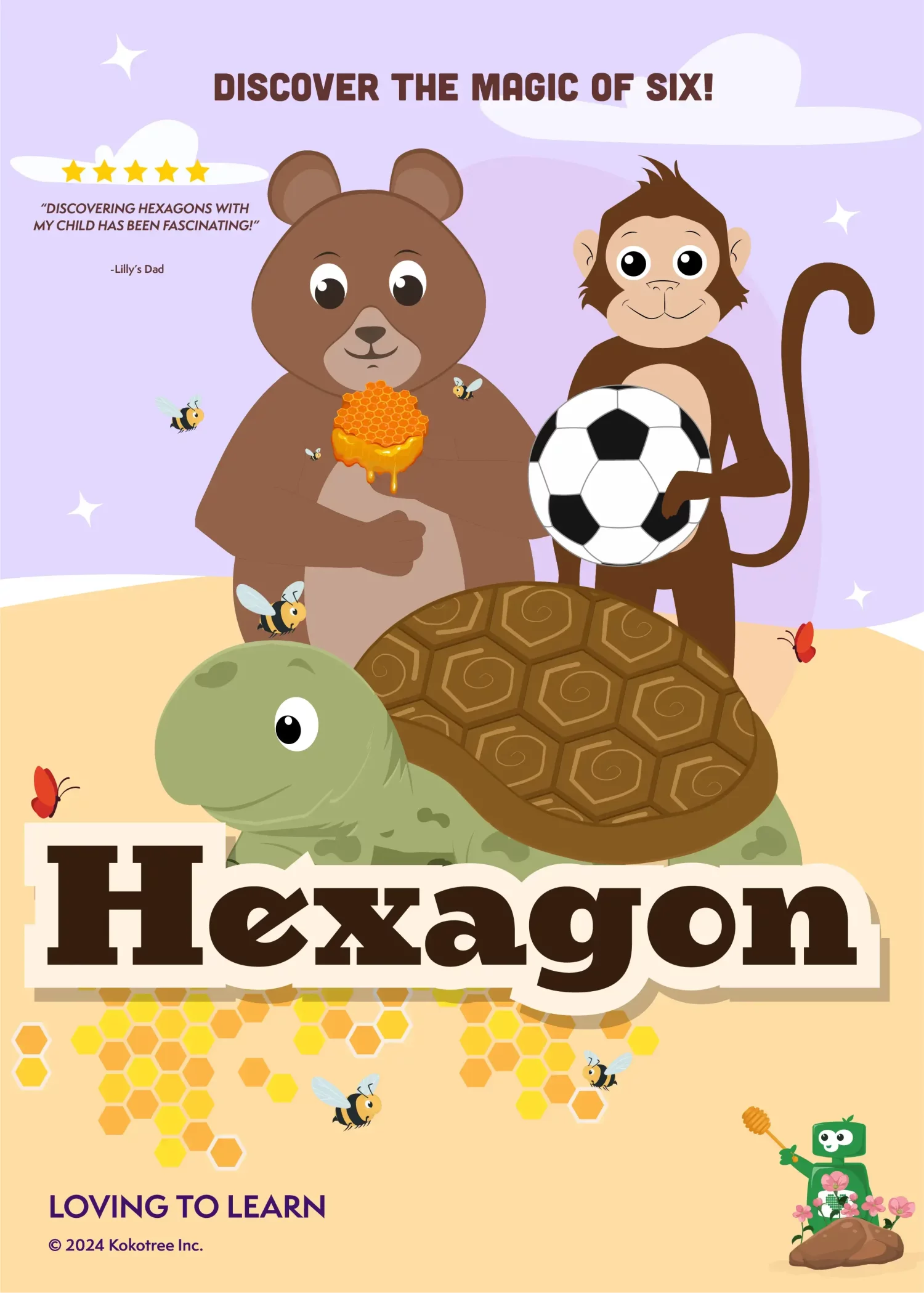
Your little learner joins Miss Elizabeth and friendly animal friends on an exciting jungle expedition to discover hexagons hiding in plain sight! After watching, they'll confidently count to six and spot this special six-sided shape everywhere—from soccer balls to honeycomb.
6 minutes
Ages 3-6
Skill: Shape recognition and counting
Your kid watches animal friends hunt for hexagons in nature. You get 6 minutes to enjoy your coffee while it's still warm.
The Kokotree class starts at a soccer field, noticing the different shapes on a soccer ball. Miss Elizabeth guides them to discover that the white patches have six sides—making them hexagons! Then the whole class heads into the jungle to find more hexagons in beehives, on a friendly tortoise's shell, and even on Gina Giraffe's own fur.
What your child learns:
This video builds strong shape recognition skills by connecting hexagons to real-world objects kids already know. Through guided counting and visual examples, children develop the ability to identify six-sided shapes independently.
- Counts to six with confidence and purpose
- Identifies hexagons by counting their six sides
- Recognizes hexagons in nature (beehives, animal patterns)
- Compares shapes (pentagon vs. hexagon)
- Connects abstract shapes to familiar objects
They'll use these skills when:
- Noticing patterns on balls, tiles, or playground equipment
- Looking at bugs, animals, or nature during outdoor play
- Sorting shape toys or building with blocks
- Pointing out shapes during walks or trips to the zoo
The Story (what keeps them watching)
After a soccer game, the Kokotree class gets curious about the shapes on their ball. They already know the black patches are pentagons with five sides—but what about the white ones? Miss Elizabeth helps them count six sides and introduces the hexagon! The adventure continues into the jungle where Bobby Bear, Gina Giraffe, Tiki Tiger, and friends discover hexagons hiding in an abandoned beehive, on a sunbathing tortoise's shell, and—surprise!—all over Gina's own spotted coat. Turns out hexagons really are nature's favorite shape!
How We Teach It (the clever part)
- First 2 minutes: The concept is introduced through something familiar—a soccer ball. Kids compare pentagons (5 sides) to the new hexagon shape (6 sides), building on prior knowledge.
- Minutes 2-5: Active discovery continues as the class explores the jungle, finding hexagons in beehives and on animals. Each discovery includes guided counting to reinforce the "six sides" rule.
- Final minute: Learning is celebrated with a visual recap showing all the hexagons found, cementing recognition through repetition.
Teaching trick: The video uses the "count the sides" method consistently, giving kids a reliable tool to identify hexagons on their own. Every time a new hexagon appears, the class counts together—building muscle memory for shape identification.
After Watching: Quick Wins to Reinforce Learning
- Mealtime activity: "Can you find anything with six sides on your plate or at the table?" (Practices scanning for shapes and counting sides—try honeycomb cereal or cut a sandwich into a hexagon!)
- Car/travel activity: "Let's look for hexagons! Check out signs, buildings, or patterns we pass." (Builds observation skills and connects learning to the real world)
- Bedtime activity: "If you were a shape detective like the Kokotree class, where would you look for hexagons tomorrow?" (Encourages planning and extends curiosity beyond screen time)
- Anytime activity: "Let's draw a hexagon together! Count out loud as we make each side: one, two, three, four, five, six!" (Reinforces counting while building fine motor skills)
When Kids Get Stuck. And How to Help.
- "My child keeps mixing up hexagons and other shapes." - Totally normal! Focus on the counting strategy: "Let's count the sides together." With practice, the six-sided rule becomes automatic. Keep it playful, not quizzy.
- "They can count to six but don't connect it to the shape." - Try tracing a hexagon with their finger while counting each side out loud. The physical movement helps lock in the connection between the number and the shape.
- "This seems advanced for my 3-year-old." - Start with just spotting hexagons without counting—recognition comes first! Point to hexagons and say "six sides" yourself. They'll start counting along when ready.
What Your Child Will Learn
Prerequisites and Building Blocks
Before watching, children benefit from familiarity with basic shapes (circles, squares, triangles) and counting to five. This video explicitly builds on pentagon knowledge, making it ideal after the pentagon lesson. The progression from five-sided to six-sided shapes follows a logical sequence, strengthening number sense while expanding shape vocabulary. This scaffolded approach ensures children feel confident tackling a more complex shape.
Cognitive Development and Teaching Methodology
The video employs discovery-based learning, perfect for preschoolers who learn best through exploration. By embedding hexagons in familiar contexts (sports equipment, animals, nature), abstract concepts become concrete. The consistent "count the sides" strategy provides a transferable tool for independent learning. Visual highlighting, verbal counting, and real-world connections address visual, auditory, and kinesthetic learners simultaneously.
Alignment with Educational Standards
This lesson aligns with Common Core Math Standard K.G.A.2 (correctly naming shapes regardless of size or orientation) and K.G.B.4 (analyzing and comparing shapes). The counting component supports K.CC.A.1 (counting to 100 by ones). Kindergarten readiness checklists emphasize shape recognition and counting fluency—both central to this video. The comparison between pentagons and hexagons builds early geometric reasoning skills.
Extended Learning Opportunities
Pair this video with hexagon tracing worksheets or pattern block activities using hexagonal pieces. The Kokotree app's shape sorting games reinforce recognition. Extend learning with a nature walk "hexagon hunt" or by examining real honeycomb. Building hexagons with craft sticks (six sticks = one hexagon) adds hands-on reinforcement. Revisit the pentagon video to strengthen comparison skills.
Transcript Highlights
- "Let's count the sides on the white patch. One, two, three, four, five...six!" — Guided counting introduces the defining characteristic
- "It's called a hexagon... hexagons are often referred to as 'Nature's favorite shape.'" — Memorable hook for retention
- "If you see a shape and it has six sides, then that's a hexagon!" — Clear, repeatable rule for independent identification
- "I knew I had a necklace with a hexagon but didn't know that I had them on my fur! How exciting!" — Models discovery joy and connects to self
Character Development and Story Arc
The Kokotree class models ideal learning behaviors throughout. They begin with genuine curiosity ("What IS that shape?"), demonstrate honesty when they don't know something, and show excitement at each discovery. Bobby Bear's humor about honey keeps things light, while Gina Giraffe's surprise at finding hexagons on her own fur models the joy of personal connection to learning. Miss Elizabeth consistently validates effort and guides without giving away answers.
The Geometry of Hexagons: Why Six Sides Matter
Hexagons hold a special place in both nature and mathematics, making them a fascinating shape for young learners to explore. A hexagon is a polygon with exactly six straight sides and six angles. What makes hexagons remarkable is their efficiency—they tessellate perfectly, meaning they fit together without gaps, which is why bees evolved to build honeycomb in hexagonal cells. It's the most material-efficient way to create storage!
For preschoolers, understanding hexagons builds critical geometric reasoning. The video's approach of comparing pentagons (5 sides) to hexagons (6 sides) develops comparative thinking—a foundational math skill. Children learn that shapes are defined by their properties (number of sides), not just how they "look." This property-based identification prepares them for more complex geometry later.
The real-world examples in this video—soccer balls, beehives, tortoise shells, and giraffe patterns—demonstrate that mathematics exists in nature, not just in textbooks. This connection sparks curiosity and helps children see themselves as mathematicians who can discover patterns everywhere. The consistent counting strategy ("one, two, three, four, five, six!") gives children an independent tool for shape identification, building both counting fluency and geometric vocabulary simultaneously. By the video's end, children don't just recognize hexagons—they understand WHY a shape qualifies as a hexagon.