
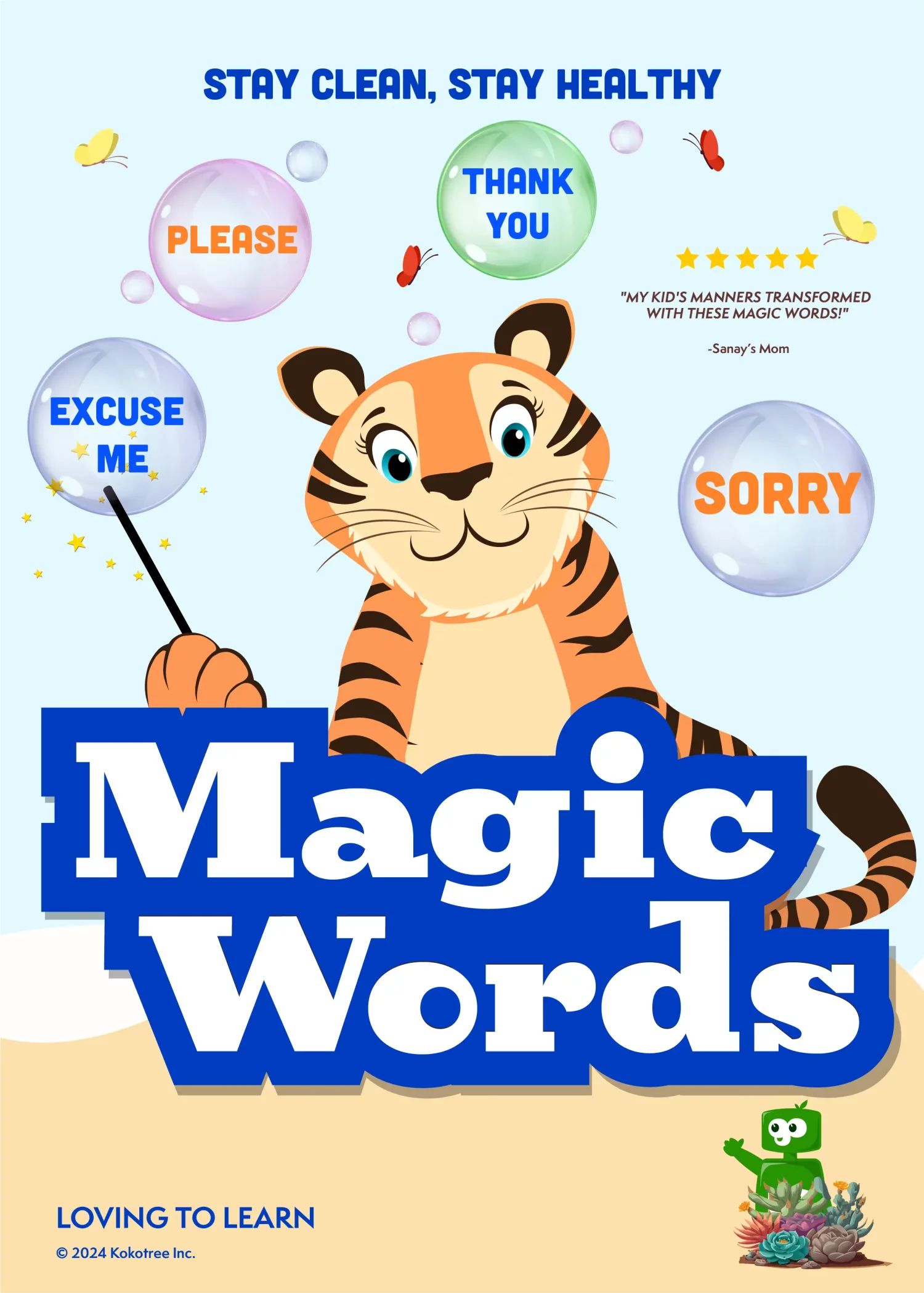
What's Magic Words - Sorry, Please, Thank You, Excuse Me About?
Your child joins the Kokotree animal friends on the soccer field to discover how four simple words can make big things happen! They'll learn when and why to use each magic word—and practice through a catchy song they'll be humming all day.
9 minutes
Ages 2-5
Skill: Polite communication and social awareness
Your kid watches friendly animals learn manners through play. You get 9 minutes to enjoy your coffee in peace.
The video opens on a windy soccer game where an accidental ball kick leads to hurt feelings. Miss Meera, the wise owl teacher, guides the class through understanding "sorry" and introduces three more magic words. The animals share real examples, ask questions, and finish with an upbeat song that reinforces all four phrases.
What your child learns:
This video teaches children that polite words aren't just rules—they're tools that help us connect with others. Through relatable scenarios and repetition, kids understand when each magic word applies and why it matters.
- Saying "sorry" when someone gets hurt (even by accident)
- Using "thank you" to show appreciation for gifts and help
- Adding "please" when asking for something
- Saying "excuse me" to get attention politely or move past someone
- Recognizing that kind words make both people feel good
They'll use these skills when:
- Accidentally bumping into a sibling or friend at the playground
- Asking for a snack or requesting more playtime
- Receiving a gift or help from a caregiver
- Needing to get past someone in a crowded space
The Story (what keeps them watching)
It's a windy day on the soccer field! Ruby Rabbit gets distracted by a cute caterpillar and—BONK—takes a soccer ball to the face from Gina Giraffe's super kick. Tears flow, but Miss Meera swoops in to help. Gina learns that saying "sorry" can help heal hurt feelings, even when accidents happen. This sparks a fun class discussion about four magic words: sorry, please, thank you, and excuse me. The animals share their own examples (Maddy Monkey really loves thanking her mom for banana everything!), and everyone wraps up with a toe-tapping song to remember all four phrases.
How We Teach It (the clever part)
- First 3 minutes: A relatable accident (the soccer ball hit) introduces "sorry" through real consequences and genuine emotions. Kids see that apologies help even when something wasn't on purpose.
- Minutes 3-7: Miss Meera introduces "thank you," "please," and "excuse me" one at a time, with the class sharing personal examples that mirror situations kids actually face.
- Final 2 minutes: A memorable song repeats all four magic words with clear scenarios, locking in the learning through music and movement.
Teaching trick: Each magic word is paired with a specific situation (hurt someone → sorry, get a gift → thank you, need help → please, need attention → excuse me). This gives kids a mental "if-then" framework they can apply instantly in real life.
After Watching: Quick Wins to Reinforce Learning
- Mealtime magic: "Can you use a magic word to ask for more food?" (Practices using "please" in a natural, low-pressure moment—bonus points for "thank you" when they get it!)
- Car ride quiz: "If I accidentally stepped on your toe, what magic word should I say?" (Reinforces matching the right word to the right situation without any real hurt feelings involved.)
- Bedtime recap: "What's one time you used a magic word today?" (Helps kids reflect on their own behavior and feel proud of their kindness.)
- Anytime game: Play "Magic Word Freeze"—when you say a magic word, everyone freezes until someone uses it in a sentence. (Turns practice into giggly fun they'll want to repeat.)
When Kids Get Stuck. And How to Help.
- "My child says sorry but doesn't seem to mean it." - Totally normal at this age! Meaning develops with practice. Focus on the habit first; sincerity grows as they experience how apologies repair relationships.
- "They forget to say please—it's always demands!" - Try a gentle prompt like "How do we ask nicely?" instead of refusing. Modeling "please" yourself constantly helps too—they're always watching.
- "Excuse me feels too advanced for my toddler." - Start with just the situations they encounter most (like getting past you in the hallway). Even a simplified "'scuse me!" counts as progress worth celebrating.
What Your Child Will Learn
Prerequisites and Building Blocks
This video works best for children who can follow a simple story and recognize basic emotions like happy and sad. It builds on foundational social awareness—understanding that other people have feelings too. No prior Kokotree videos are required, but it pairs beautifully with other social skills content in the Budding Sprouts program. This lesson establishes vocabulary and scenarios that future videos on friendship, cooperation, and conflict resolution will expand upon.
Cognitive Development and Teaching Methodology
Preschoolers learn social skills best through modeling and repetition in context. This video leverages observational learning—children watch peers (the animal classmates) navigate real situations and see positive outcomes. The multi-sensory approach combines visual storytelling, verbal explanation from Miss Meera, peer discussion, and a musical summary to address visual, auditory, and kinesthetic learners. Repetition of each magic word in multiple contexts builds neural pathways for automatic recall.
Alignment with Educational Standards
This video addresses Head Start Early Learning Outcomes in Social and Emotional Development, specifically SE-ATL (Approaches to Learning) and SE-SOC (Social Relationships). It supports kindergarten readiness indicators around using polite language, taking responsibility for actions, and demonstrating empathy. Teachers expect incoming students to use basic courtesy words independently—this video provides the scaffolded practice that builds that expectation into habit.
Extended Learning Opportunities
Pair this video with Kokotree's printable "Magic Words" coloring pages featuring the four phrases. The app's interactive "Polite Phrases" matching game reinforces word-to-situation connections. At home, create a simple "Magic Word Chart" where kids earn stickers for unprompted use of each phrase. Role-playing with stuffed animals extends learning kinesthetically—have toys bump into each other and practice apologies!
Transcript Highlights
- On the power of sorry: "If we feel bad for something and say we're sorry, it can make things a little better. It may not change whatever has happened, but it surely leaves a positive effect on the person who was hurt."
- Defining thank you: "'Thank you' are the magic words we say to express our gratitude toward services or gifts we receive from others."
- Why please works: "Please is always welcomed as a request rather than a demand. Most of the time we get what we want and sometimes we get more than we need just by saying please."
- Excuse me explained: "'Excuse me' is a polite way of seeking attention. We use it when we need permission to interrupt for something."
Character Development and Story Arc
Gina Giraffe models accountability beautifully—she didn't mean to hurt Ruby, but she still takes responsibility and apologizes sincerely. Ruby Rabbit demonstrates gracious acceptance, showing that receiving an apology kindly matters too. Miss Meera acts as a gentle facilitator rather than a rule-enforcer, guiding discovery instead of lecturing. The whole class participates by sharing personal examples, modeling how peers learn from each other and normalize polite behavior as something everyone does.
Social Communication Development Deep Dive
Polite language acquisition is a cornerstone of pragmatic language development—the social rules governing how we use words in real interactions. Between ages 2-5, children transition from egocentric communication (focused on their own needs) to socially-aware communication (considering the listener's perspective). Magic words are among the first "scripts" children learn for navigating social situations successfully.
Research in developmental psychology shows that children who master courtesy phrases earlier tend to have smoother peer interactions and receive more positive responses from adults, creating a reinforcing cycle of social success. The four words in this video represent distinct social functions: repair (sorry), appreciation (thank you), request softening (please), and attention-seeking (excuse me). Each requires the child to recognize a social context and select the appropriate verbal tool.
This video's approach—embedding instruction in a relatable narrative, providing multiple examples, and using music for memory consolidation—aligns with best practices in early childhood social-emotional curriculum. The soccer ball accident is particularly effective because it shows that apologies matter even for unintentional harm, a nuance many young children struggle with ("But I didn't MEAN to!"). By seeing Gina apologize despite the accident being unintentional, children learn that impact matters alongside intent—a sophisticated social concept delivered in an accessible way.