
What's Learning Sounds I and J About?
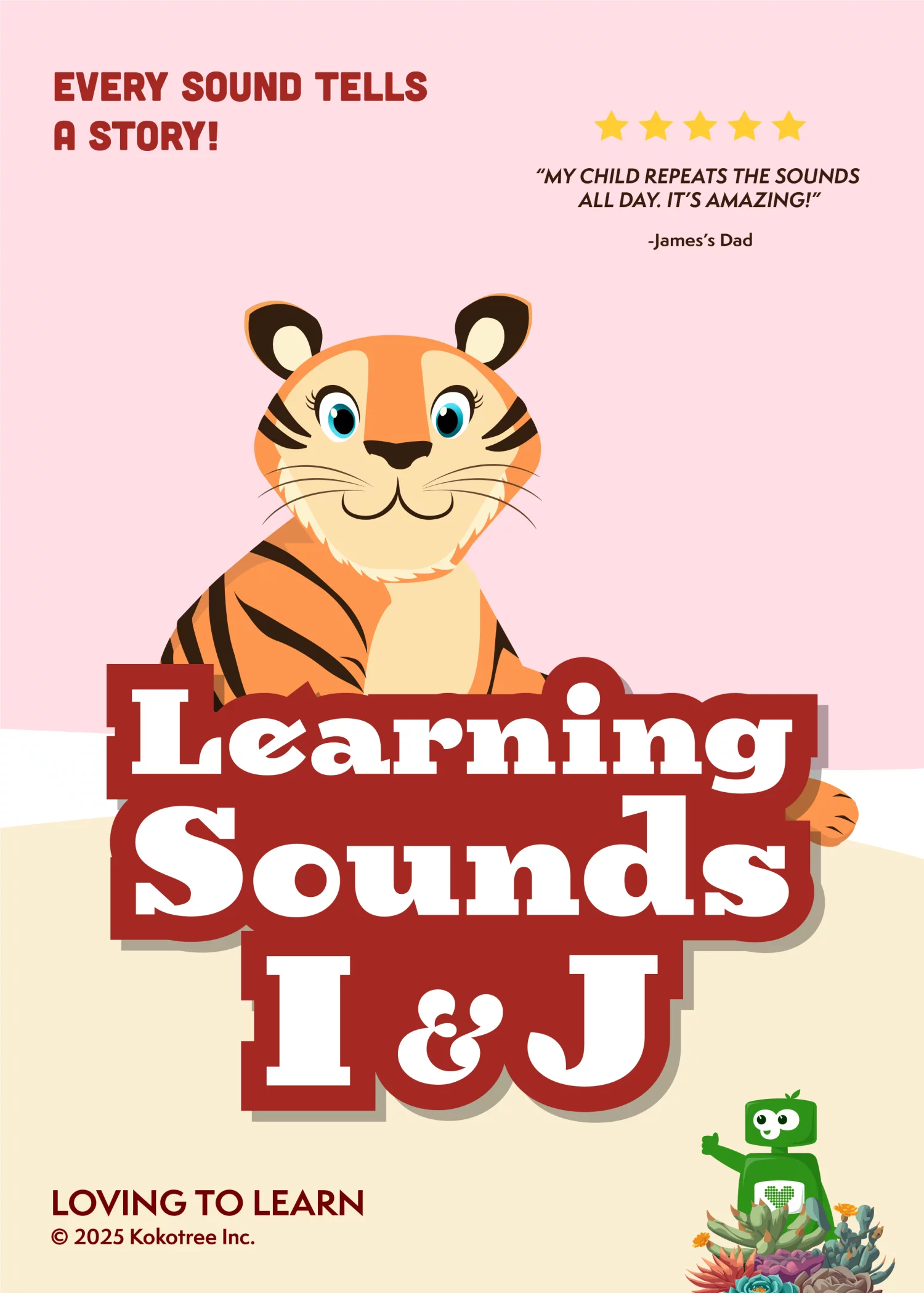
Your little learner joins Miss Meera for two exciting story adventures that bring the letters I and J to life! They'll discover that the letter I has two sounds (like a superhero with two powers!) and practice the bouncy "juh" sound through a hilarious tale of jungle jokers.
8 minutes
Ages 3-6
Skill: Letter sounds and phonics awareness
Your kid watches friendly animals discover letter sounds through stories. You get 8 minutes to enjoy your coffee while it's still warm.
Miss Meera gathers the curious Kokotree class after a rainy day and launches into two delightful stories. First, an iguana named Ira visits puffin friends in Iceland and builds an igloo. Then, three jokers venture into the jungle to make animals laugh. Each story is packed with words featuring the target letter sounds.
What your child learns:
This video teaches children that some letters make more than one sound—a key phonics concept. They'll practice identifying the short "ih" sound (igloo, incredible) and long "ai" sound (ice, idea) for letter I, plus the consistent "juh" sound for letter J.
- Recognizes the letter I makes two different sounds
- Identifies the short "ih" sound in words like iguana and igloo
- Identifies the long "ai" sound in words like ice and idea
- Produces the "juh" sound for letter J
- Connects letter sounds to familiar words and objects
They'll use these skills when:
- Sounding out words in picture books at bedtime
- Spotting letters on signs during car rides
- Playing alphabet games with friends
- Writing their first words and spelling out sounds
The Story (what keeps them watching)
Miss Meera tells two adventure stories that kids can't resist! First, Ira the iguana travels from her warm island to snowy Iceland to visit puffin friends Isha and Isabelle. When Ira gets too cold, they work together to build a cozy igloo—teamwork saves the day!
Then we meet Jumbo, Jumper, and Junior—three jokers who drive their jeep into the jungle to make animals laugh. Even the scary jackals end up giggling! Both stories are stuffed with I and J words, making letter learning feel like pure adventure.
How We Teach It (the clever part)
- First 4 minutes: Miss Meera introduces letter I through Ira's igloo adventure, naturally weaving in I-words. The class discovers that I makes TWO sounds—mind blown!
- Minutes 4-6: Children practice identifying short and long I sounds together, repeating words like "ih-ih-Ira" and "ih-ih-incredible."
- Final 2 minutes: The joker story introduces the J sound, and kids practice "juh-juh-jungle" and "juh-juh-jeep" with the class.
Teaching trick: Miss Meera uses the "sound stretching" technique—breaking words into their beginning sounds ("Ih...ih...Ira") so kids can physically hear and feel how letters connect to words they already know.
After Watching: Quick Wins to Reinforce Learning
- Mealtime activity: "Can you find something on your plate that starts with the 'juh' sound?" (Think jam, juice, or jelly! They're practicing sound-to-object matching.)
- Car/travel activity: "Let's play I-Spy with letter sounds! I spy something that makes the 'ih' sound." (Builds scanning and sound recognition skills.)
- Bedtime activity: "If you were building an igloo like Ira, what would you put inside?" (Reinforces the I-sound connection while sparking imagination.)
- Anytime activity: Practice jumping like Jumper while saying "Juh-juh-JUMP!" each time you land. (Combines movement with phonics for multi-sensory learning.)
When Kids Get Stuck. And How to Help.
- "My child keeps mixing up the two I sounds." - Totally normal! The short and long vowel distinction takes time. Use hand motions: a quick tap for short "ih" and a long stretch for "ai" to make the difference physical.
- "They can say the sound but can't find it in words." - Start with just the beginning sound. Ask "Does 'igloo' start with 'ih' or 'juh'?" Making it multiple choice removes pressure and builds confidence.
- "This seems too advanced for my 3-year-old." - Focus on just ONE sound per sitting. The short "ih" sound is easiest to start with. Mastery isn't the goal—exposure and fun repetition is!
What Your Child Will Learn
Prerequisites and Building Blocks
Children benefit from prior exposure to basic alphabet recognition before this video. Ideally, they've already explored earlier letter sounds (A through H) in the Budding Sprouts program. This video builds on the concept introduced with letter E—that some vowels make two different sounds. Understanding that letters represent sounds is the foundational skill being reinforced and expanded here.
Cognitive Development and Teaching Methodology
The story-based approach leverages narrative transportation, which helps preschoolers encode information more effectively than rote instruction. Visual learners benefit from the animated story sequences, auditory learners from the repeated sound practice, and kinesthetic learners from the call-and-response format that encourages verbal participation. The dual-story structure provides natural brain breaks while maintaining engagement.
Alignment with Educational Standards
This video addresses Common Core Foundational Skills RF.K.3 (knowing letter-sound correspondences) and RF.K.2 (demonstrating understanding of spoken words and sounds). It specifically targets kindergarten readiness indicators for phonemic awareness. Teachers expect entering kindergarteners to recognize most letter sounds—this video builds that exact skill through developmentally appropriate repetition.
Extended Learning Opportunities
Pair this video with letter I and J tracing worksheets for fine motor practice. The Kokotree app's letter matching games reinforce these sounds through interactive play. Parents can extend learning by creating an "I and J treasure hunt" around the house, or making a simple picture book with magazine cutouts of I and J words.
Transcript Highlights
- "Just like the Letter E, the Letter I is a special letter. It has two sounds. One is the short sound 'ih' as in the word igloo and the other is the long sound 'ai' as in the word ice."
- "Ih...ih...Ira. Your turn, Class!"
- "Let's jump into the words and join them with the 'juh' sound!"
- "Juh...juh...jungle."
Character Development and Story Arc
Miss Meera models curiosity and enthusiasm for learning, showing children that teachers find discovery exciting too. The Kokotree class demonstrates active participation—raising hands, making guesses, and practicing together. Characters like Ira show problem-solving (building an igloo when cold) and the jokers demonstrate bravery and persistence (performing for scary animals). These behaviors model growth mindset for young viewers.
Phonics Development: Understanding Vowel Sounds and Consonant Consistency
The letter I presents one of phonics' most important concepts: vowel variability. Unlike consonants, which typically make one sound, vowels like I shift between short and long pronunciations depending on word structure. This video introduces this concept gently, helping children understand that the same letter can sound different in different words—a crucial insight for future reading success.
The short I sound (as in "igloo") is produced with the tongue in a high-front position with lips relaxed. The long I sound (as in "ice") is actually a diphthong—the mouth moves from one position to another within the single vowel sound. Children don't need to understand the mechanics, but exposure to both sounds builds phonemic flexibility.
In contrast, the letter J provides a consistent consonant sound, giving children a "reliable" letter after the complexity of I. The "juh" sound is a voiced palato-alveolar affricate—produced by briefly stopping airflow then releasing it with friction. This sound is satisfying for children to produce and easy to identify.
The video's approach of embedding target sounds in memorable stories (Ira's igloo adventure, the jungle jokers) creates multiple retrieval pathways in memory. When children later encounter these letters, they can recall the stories and associated sounds. This narrative anchoring technique is particularly effective for the 3-6 age range, when children's brains are primed for story-based learning.
Research shows that children need 4-14 exposures to a new phoneme before it becomes automatic. This single video provides numerous exposures through the story context, explicit instruction, and group practice—laying strong groundwork for letter-sound mastery.