
What's Letter B About?
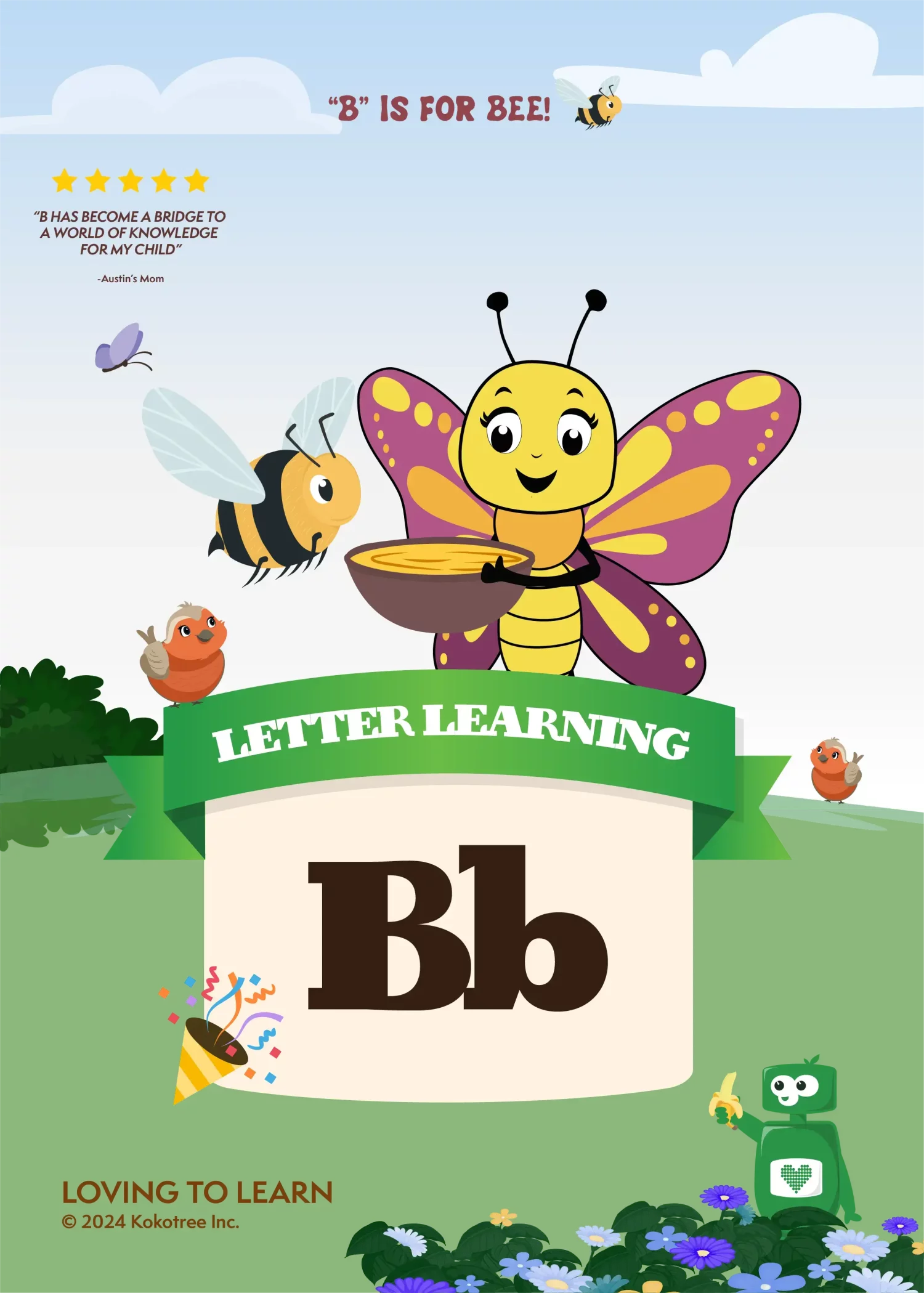
Your little one joins the lovable Kokotree classroom crew to master the letter B through an adorable butterfly story and hands-on letter practice. They'll confidently identify the "buh" sound and write the letter B by the end!
11 minutes
Ages 2-5
Skill: Letter recognition, phonics, and handwriting basics
Your kid watches friendly animals discover B words everywhere. You get 11 minutes to enjoy your coffee while it's still warm.
Miss Meera gathers her animal students for an exciting lesson about the letter B. The class listens to a charming story about Booboo the butterfly who makes friends with Bruce the bee, then heads outside to spot B words in nature before learning to write both uppercase and lowercase B on the chalkboard.
What your child learns:
This video builds essential pre-reading skills by connecting the letter B to its sound and real-world objects. Children practice phonemic awareness through repetition and discover that letters are all around them in everyday life.
- Recognizes the letter B in both uppercase and lowercase forms
- Identifies the "buh" sound at the beginning of words
- Connects the B sound to familiar objects (butterfly, bee, bird, blue)
- Practices letter formation with step-by-step guidance
- Builds vocabulary with nature-based B words (branch, bark, bud)
They'll use these skills when:
- Spotting the letter B on cereal boxes, books, and street signs
- Sounding out words when looking at picture books together
- Writing their name if it contains the letter B
- Playing alphabet games with friends or siblings
The Story (what keeps them watching)
Maddy Monkey kicks things off with an impressive handstand trick that has the whole class amazed! Then Miss Meera introduces the letter B through a sweet story about Booboo, a baby butterfly who's hungry and goes exploring. She meets Bruce the bee, tries honey for the first time (Bobby Bear gets excited about this part!), and they become best buddies. The class then hunts for B words outside before heading back in to learn how to write the letter. Bobby Bear is thrilled because now he can write his own initials!
How We Teach It (the clever part)
- First 3 minutes: The engaging classroom scene hooks kids in, then introduces the letter B through Bobby Bear's name—making it personal and memorable.
- Minutes 3-7: The Booboo butterfly story immerses children in B words naturally (blue sky, buzzing bees, beautiful butterflies, best buddies), followed by call-and-response phonics practice.
- Final 4 minutes: Miss Meera teaches letter formation step-by-step, using the clever visual of a butterfly hiding in the uppercase B to make it stick.
Teaching trick: The video uses a "sound stacking" technique—saying "buh...buh...bird"—which helps children isolate the beginning sound before blending it into the full word. This builds phonemic awareness, a critical pre-reading skill.
After Watching: Quick Wins to Reinforce Learning
- Mealtime activity: "Can you find something on your plate that starts with B?" (Think banana, bread, beans, broccoli—they'll practice connecting the sound to real objects right at the table.)
- Car/travel activity: "Let's play B-spy! Who can spot something blue or something that starts with the buh sound?" (Turns any drive into phonics practice while keeping little eyes busy.)
- Bedtime activity: "Let's trace a big B on your back with my finger—can you guess what letter it is?" (Reinforces letter formation through touch, perfect for winding down.)
- Anytime activity: "Can you walk like Bobby Bear and tell me three B words?" (Gets wiggles out while reinforcing vocabulary—butterfly, bee, bird, anything goes!)
When Kids Get Stuck. And How to Help.
- "My child confuses B and D when writing." - This is incredibly common and completely normal! The butterfly visual from the video helps—remind them that the B has "bumps on the right side, like butterfly wings." Practice will build muscle memory over time.
- "They can say the sound but can't find B words on their own." - Start with objects they love. If they like balls, bananas, or birds, use those as anchors. Once they connect the sound to something meaningful, other words will follow.
- "The uppercase B seems too hard for my child to write." - Focus on the lowercase b first—it's just a line and one bump! Miss Meera teaches both, but mastering the simpler one builds confidence before tackling the bigger challenge.
What Your Child Will Learn
Prerequisites and Building Blocks
This video works best for children who have basic familiarity with the concept of letters and can follow simple verbal instructions. It builds beautifully on alphabet introduction videos and prepares children for subsequent letter lessons. The phonemic awareness skills practiced here (isolating beginning sounds) are foundational for all future phonics work. Children who have watched videos about other letters will recognize the teaching pattern, making learning feel comfortable and predictable.
Cognitive Development and Teaching Methodology
The video leverages narrative learning theory by embedding letter concepts within an engaging story—research shows children retain information better when it's contextualized. The call-and-response format ("Repeat after me: buh...buh...bird") activates auditory processing and verbal production simultaneously. Visual learners benefit from seeing the letter formed on screen, while the outdoor exploration segment addresses kinesthetic learners who connect best when concepts relate to physical environments they can explore.
Alignment with Educational Standards
This lesson aligns with Common Core Foundational Skills for Kindergarten (RF.K.1d, RF.K.3a) focusing on letter recognition and basic phonics. It addresses Head Start Early Learning Outcomes Framework goals for phonological awareness and print concepts. The handwriting instruction meets kindergarten readiness benchmarks for fine motor development and letter formation. Teachers expect incoming kindergarteners to recognize most letters—this video directly supports that preparation.
Extended Learning Opportunities
Pair this video with Kokotree's letter B tracing worksheets for additional handwriting practice. The app's "B Word Hunt" game reinforces vocabulary learned in this episode. Parents can extend learning by creating a "B basket" at home filled with small objects starting with B. Reading picture books featuring butterflies or bees after watching creates meaningful connections between screen learning and print literacy experiences.
Transcript Highlights
- Teaching the sound: "Buh...buh...bird. Good! Now, buh...buh...blue." (Direct phonics instruction with immediate practice)
- Making it memorable: "Can you spot the butterfly in the B?" (Visual mnemonic device for letter recognition)
- Step-by-step guidance: "We start with drawing a standing line. Then we make a curve from top till the midline. And then another curve from midline to the base." (Clear, sequential handwriting instruction)
- Real-world connection: "So children, aren't you thrilled to identify so many B words around you?" (Encouraging environmental print awareness)
Character Development and Story Arc
Bobby Bear models enthusiastic learning throughout the video, showing children that personal connections to content ("I have LOTS of Bs in my name!") make learning exciting. When Bobby interrupts the story about honey, Miss Meera gently redirects him, demonstrating appropriate classroom behavior. Maddy Monkey's opening handstand scene shows playfulness balanced with following instructions when asked. The Booboo butterfly character models curiosity and initiative—she independently seeks food and bravely approaches a new friend.
Phonics and Early Literacy Deep Dive
The letter B is an ideal early phonics target because it produces a consistent, easily identifiable sound. Unlike vowels or letters with multiple sounds, B reliably makes the "buh" sound at the beginning of words, giving young learners a dependable pattern to recognize.
This video employs the "sound isolation" technique central to systematic phonics instruction. By breaking words into "buh...buh...butterfly," children learn to segment the initial phoneme—a critical skill for eventual decoding and spelling. Research from the National Reading Panel confirms that explicit phonemic awareness instruction significantly improves reading outcomes.
The vocabulary selection is intentionally strategic. Words like "butterfly," "bee," "bird," and "blue" are high-frequency in children's literature and daily life, maximizing transfer opportunities. Nature-based words (branch, bark, bud) expand vocabulary while maintaining thematic coherence.
The handwriting instruction follows developmentally appropriate progression: vertical lines before curves, uppercase before lowercase. The butterfly mnemonic ("Can you spot the butterfly in the B?") leverages visual imagery to aid letter discrimination—particularly helpful for distinguishing B from similar letters like D, P, and R.
The story-based approach activates what literacy researchers call "narrative schema"—children naturally remember information embedded in stories better than isolated facts. Booboo and Bruce's friendship provides emotional engagement that cements the B-word vocabulary in long-term memory. This dual-coding of information (verbal + narrative) creates multiple retrieval pathways, making recall easier during future reading encounters.