
What's Counting Numbers 7, 8, & 9 About?
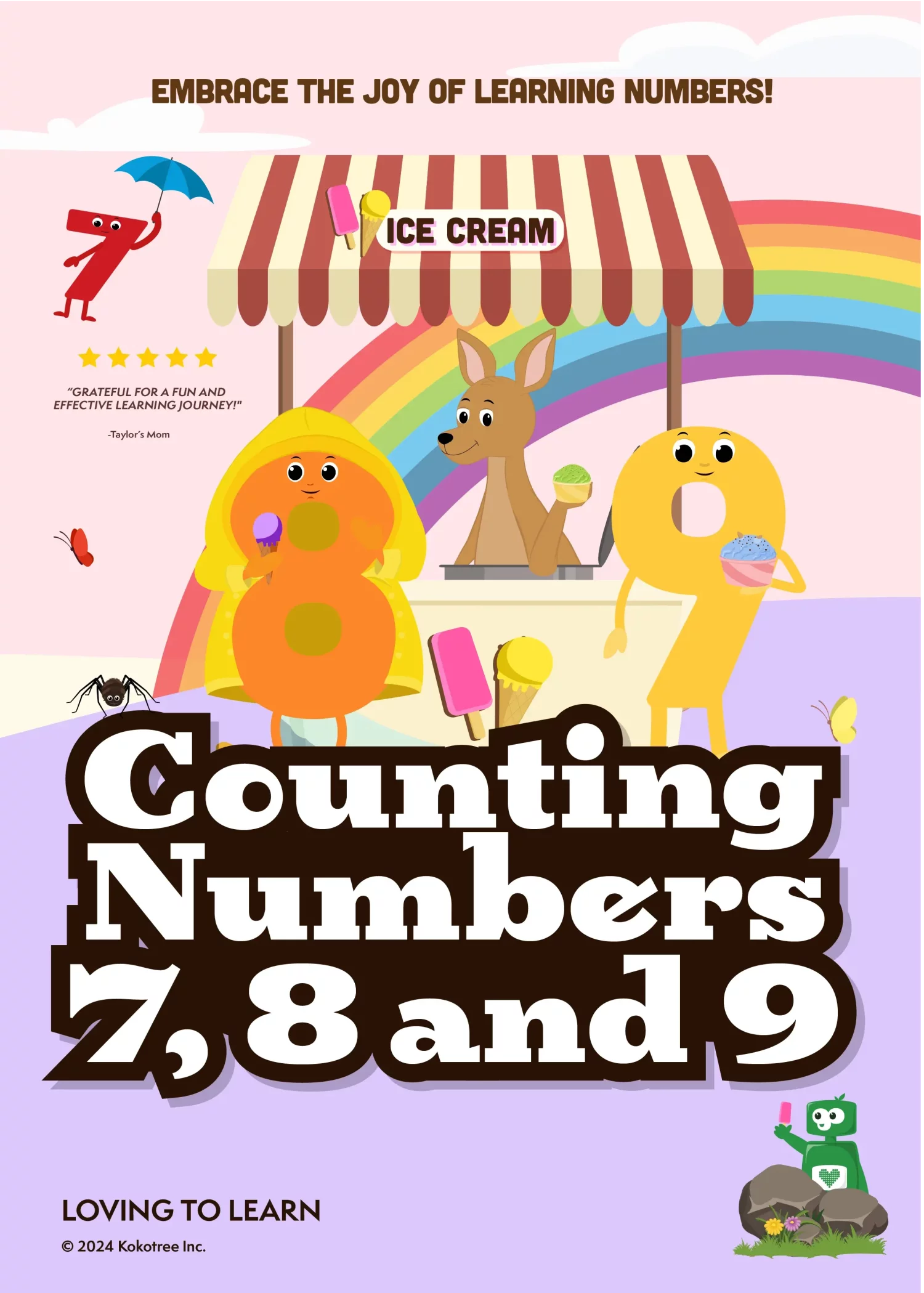
Your little one joins the Kokotree animal friends on an ice cream adventure where counting becomes absolutely delicious! They'll master numbers 7, 8, and 9 through catchy songs and real-world examples they can spot everywhere.
9.5 minutes
Ages 3-5
Skill: Counting and number recognition (7-9)
Your kid watches friendly animals count ice cream scoops together. You get 9 minutes to enjoy your coffee while it's still warm.
The Kokotree Class takes a walk on a sunny day when they discover an ice cream vendor with every flavor imaginable. As each friend gets a scoop, Mr. Rocko leads the counting—first seven ice creams, then eight, then nine! Singing number characters pop in with catchy songs about where we find these numbers in real life.
What your child learns:
This video builds counting confidence by connecting numbers to things kids already love. Each number gets its own memorable song packed with real-world examples like rainbow colors, octopus arms, and baseball teams.
- Counting objects from 1-9 with one-to-one correspondence
- Recognizing numbers 7, 8, and 9 by sight
- Understanding that numbers represent real quantities
- Connecting numbers to everyday objects (rainbow colors, spider legs, tic-tac-toe squares)
- Sequential counting as new items are added to a group
They'll use these skills when:
- Counting snacks at the table ("I have nine grapes!")
- Spotting numbers on signs, clocks, and books during errands
- Playing games that involve counting spaces or pieces
- Sharing toys equally among friends at playdates
The Story (what keeps them watching)
Mr. Rocko leads Tiki Tiger, Ruby Rabbit, Maddy Monkey, Bobby Bear, Gina Giraffe, Eddie Elephant, and Ronnie Rhino on a walk to Newburg. When they spot an ice cream vendor, Mr. Rocko treats everyone! They count seven ice creams for seven friends. A sudden rainstorm sends them into a cave where they admire a seven-colored rainbow—and meet the singing Number Seven! Mr. Rocko gets the eighth ice cream, then the vendor gets the ninth. Each new number brings a fun character with a catchy song about where that number appears in our world.
How We Teach It (the clever part)
- First 3 minutes: Sets up the story and introduces counting to seven through the ice cream purchase. Kids watch Mr. Rocko point to each friend while counting, modeling one-to-one correspondence.
- Minutes 3-7: Numbers 7 and 8 arrive with songs that connect these quantities to familiar things (rainbow colors, octopus arms, days of the week). Each counting moment is visually reinforced with highlighted objects.
- Final 2.5 minutes: Number 9 appears, and the whole group recounts all nine ice creams together, cementing the full sequence.
Teaching trick: Each time a new ice cream is added, the whole group counts from one again. This repetition with growing quantities helps kids understand that adding one more means saying the next number—a foundational math concept.
After Watching: Quick Wins to Reinforce Learning
- Mealtime activity: "Let's count how many bites are on your plate!" Start with seven items (peas, crackers, berries) and add one at a time to reach nine. (Practices adding one more and recounting)
- Car/travel activity: "Can you find the number 7, 8, or 9 on signs or buildings?" Call out each discovery like a treasure hunt. (Builds number recognition in real environments)
- Bedtime activity: "Let's count seven stuffed animals, then add your favorite to make eight!" Line them up and point to each one. (Reinforces one-to-one correspondence)
- Anytime activity: "How many fingers am I holding up?" Show 7, 8, or 9 fingers and have them count. Then switch roles! (Makes counting interactive and playful)
When Kids Get Stuck. And How to Help.
- "My child keeps skipping numbers when counting." - Totally normal! Slow down and touch each object as you count together. The video shows Mr. Rocko pointing to each friend—do the same with toys or snacks at home.
- "They can say the numbers but don't seem to understand what they mean." - This is the difference between rote counting and number sense. Use the ice cream example: "If we have eight cookies and eat one, how many are left?" Concrete objects make abstract numbers real.
- "Seven, eight, and nine seem too advanced for my child." - If they're comfortable with 1-6, they're ready! The video builds from counting seven (which includes 1-6 review) and only adds one number at a time. Watch it together and pause to count along.
What Your Child Will Learn
Prerequisites and Building Blocks
Children benefit most from this video when they can already count to six with confidence and recognize numbers 1-6 by sight. This episode builds directly on earlier Kokotree counting videos covering numbers 1-3 and 4-6, extending the number sequence while reinforcing foundational counting principles. The progression follows developmental math standards by introducing just three new numbers while continuously reviewing the full sequence from one, ensuring mastery through repetition rather than overwhelming young learners.
Cognitive Development and Teaching Methodology
The video leverages concrete-representational-abstract (CRA) methodology perfectly suited for preschoolers. Children first see concrete objects (ice cream scoops), then representational numbers appear above each item, connecting quantity to symbol. The catchy songs provide auditory anchoring while the visual highlighting addresses kinesthetic learners who benefit from seeing the counting action. Repetitive counting from one each time a new ice cream is added builds procedural fluency and reinforces cardinality—the understanding that the last number counted represents the total quantity.
Alignment with Educational Standards
This video addresses Common Core Math Standard K.CC.A.3 (writing numbers 0-20) through number recognition and K.CC.B.4 (understanding counting relationships). It supports kindergarten readiness indicators requiring children to count to ten with one-to-one correspondence. The real-world connections (rainbow colors, spider legs, baseball players) align with NAEYC guidelines emphasizing meaningful math contexts. Teachers expect incoming kindergartners to count objects to ten reliably—this video builds that exact skill.
Extended Learning Opportunities
Pair this video with Kokotree's printable number tracing worksheets for 7, 8, and 9 to build number writing skills alongside recognition. The app's "Count and Match" game reinforces these specific numbers through interactive play. Extend learning by creating a number hunt around your home—find seven books, eight blocks, nine crayons. For advanced learners, introduce simple addition: "We have seven, and one more makes...?" This connects to upcoming addition concepts in the curriculum.
Transcript Highlights
- Teaching one-to-one correspondence: "Mr. Rocko starts to point at each of the Kokotree Class as he counts... 'One. Two, three, four, five, six, and... seven.'"
- Connecting numbers to real life (Number 7's song): "Seven colors of the rainbow, Seven days of a week in a flow, Seven Wonders of the world, And the continents on the Earth"
- Building number sense (Number 8's song): "Eight arms of the octopus, It moves them all nonstop, Eight legs of the scorpion... Eight legs of the spider"
- Reinforcing sequential counting: "One. Two. Three. Four. Five. Six. Seven. Eight... and nine."
Character Development and Story Arc
Mr. Rocko models excellent teaching behaviors throughout—he turns everyday moments into learning opportunities and celebrates each discovery. The singing number characters (Seven, Eight, Nine) demonstrate enthusiasm for learning, showing children that numbers have personality and appear everywhere in our world. Eddie Elephant's curiosity ("How do you know that, Mr. Rocko?") models asking questions, while Ruby Rabbit's observation about rainbow colors shows children noticing patterns. The group's collaborative counting demonstrates that learning is a social, joyful activity.
Mathematical Foundations: Understanding Quantity and Cardinality
Numbers 7, 8, and 9 represent a significant cognitive leap for young children. While quantities 1-5 can often be "subitized" (recognized instantly without counting), larger numbers require deliberate counting strategies. This video builds crucial understanding of cardinality—the principle that when counting objects, the last number spoken represents the total quantity of the set.
The repeated counting sequences serve a vital mathematical purpose. Each time the group adds an ice cream and recounts from one, children internalize that adding one more object means saying one more number in the sequence. This is foundational for addition concepts they'll encounter later.
The number songs brilliantly connect abstract numerals to concrete quantities children can visualize: seven rainbow colors, eight octopus arms, nine baseball players. Research shows that multiple representations of the same number strengthen number sense. When a child can think "eight means octopus arms AND spider legs AND reindeer," they develop flexible mathematical thinking.
The visual highlighting during counting addresses a common error: children often count too fast or skip objects. By showing each ice cream light up as it's counted, the video models the deliberate pointing-and-counting strategy that ensures accuracy. Parents can replicate this at home by touching each object while counting together, building the motor-verbal coordination that supports mathematical precision.