
What's Letter D About?
Your little learner joins Miss Meera for an imaginative journey through a dream world filled with dinosaurs, dolphins, and dancing daffodils—all while mastering the letter D! They'll come away recognizing the "duh" sound and writing both uppercase and lowercase D with confidence.
10 minutes
Ages 2-5
Skill: Letter recognition and phonics
Your kid watches animals explore a magical D-word dream adventure. You get 10 minutes to [enjoy your coffee/fold laundry/take a breath].
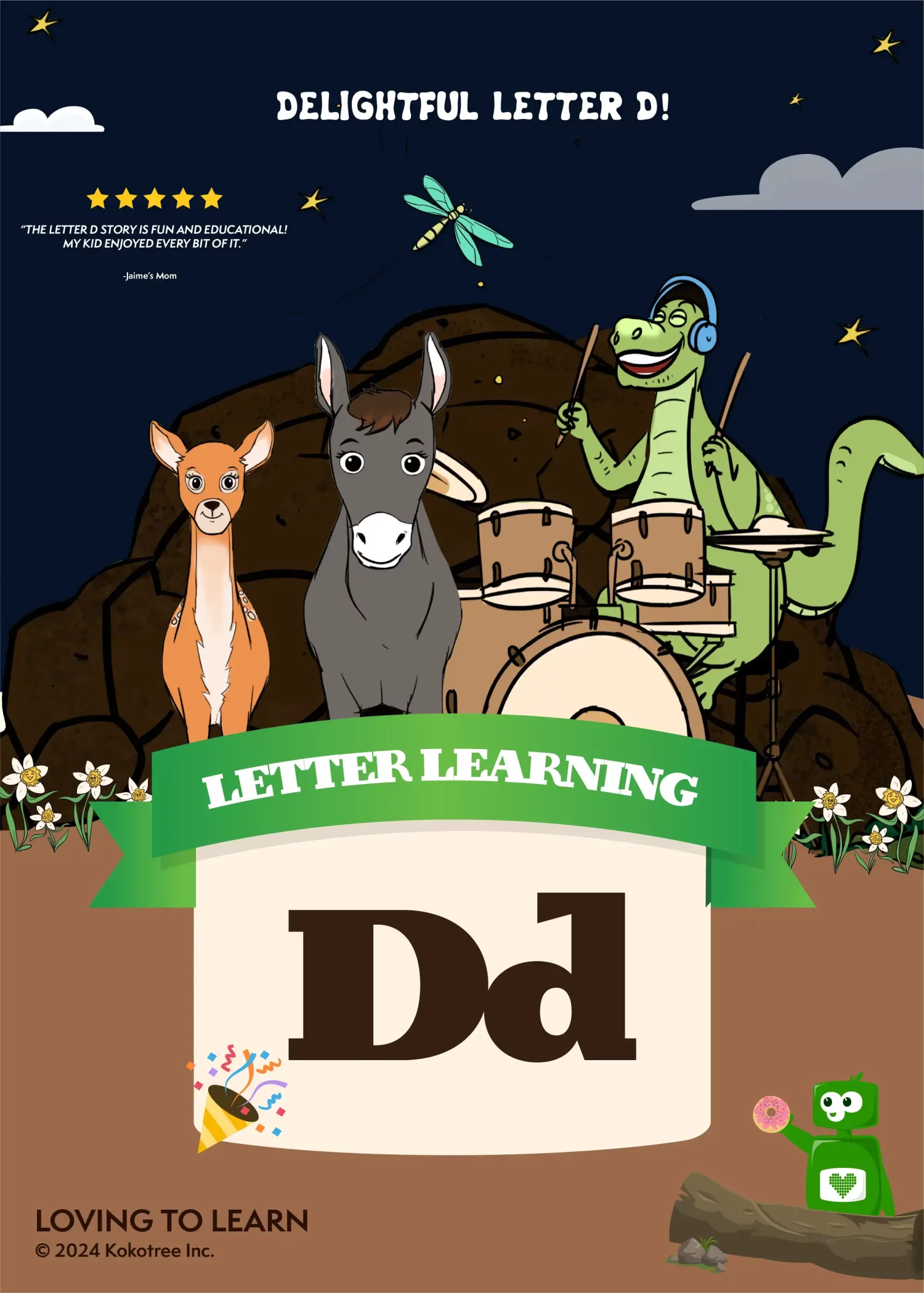
Miss Meera gathers her animal students on the playground and tells them an enchanting story about Dora the Donkey who dreams of a mysterious red door. Through the door, Dora discovers dolphins, ducklings, dragonflies, and even a drum-playing dinosaur—each one reinforcing that satisfying "duh" sound.
What your child learns:
This video builds strong phonemic awareness by connecting the letter D to its sound through memorable story elements and interactive riddles. Children also practice letter formation with clear, step-by-step guidance.
- Recognizes uppercase D and lowercase d by sight
- Produces the "duh" phoneme correctly and consistently
- Identifies words that start with the D sound (dinosaur, duck, donut)
- Writes uppercase D using "standing line plus curve" technique
- Writes lowercase d using "circle plus standing line" method
They'll use these skills when:
- Spotting the letter D on cereal boxes, street signs, and book covers
- Sounding out new words during storytime ("D-d-d... dog!")
- Writing their name if it contains a D
- Playing alphabet games with friends or siblings
The Story (what keeps them watching)
Dora the Donkey wakes up from a mysterious dream about a big red door hidden deep in the forest. With her friend Diana the Deer, she ventures into a dark den, follows glowing red dots, and pushes through a door shaped like the letter D. On the other side? Pure magic! Dancing daffodils, friendly dolphins, quacking ducklings, a sparkling dragonfly, and—wait for it—a dinosaur playing drums! Just as Dora gets lost in this dreamlike wonderland, her mother's voice calls her back to the barn. It was all a dream, but the "duh" sounds stick around forever!
How We Teach It (the clever part)
- First 3 minutes: Miss Meera introduces the letter D and its "duh" sound, then launches into Dora's captivating story, naturally embedding D-words throughout the narrative.
- Minutes 4-7: The story continues with dolphins, ducks, dragonflies, dinosaurs, and more—each word reinforced visually and verbally. After the story, students recall D-words they heard, practicing phonemic identification.
- Final 3 minutes: Interactive riddles test comprehension (doll, duck, donut), followed by explicit letter-writing instruction for both uppercase D and lowercase d with visual memory aids.
Teaching trick: The story uses a door shaped like the letter D as a central plot device—so every time kids see a door in real life, they'll remember the letter D and its shape!
After Watching: Quick Wins to Reinforce Learning
- Mealtime activity: "Can you find something on your plate that starts with the 'duh' sound?" (Works great with drinks, dips, or if you're lucky—donuts! Reinforces sound-to-word connection.)
- Car/travel activity: "Let's spot things outside that start with D—dogs, doors, dirt!" (Turns any trip into a phonics scavenger hunt without any prep.)
- Bedtime activity: "What would YOU see behind a magical D door in your dreams?" (Encourages creative thinking while reinforcing the D sound through imagination.)
- Anytime activity: "Let's draw a big D together—standing line first, then curve!" (Use a finger on a foggy window, in sand, or on their back for tactile learning.)
When Kids Get Stuck. And How to Help.
- "My child confuses D with B." - Totally normal! Point out that D's belly faces right (like it's looking at the next letter). Practice tracing both letters side by side to feel the difference.
- "They can say the sound but can't write the letter." - Writing comes after recognition—that's the natural order! Keep practicing the "standing line plus curve" motion in the air or on different surfaces before paper.
- "The lowercase d seems harder for them." - Lowercase letters are trickier for little hands. Start with the circle first (like drawing a ball), then add the tall line. Bigger movements help build muscle memory.
What Your Child Will Learn
Prerequisites and Building Blocks
Children benefit most from this video if they've been introduced to basic letter concepts and understand that letters represent sounds. This lesson builds beautifully on earlier alphabet videos (A, B, C) and reinforces the pattern of connecting phonemes to graphemes. It prepares learners for upcoming consonant lessons while strengthening the foundational skill of phonemic isolation—hearing that first sound in a word.
Cognitive Development and Teaching Methodology
The narrative-based approach leverages preschoolers' natural love of stories to create emotional anchors for learning. By embedding D-words in an adventure context, the video activates episodic memory alongside semantic learning. Visual learners benefit from on-screen text and letter demonstrations, auditory learners from repeated "duh" sounds, and kinesthetic learners from the invitation to trace letters along with Miss Meera.
Alignment with Educational Standards
This video supports Common Core Foundational Skills for Reading (RF.K.1d, RF.K.3a) focusing on letter recognition and letter-sound correspondence. It addresses kindergarten readiness indicators for print awareness and phonological awareness. The letter formation instruction aligns with handwriting standards emphasizing proper stroke sequence and directionality expected before formal schooling.
Extended Learning Opportunities
Pair this video with Kokotree's letter D tracing activities and the "D Sound Sort" game in the app. Print simple worksheets featuring D-word pictures for coloring and labeling. Create a "D Discovery Box" at home filled with small objects (toy dinosaur, plastic duck, play donut) for hands-on sorting practice that extends screen learning into tactile exploration.
Transcript Highlights
- "It sounds like duh...duh. D says duh... duh." (Clear phoneme introduction with repetition)
- "Can you hear the duh sound in doll? Duh...duh...Doll." (Guided phonemic awareness practice)
- "First, make a standing line. Then go back to the top, slide right and make a curve till the bottom of the standing line." (Explicit stroke-by-stroke letter formation)
- "Draw a circle below the middle line. Then, go back to the top line and draw a standing line just touching the circle till the bottom line." (Lowercase formation with spatial guidance)
Character Development and Story Arc
Dora the Donkey models curiosity and courage—she's initially frightened by her dream but chooses to explore rather than retreat. Diana the Deer demonstrates supportive friendship, encouraging Dora with enthusiasm ("Sounds like it could be quite the discovery!"). Together they show that learning adventures are better with friends, and that persistence through uncertainty (the "dull and dark" den) leads to wonderful discoveries.
Phonics Deep Dive: The Power of the Letter D
The letter D holds a special place in early phonics instruction because it produces one of the clearest, most consistent sounds in English. Unlike vowels or letters like C and G that change sounds based on context, D reliably produces the voiced alveolar stop /d/—that satisfying "duh" that children can feel vibrating in their throat.
This video masterfully introduces D through what literacy experts call "embedded phonics"—weaving target sounds into meaningful narrative context. Research shows that children retain phonemic information better when it's connected to story and emotion rather than presented in isolation. Dora's dream adventure creates what cognitive scientists call "elaborative encoding"—the more connections a child's brain makes to new information, the stronger the memory.
The progression from sound recognition to letter formation follows the developmental sequence recommended by reading specialists: hear it, say it, see it, write it. Miss Meera's riddles add an important metacognitive layer, asking children to actively retrieve D-words rather than passively receive them. This retrieval practice strengthens neural pathways far more effectively than simple repetition.
The visual mnemonic of the D-shaped door is particularly clever. Memory research confirms that unusual, vivid images create stronger recall than abstract symbols. Every time your child sees a door, they now have a built-in reminder of the letter D—learning that literally walks through their daily life.
For children ready to advance, this foundation prepares them for consonant blends (dr- in drum, dream) and eventually reading simple CVC words containing D (dad, did, dug).