
What's Are You My Mother About?
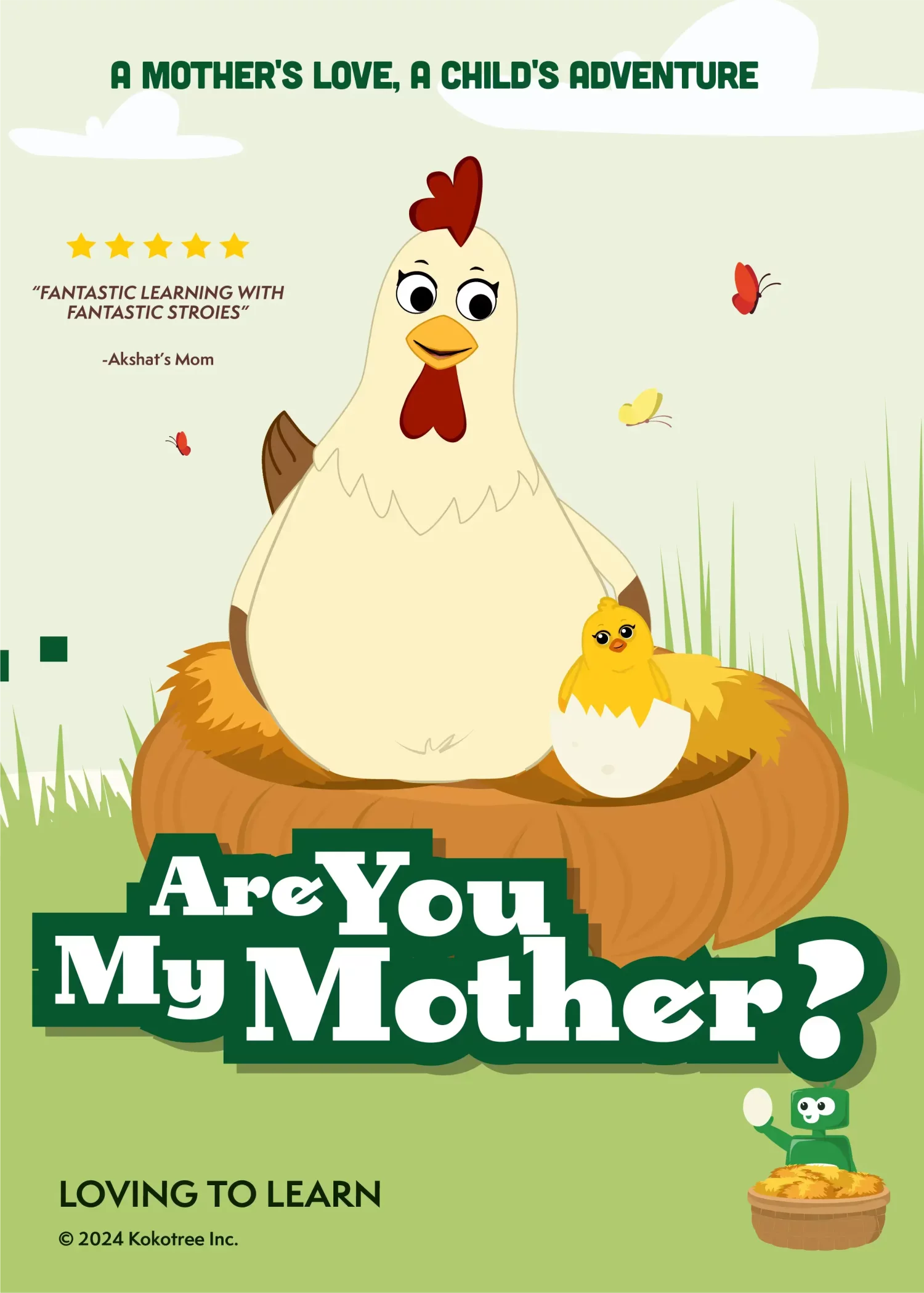
Your little one joins Miss Meera for an adorable story about a baby chick who hatches alone and must find his mother by learning what makes him unique. They'll discover how to identify animals by their features and understand the importance of asking for help.
6 minutes
Ages 1-6
Skill: Animal identification and physical characteristics
Your kid watches a baby chick learn what wings and beaks are. You get 6 minutes to finish that cup of coffee.
Miss Meera gathers the Kokotree class for Story Day and tells the tale of a baby chick who rolls out of his nest before his mother returns. The adorable chick meets different animals—a kitten, dog, cow, and monkey—each helping him understand what features to look for in his mother.
What your child learns:
This story teaches children how to identify animals by their physical features like wings, beaks, and feathers. They'll also learn about problem-solving through asking questions and the value of persistence when searching for answers.
- Identifying animal body parts (wings, beak, feathers, paws)
- Understanding that baby animals look like their parents
- Asking for help when confused or lost
- Listening carefully to gather information
- Persistence in solving problems
They'll use these skills when:
- Spotting birds at the park and describing what they see
- Matching baby animals to their parents in picture books
- Asking grown-ups for help finding something they've lost
- Describing what makes different pets unique at a friend's house
The Story (what keeps them watching)
Mother Hen leaves her egg to find food, but the egg has other plans—it jumps right out of the nest and rolls down the hill! Baby Chick hatches at the bottom, totally confused about where (and who!) his mother is. He asks a kitten, meets a helpful dog, chats with a cow, and gets great advice from a monkey who points out that Baby Chick has wings, a beak, and feathers. Armed with this new knowledge, Baby Chick rushes up the hill and reunites with his worried mother for the sweetest hug ever!
How We Teach It (the clever part)
- First 2 minutes: Miss Meera builds excitement for Story Day and introduces the concept of a lost baby chick, sparking curiosity about how he'll find his mother.
- Minutes 2-5: Baby Chick encounters different animals, each interaction teaching a new physical characteristic. The monkey's explanation of wings, beak, and feathers is the key learning moment.
- Final minute: The joyful reunion reinforces that understanding your own features helps you find where you belong, plus Miss Meera encourages retelling the story.
Teaching trick: Each animal Baby Chick meets contributes one piece of the puzzle. The kitten ignores him (not his family), the dog offers help, the cow gives direction, and the monkey names his features—building understanding layer by layer.
After Watching: Quick Wins to Reinforce Learning
- Mealtime activity: "What does a chicken have that we don't?" Point to your nose and ask what a chicken has instead. Practice naming beak, wings, and feathers while they eat their nuggets.
- Car/travel activity: "I spy something with feathers!" Look for birds outside and describe what makes them different from dogs or cats you see.
- Bedtime activity: "If you were lost, what would you tell someone to help find me?" Practice describing physical features like hair color or glasses—just like Baby Chick learned!
- Anytime activity: Flip through a picture book and play "match the baby." Point to baby animals and find their parents based on similar features.
When Kids Get Stuck. And How to Help.
- "My child doesn't understand why the chick didn't know his mother" - Totally normal! Explain that Baby Chick had never seen his mother before because he was inside his egg. Ask your child what they would do if they woke up somewhere new.
- "They keep mixing up animal features" - This is part of learning! Make it a game by pointing to your arm and asking "Is this a wing or a paw?" Silly comparisons help cement the differences.
- "The story seems too simple for my child" - Try extending it! Ask what other animals Baby Chick could have met, and what features those animals have. Let them create their own version of the adventure.
What Your Child Will Learn
Prerequisites and Building Blocks
Children benefit from basic familiarity with common animals like chickens, dogs, cats, and cows before watching. This video builds on foundational vocabulary about animals introduced in earlier Kokotree content. It serves as a bridge between simple animal recognition and more complex classification skills, preparing children for sorting animals by characteristics like "animals with feathers" versus "animals with fur" in future lessons.
Cognitive Development and Teaching Methodology
The narrative structure leverages young children's natural affinity for stories with clear problems and resolutions. By having Baby Chick encounter multiple animals, the video uses spaced repetition—each interaction reinforces the question-asking pattern while introducing new vocabulary. Visual learners see the features, auditory learners hear them named, and the emotional journey keeps kinesthetic learners engaged through the character's movement and searching.
Alignment with Educational Standards
This video supports early science standards for life sciences, specifically identifying basic external features of animals. It aligns with kindergarten readiness indicators for vocabulary development and listening comprehension. The problem-solving narrative supports social-emotional standards around asking for help and persistence—skills teachers expect children to demonstrate when entering structured learning environments.
Extended Learning Opportunities
Pair this video with animal sorting activities in the Kokotree app where children group animals by features. Print simple worksheets showing animal outlines where children can label "beak," "wings," and "feathers." Extend learning with nature walks to spot real birds, or use toy animals for hands-on sorting games. The retelling prompt at the end encourages language development through storytelling practice.
Transcript Highlights
- "I don't have a beak and wings the way you do. I guess your mother probably looks like you." - The monkey introduces the key concept that babies resemble their parents.
- "You have wings. And a beak. And feathers." - The dog and monkey collaborate to name Baby Chick's features, modeling how to describe physical characteristics.
- "Okay. Well that helps me narrow it down." - Baby Chick demonstrates using new information to solve a problem.
- "Why don't you go and tell this story to your friends and family?" - Miss Meera encourages retelling, reinforcing comprehension and communication skills.
Character Development and Story Arc
Baby Chick models the learning journey beautifully—starting confused and scared, then actively seeking help rather than giving up. Each animal he meets demonstrates different helpful behaviors: the dog offers companionship, the cow gives directions, and the monkey provides crucial information. This shows children that different helpers contribute different things, and that persistence pays off. The joyful reunion rewards Baby Chick's effort and bravery.
Animal Classification and Physical Features Deep Dive
Understanding that animals have distinct physical features is a foundational life science concept that children begin developing between ages 2-5. This video introduces taxonomic thinking at its most basic level—the idea that we can identify and categorize living things by observable characteristics.
The features highlighted—wings, beaks, and feathers—are defining characteristics of birds, making this an early introduction to classification. When the monkey explains that Baby Chick's mother "probably looks like you," the video touches on heredity in age-appropriate terms: offspring resemble their parents.
The teaching approach mirrors how scientists classify animals: by observing and naming specific features. Children naturally engage in this type of thinking when they notice that dogs have four legs while birds have two, or that fish have scales while mammals have fur. This video scaffolds that natural curiosity into structured vocabulary.
Research shows that children learn classification best through concrete examples rather than abstract rules. By showing Baby Chick next to a kitten (no beak), a dog (no feathers), a cow (no wings), and a monkey (none of the above), children see clear contrasts that make bird features memorable.
This foundational understanding prepares children for more complex sorting activities, habitat discussions, and eventually understanding food chains and ecosystems. The emotional story wrapper ensures the scientific content sticks—children remember what Baby Chick learned because they cared about his journey home.