
What's Letter H About?
Your child joins the Kokotree classroom for a storytelling adventure that sneakily teaches them all about the letter H! They'll master the "huh" sound, identify H-words everywhere, and learn to write both uppercase and lowercase H.
6 minutes
Ages 3-5
Skill: Letter recognition and phonics
Your kid watches Maddy share his hat story while learning letter H. You get 6 minutes to finish your coffee in peace.
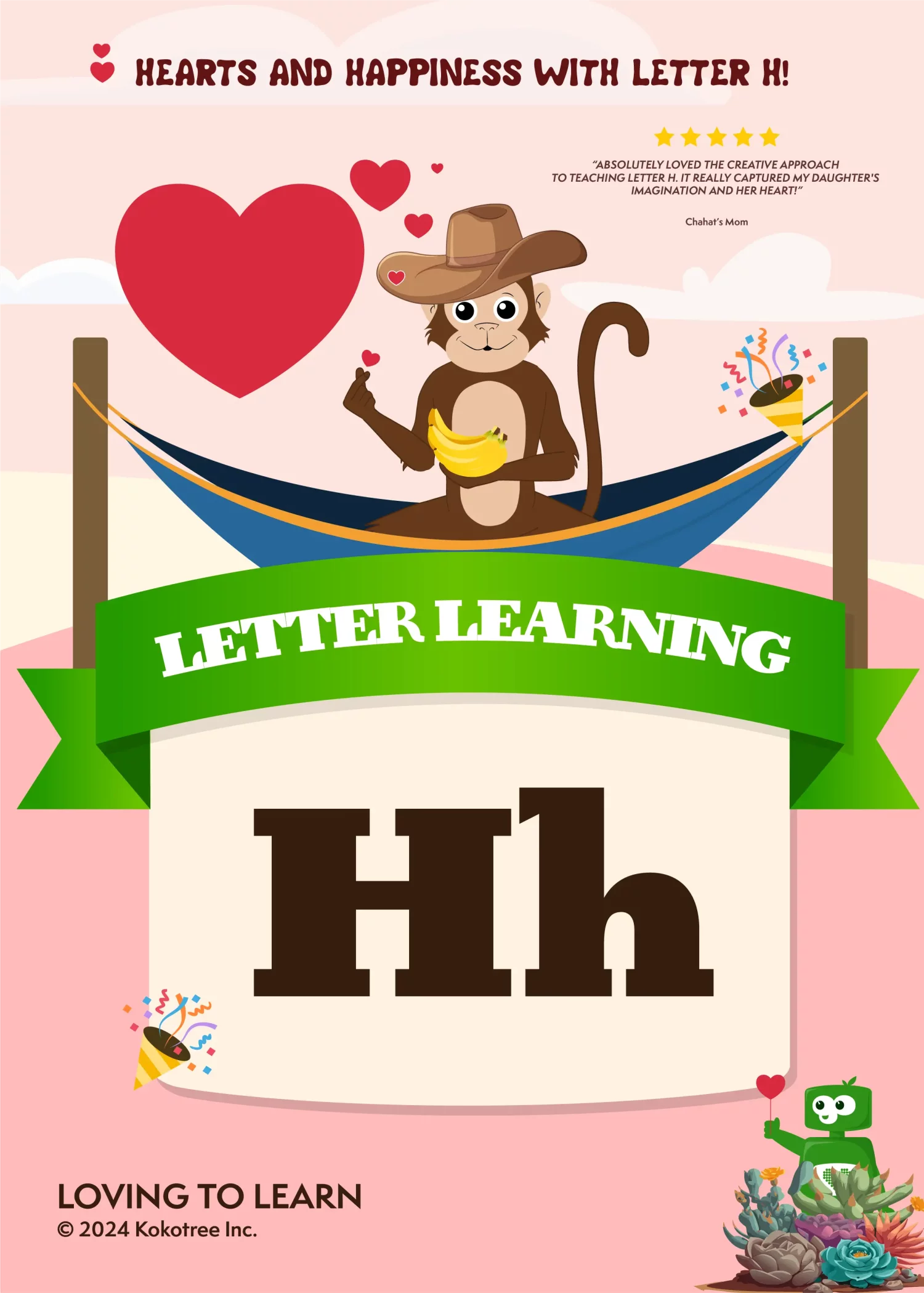
Maddy the monkey shows off his cool cowboy hat and tells the class how he got it as a surprise gift. Miss Meera cleverly points out that the story was packed with H-words—hat, hut, hammock, happy, hopping! Then she guides everyone through the "huh" sound and teaches them to write H step by step.
What your child learns:
This video builds essential pre-reading skills by connecting the letter H to its sound and real words kids already know. Your child practices both listening for sounds and forming letters—two foundations for reading success.
- Recognizes the letter H in uppercase and lowercase forms
- Produces the "huh" phonetic sound correctly
- Identifies H-words in everyday vocabulary (hat, heart, home, hands)
- Writes uppercase H using the "down, down, across" method
- Writes lowercase h using the "down, up, around, and down" stroke pattern
They'll use these skills when:
- Spotting the letter H on street signs, books, and food packages at the grocery store
- Sounding out new words while reading picture books together
- Writing their name if it contains the letter H
- Playing alphabet games with friends or siblings
The Story (what keeps them watching)
Maddy bounces into class wearing an enormous cowboy hat, and everyone wants to know where he got it! He tells the tale of finding it on a hammock outside his hut—a surprise gift from his Uncle Hubert. Miss Meera uses this moment brilliantly, asking the class if they noticed a special sound repeated throughout the story. Bobby Bear guesses correctly: it's the "huh" sound! From there, the whole class hunts for H-words together before learning to write the letter. The clever twist? Miss Meera keeps accidentally saying more H-words, making everyone giggle.
How We Teach It (the clever part)
- First 2 minutes: Maddy's engaging hat story naturally introduces multiple H-words (hut, hammock, happy, hopping, hat, Hubert) without explicitly teaching yet—building curiosity and exposure.
- Minutes 2-4: Miss Meera reveals the pattern, teaches the "huh" sound, and the class brainstorms H-words together (hat, hill, hands, heart, home), making learning collaborative and interactive.
- Final 2 minutes: Step-by-step letter formation for both uppercase and lowercase H, with memorable visual cues like "two friends holding hands" for uppercase H.
Teaching trick: The story-first approach means kids hear the "huh" sound naturally repeated 10+ times before they're asked to identify it—building phonemic awareness through immersion rather than drilling.
After Watching: Quick Wins to Reinforce Learning
- Mealtime activity: "Can you find something on your plate that starts with H?" (Hot dog, hamburger, honey—or play the sound game: "Does 'ham' start with huh-huh-H?")
- Car/travel activity: "Let's be H detectives! Can you spot anything outside that starts with the 'huh' sound?" (Houses, hills, horses on signs—keeps them scanning and thinking)
- Bedtime activity: "Draw an H in the air with your finger—remember, down, down, across!" (Reinforces muscle memory for letter formation without needing paper)
- Anytime activity: "Put your hand on your heart. Can you feel it beating? Heart starts with H! What else on your body starts with H?" (Hands, head, hair—connects learning to their own body)
When Kids Get Stuck. And How to Help.
- "My child keeps confusing H with other letters" - Totally normal! The letter H looks similar to I, N, and M to little eyes. Emphasize the "two friends holding hands" visual—that bridge in the middle is what makes H special.
- "They can say the sound but can't find H-words on their own" - Sound isolation takes practice. Start with yes/no questions: "Does 'horse' start with huh?" before asking them to generate words independently.
- "The lowercase h seems too hard for them" - Lowercase letters with humps (h, n, m) are tricky! Let them master uppercase first—there's no rush. When ready, practice the "up and around" motion in sand, shaving cream, or with finger paint to build muscle memory.
What Your Child Will Learn
Prerequisites and Building Blocks
Before watching Letter H, children benefit from basic alphabet awareness—knowing that letters exist and have names. This video builds on foundational phonemic awareness skills introduced in earlier Kokotree lessons. It fits into the systematic phonics progression, where each letter's sound is taught individually before blending begins. Children who have explored letters with simpler formations (like I, L, or T) will find H's straight lines familiar.
Cognitive Development and Teaching Methodology
This video leverages narrative-based learning, proven effective for ages 3-5 when attention spans are short but story engagement is high. The embedded phonics approach (hiding H-words in Maddy's story) activates pattern recognition skills. Visual learners benefit from the chalkboard demonstrations, auditory learners from repeated "huh" sounds, and kinesthetic learners from the invitation to write in sand or air. The "two friends holding hands" metaphor uses concrete imagery to anchor abstract letter shapes.
Alignment with Educational Standards
This lesson aligns with Common Core Foundational Skills RF.K.1d (recognize uppercase and lowercase letters) and RF.K.3a (demonstrate basic knowledge of letter-sound correspondences). It supports kindergarten readiness benchmarks for letter identification and phonemic awareness. Teachers expect incoming kindergarteners to recognize most letters and produce their sounds—this video directly builds those competencies through explicit instruction and guided practice.
Extended Learning Opportunities
Pair this video with Kokotree's Letter H tracing worksheets for fine motor practice. Explore the "H Hunt" game in the app where children tap H-words in illustrated scenes. Extend learning with playdough letter formation, creating H shapes with craft sticks, or going on a real-world H scavenger hunt. Follow up with videos on letters with similar formations (I, T, L) or similar sounds (soft H versus silent H in advanced lessons).
Transcript Highlights
- Sound introduction: "'Huh' is the sound of the Letter H. Let's practice that sound. Like, huh... huh... hairy. Huh... huh... horse. Huh... huh... happy."
- Collaborative word-finding: "Can you also hear the 'huh' sound in the word hill? Huh... huh... hill."
- Uppercase formation: "Start at the topline and make a line down till the baseline. Then, go back to the top and make another line down all the way to the baseline. Next, go to the middle and make a line across."
- Visual memory aid: "Uppercase H appears as if two friends are standing and holding hands. Down, down, across."
Character Development and Story Arc
Maddy models enthusiasm for sharing and storytelling, demonstrating confidence when speaking to a group. Bobby Bear shows active listening by correctly identifying the repeated sound—modeling how paying attention leads to learning success. Miss Meera exemplifies encouraging teaching, praising attempts ("Good job Bobby!") and celebrating discoveries. The characters demonstrate curiosity when finding new H-words together, showing children that learning is collaborative and joyful rather than solitary or stressful.
Phonics Deep Dive: The Letter H and Early Literacy Development
The letter H holds a unique position in early phonics instruction. Its sound—a voiceless glottal fricative—is produced by pushing air through an open throat, making it one of the easier consonant sounds for young children to articulate. Unlike sounds requiring precise tongue placement (like L or R), the "huh" sound comes naturally to most children by age 3.
This video employs the embedded phonics method, where target sounds appear naturally in context before explicit instruction. Research shows this approach builds stronger phonemic awareness than isolated drill because children's brains are wired to detect patterns. By the time Miss Meera asks "what sound was repeated," children have already heard "huh" unconsciously in hut, hammock, hat, happy, hopping, and Hubert.
The letter formation instruction follows developmental handwriting research. Uppercase H uses only straight lines—vertical and horizontal—which are easier for developing fine motor control than curves. The memorable phrase "down, down, across" creates a verbal motor plan that children can repeat while writing, reducing cognitive load. The "two friends holding hands" visualization transforms an abstract symbol into a meaningful image, leveraging the brain's superior memory for concrete concepts.
Lowercase h introduces the first curved element (the hump), preparing children for similar letters like n, m, and r. Teaching both cases together helps children understand that letters have multiple forms while representing the same sound—a crucial insight for reading fluency.