
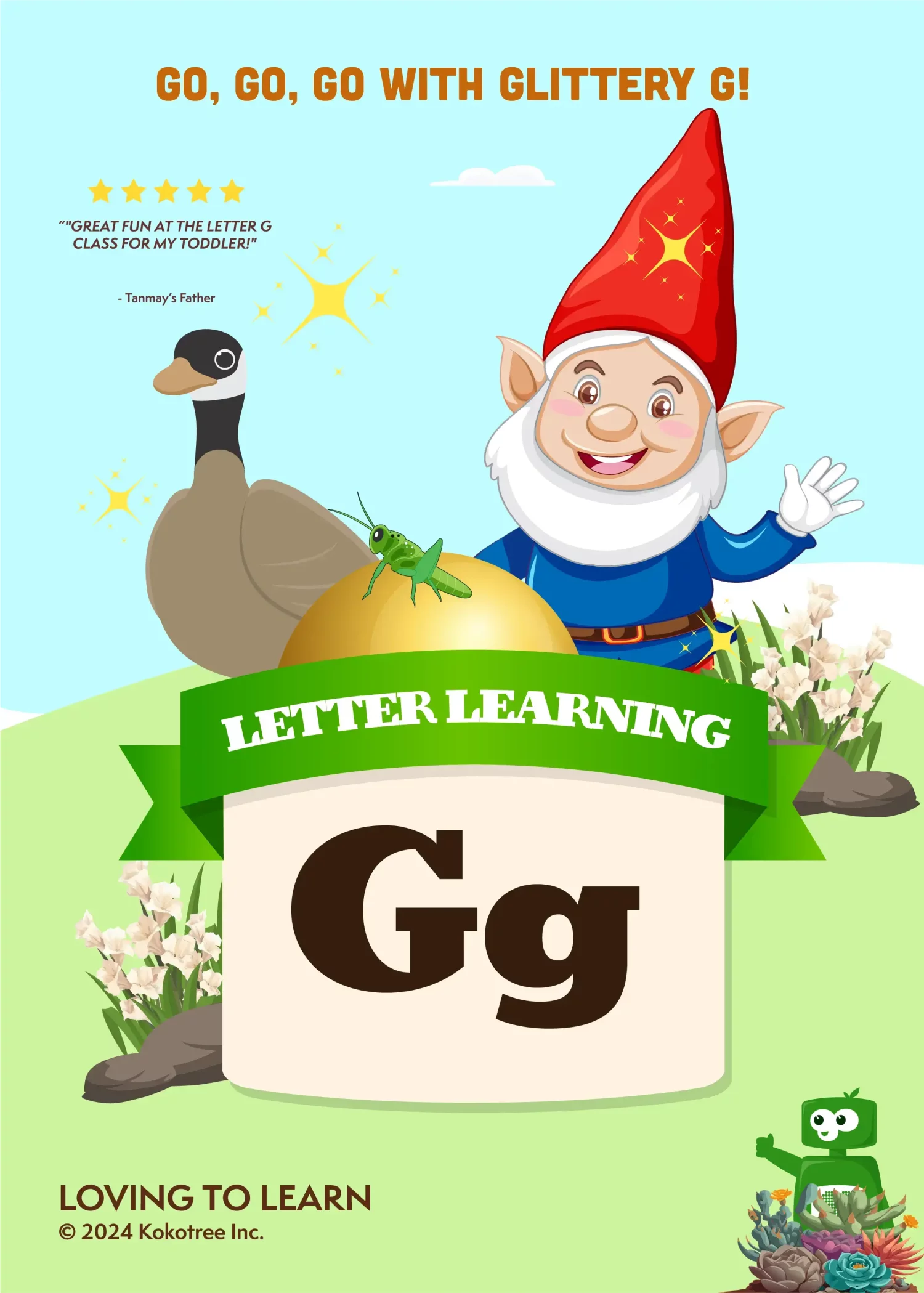
What's Letter G About?
Your little learner joins Miss Meera for a glowing adventure through a magical gnome garden—all while mastering the letter G! They'll practice the "guh" sound, identify G-words in a story, and learn to write both uppercase and lowercase G.
8 minutes
Ages 3-5
Skill: Letter recognition and phonics
Your kid watches friendly animals discover G through storytelling. You get 8 minutes to enjoy your coffee while it's still warm.
The video opens with Ronnie, Ruby, and Maddy playing catch with a golden ball. Miss Meera arrives and tells an enchanting story about gnomes caring for a glowing golden ball in a beautiful garden. The class then practices the "guh" sound together, identifies G-words from the story, and learns step-by-step how to trace both uppercase and lowercase G.
What your child learns:
This video builds essential pre-reading skills by connecting the letter G to its sound through repetition and storytelling. Your child will hear dozens of G-words in context, making the "guh" sound memorable and meaningful.
- Recognizes the letter G in uppercase and lowercase forms
- Produces the "guh" phonetic sound correctly
- Identifies words that begin with the G sound
- Traces uppercase G using proper stroke order
- Traces lowercase g with the descender below the baseline
They'll use these skills when:
- Spotting the letter G on grocery store signs and food packages
- Sounding out words in picture books at bedtime
- Writing their name if it contains the letter G
- Playing "I Spy" games looking for G-words around the house
The Story (what keeps them watching)
Miss Meera captivates the class with a tale about hardworking gnomes who tend a magical garden lit by a grand glowing golden ball. When the ball starts to fade and turn grey, the gnomes work together day after day to polish it back to brilliance. The grass, goats, grasshoppers, and guava tree all come back to life! After the story, the class discovers they've been hearing the "guh" sound all along. Bobby even spots a gaggle of geese outside—and one goose is standing in the shape of the letter G! Perfect timing for a writing lesson.
How We Teach It (the clever part)
- First 3 minutes: Children are drawn in through play and storytelling, hearing G-words naturally woven throughout the gnome garden tale without explicit instruction yet.
- Minutes 3-6: Miss Meera reveals the pattern—the "guh" sound—and leads call-and-response practice with words like golden, glow, grand, green, and grass. Students contribute their own G-words too.
- Final 2 minutes: Step-by-step letter formation instruction for both uppercase G and lowercase g, with clear verbal cues and visual demonstrations.
Teaching trick: The story is packed with alliteration ("grand glowing golden ball") so children hear the G-sound repeated naturally before being asked to identify it—building phonemic awareness through immersion rather than drilling.
After Watching: Quick Wins to Reinforce Learning
- Mealtime activity: "Can you find something on your plate that starts with G?" (Grapes, green beans, granola—practice connecting sounds to real objects)
- Car/travel activity: "Let's play the G game! Point to anything you see that starts with guh-guh-G." (Grass, garage, gas station—builds observation skills and sound recognition)
- Bedtime activity: "Trace a big G on my back with your finger while I guess what letter it is!" (Reinforces letter formation through touch without paper)
- Anytime activity: "Let's be gnomes! What G-words can we act out?" (Gallop, giggle, grow—connects movement to learning)
When Kids Get Stuck. And How to Help.
"My child keeps confusing G with C" - That's actually great pattern recognition! Both letters curve the same way. Point out that G has a little "shelf" or "sleeping line" that C doesn't have. Practice tracing both side by side.
"They can make the sound but can't write the letter" - Totally normal! Sound recognition develops before fine motor skills. Let them trace G in sand, shaving cream, or with a finger in the air before expecting pencil work.
"The lowercase g seems too hard with that tail" - Miss Meera calls it a "heavy baby" for a reason! Start with uppercase G only. When ready for lowercase, use four-line paper and emphasize that the tail goes below—just like the letter hangs down to rest.
What Your Child Will Learn
Prerequisites and Building Blocks
Children benefit from prior exposure to curved letters, especially the letter C, which Miss Meera directly references during instruction. This video builds on basic letter recognition skills and assumes familiarity with the concepts of uppercase and lowercase. It fits within a sequential phonics progression, ideally viewed after letters A-F. Children should be comfortable with call-and-response activities and have developing fine motor readiness for tracing.
Cognitive Development and Teaching Methodology
This video leverages narrative-based learning, which activates memory centers more effectively than rote instruction for preschoolers. The story-first approach builds phonemic awareness implicitly before explicit instruction begins. Visual learners benefit from the goose-shaped G demonstration, auditory learners from repeated "guh" sounds, and kinesthetic learners from the tracing invitation. The call-and-response format supports active participation and verbal processing.
Alignment with Educational Standards
This lesson aligns with Common Core Foundational Skills RF.K.1d (recognize uppercase and lowercase letters) and RF.K.3a (demonstrate basic knowledge of letter-sound correspondences). It supports kindergarten readiness indicators for letter naming fluency and phonemic awareness. The handwriting instruction follows developmental guidelines for proper stroke sequence, preparing children for manuscript writing expectations in early elementary grades.
Extended Learning Opportunities
Pair this video with letter G tracing worksheets available in the Kokotree app. Extend learning with the "G Sound Hunt" game where children photograph G-items around the home. Create a "G Garden" collage using magazine cutouts of green grass, grapes, and other G-words. Practice letter formation in sensory bins filled with rice or sand. Follow up with related phonics videos covering similar curved letters.
Transcript Highlights
- "'Guh' is the sound of the Letter G." - Clear, direct phonics instruction connecting sound to symbol.
- "We will start below the headline and circle back around, ending at the midline. Now slide left making a small sleeping line." - Precise verbal cues for uppercase G formation.
- "Oh this baby is a little heavy, we need one extra line below the baseline to give it support." - Child-friendly language making the descender concept memorable.
- "You can practice at home in a sandbox or on some notebook paper or even with a stick in the dirt." - Empowering children with multiple practice options.
Character Development and Story Arc
The Kokotree class models collaborative learning beautifully—Ronnie shares his golden ball, students take turns answering, and everyone participates in call-and-response. Bobby demonstrates observational skills by noticing the geese outside, showing children that learning opportunities exist everywhere. Miss Meera validates each student's contribution ("Well done, Gina!" "Wonderful, Ronnie!"), modeling encouragement and creating a safe space for trying. The gnomes in the story demonstrate persistence and teamwork, polishing the ball "day after day" until they succeed.
Phonics Deep Dive: The Letter G and Early Literacy Development
The letter G presents unique challenges and opportunities in early phonics instruction. As a "stop consonant," the /g/ sound is produced by briefly stopping airflow at the back of the throat—making it satisfying for children to produce with emphasis ("guh-guh-golden").
This video wisely focuses exclusively on the "hard G" sound heard in words like garden, gold, and green. The "soft G" (as in giraffe or gentle) follows different phonetic rules and is appropriately saved for later instruction. By building strong hard-G recognition first, children develop a reliable foundation.
The alliterative story serves a crucial phonological purpose: when children hear "grand glowing golden ball" and "grass, grasshoppers, goats, gladiolus, and guava," they're processing the /g/ phoneme in initial position repeatedly. Research shows this type of exposure—hearing target sounds in meaningful context—builds stronger phonemic awareness than isolated drill.
Letter formation instruction addresses a common challenge: G is one of the few letters requiring children to change direction mid-stroke. The "circle back around" language helps children understand they're making a C-shape first, then adding the distinguishing horizontal line. For lowercase g, the descender (tail below the baseline) introduces children to letters that occupy more vertical space—preparing them for y, p, q, and j.
The visual connection between the goose's pose and the letter G exemplifies embodied cognition—linking abstract symbols to concrete, memorable images. This technique helps children recall letter shapes by connecting them to the physical world around them.