
What's Letter N About?
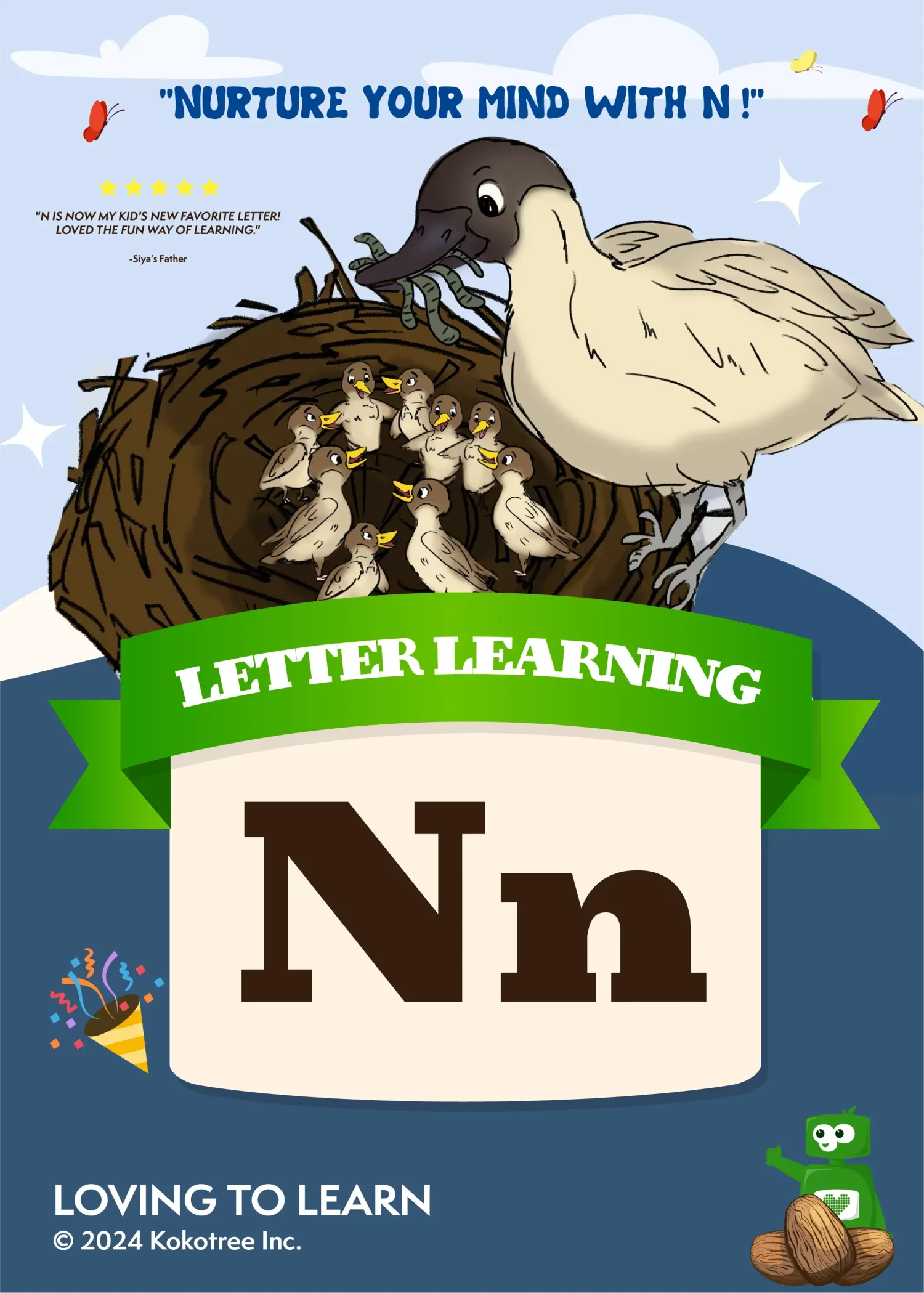
Your little one joins the Kokotree Class on a jungle adventure where they discover a nest of hungry chicks and learn all about the letter N! They'll master the "nuh" sound, spot N words everywhere, and practice writing both uppercase and lowercase letters.
8 minutes
Ages 2-5
Skill: Letter Recognition & Phonics
Your kid watches friendly animals discover N words in nature. You get 8 minutes to enjoy your coffee in peace.
The Kokotree Class finds a nest with chirping chicks in a tree, then gathers around Miss Meera for a magical story about a nene bird and her nine eggs. Kids touch their nose, neck, and nails while practicing the "nuh" sound, then learn step-by-step letter writing in the dirt.
What your child learns:
This video builds essential pre-reading skills by connecting the letter N to its sound and real objects kids can see and touch. Through storytelling and body movement, children develop phonemic awareness that forms the foundation for reading success.
- Recognizes uppercase N and lowercase n by sight
- Produces the "nuh" phonetic sound correctly
- Identifies N at the beginning of words (nest, nuts, nine, nose, neck, nails)
- Writes uppercase N using "down, slant right, up" strokes
- Writes lowercase n using "down, up and around" motion
They'll use these skills when:
- Spotting the letter N on cereal boxes, signs, and books at home
- Sounding out new words while learning to read
- Writing their name if it contains the letter N
- Playing alphabet games with friends or siblings
The Story (what keeps them watching)
Gina Giraffe hears chirping in the jungle and discovers hungry chicks in a nest! Maddy Monkey swings up to deliver nuts to the babies, showing kindness in action. Then Miss Meera gathers everyone for a special story about a nene bird—the world's rarest goose—who hatches nine eggs in November. The baby birds nibble nits, nestle in feathers, and eventually fly free! Back in the jungle, the class celebrates by finding N words in their own bodies—nose, neck, and nails—before learning to write the letter together.
How We Teach It (the clever part)
- First 3 minutes: The story hook! Kids meet the hungry chicks and naturally encounter "nest" and "nuts"—their first N words—in a real context that makes the letter meaningful.
- Minutes 3-6: Miss Meera's nene bird story layers in dozens of N words (nine, November, noon, nap, nibble, nourish, nestle) through engaging narrative, building phonemic awareness through repetition.
- Final 2 minutes: Physical practice time! Kids touch body parts (nose, neck, nails) while saying the sound, then follow step-by-step letter formation for both cases.
Teaching trick: The video uses body-part identification (nose, neck, nails) so kids can practice the "nuh" sound while touching something real—making the abstract letter concrete and memorable through kinesthetic learning.
After Watching: Quick Wins to Reinforce Learning
- Mealtime activity: "Can you find something on your plate that starts with N?" Point out noodles, napkins, or even say "Nuh-nuh-nibble your food!" (Practices sound recognition in everyday context)
- Car/travel activity: "Let's count to nine together! Nuh-nuh-nine!" Then spot things outside that might start with N. (Reinforces number-letter connection)
- Bedtime activity: "Touch your nose, then your neck, then your nails—and say the nuh sound for each one!" (Builds muscle memory for the phoneme)
- Anytime activity: Use your finger to trace a big N in the air together. Say "Down, slant right, up!" as you go. (Practices letter formation without any materials)
When Kids Get Stuck. And How to Help.
- "My child keeps mixing up N and M sounds" - Totally normal! These letters look and sound similar. Practice by exaggerating: M has your lips together (mmm like humming), N has your tongue behind your teeth (nnn). Touch your nose for N!
- "She can say the sound but doesn't recognize the letter" - Sound awareness often develops before visual recognition. Keep pointing out the letter N in books and signs. Say "Look! There's the N that makes the nuh sound!" Connection builds with exposure.
- "The uppercase N seems too hard to write" - Start BIG! Draw it in sand, trace it in shaving cream, or use your whole arm in the air. Fine motor skills for pencil grip come later—right now, the motion matters most.
What Your Child Will Learn
Prerequisites and Building Blocks
Children benefit most from this video after exposure to earlier alphabet letters, particularly M (referenced directly in the lesson). Familiarity with basic letter concepts—that symbols represent sounds—helps learners connect the "nuh" phoneme to its written form. This video builds on emerging phonemic awareness and prepares children for subsequent letters while reinforcing the alphabetical sequence. No prior writing skills are required, as formation is taught from scratch.
Cognitive Development and Teaching Methodology
This lesson employs multisensory learning principles ideal for ages 2-5. Visual learners see the letter displayed and highlighted in words. Auditory learners hear the "nuh" sound repeated consistently. Kinesthetic learners touch body parts (nose, neck, nails) while producing the sound, creating motor-memory associations. The embedded narrative activates imagination and emotional engagement, which research shows improves retention in early childhood.
Alignment with Educational Standards
This video addresses foundational literacy standards including letter recognition (identifying N in isolation and words), phonemic awareness (isolating initial sounds), and print concepts (understanding letters represent sounds). These skills align with kindergarten readiness benchmarks and pre-K learning objectives. Letter formation instruction supports fine motor development and early writing standards expected before formal schooling begins.
Extended Learning Opportunities
Pair this video with letter N tracing worksheets or sandpaper letter activities for tactile reinforcement. Encourage nature walks to find "N things" (nests, nuts). The Kokotree app offers interactive games for letter-sound matching and formation practice. Create an "N collection" with small objects (toy narwhal, napkin, number nine) for hands-on sorting activities that extend screen learning into physical play.
Transcript Highlights
- Sound introduction: "Letter N makes the sound nuh... nuh. Can you all repeat that sound?" — Direct phonemic instruction with immediate practice
- Word connection: "Nuh! As in nuts!" — Gina immediately connects abstract sound to concrete object
- Body-based learning: "You can touch your nose with your finger and say, nuh...nuh...nose." — Kinesthetic reinforcement strategy
- Writing instruction: "Start at the topline and make a line down to the baseline. Then go back to the top and slant right to the baseline. Now make one more line back to the topline." — Clear, sequential formation guidance
Character Development and Story Arc
The Kokotree Class models collaborative learning and kindness throughout this episode. When Gina discovers hungry chicks, the group problem-solves together, with Maddy volunteering her climbing skills to help. This demonstrates prosocial behavior naturally. During the lesson, characters enthusiastically participate—raising hands, offering examples, attempting challenges (touching nose with tongue)—modeling engaged learning behaviors. Their genuine excitement about discovering N words shows children that curiosity and participation make learning fun.
Phonics and Letter Formation Deep Dive
The letter N holds a crucial position in early literacy development as a nasal consonant—one of the first consonant sounds children naturally produce. The "nuh" sound is formed by pressing the tongue against the alveolar ridge (behind the upper teeth) while allowing air to flow through the nose. This makes N highly accessible for young learners compared to more complex phonemes.
This video strategically introduces N after M because these letters share visual similarities (vertical lines with connecting strokes) and phonetic properties (both are nasal consonants). By explicitly referencing "we learned Letter M," Miss Meera activates prior knowledge and helps children understand alphabetical sequence—a foundational concept for dictionary skills and organizational thinking.
The story-based approach embeds N words in meaningful context rather than isolated drill. Research in emergent literacy shows that children retain phonemic information better when sounds appear in narrative contexts. The nene bird story contains over fifteen N words (nation, nutmeg, nest, nine, nene, noon, November, nap, noise, narrow, necks, nares, nourish, nibbled, nestled), providing massive repetition without feeling repetitive.
Letter formation instruction follows developmental best practices: starting with gross motor movements (drawing in dirt, tracing in air) before expecting fine motor pencil control. The verbal cues "down, slant right, up" create memorable language patterns that children can self-talk through while practicing independently. This scaffolded approach respects the neurological reality that large muscle control develops before small muscle precision in young children.