
What's The Greedy Bird About?
Watch Ruby Rabbit learn a valuable lesson about gratitude through Miss Meera's story of a kingfisher who wanted more than he needed. Your child will understand why appreciating what we have leads to happiness!
6 minutes
Ages 3-6
Skill: Gratitude and thoughtful decision-making
Your kid watches a kingfisher learn why greed leads to loss. You get 6 minutes to enjoy your coffee while it's still warm.
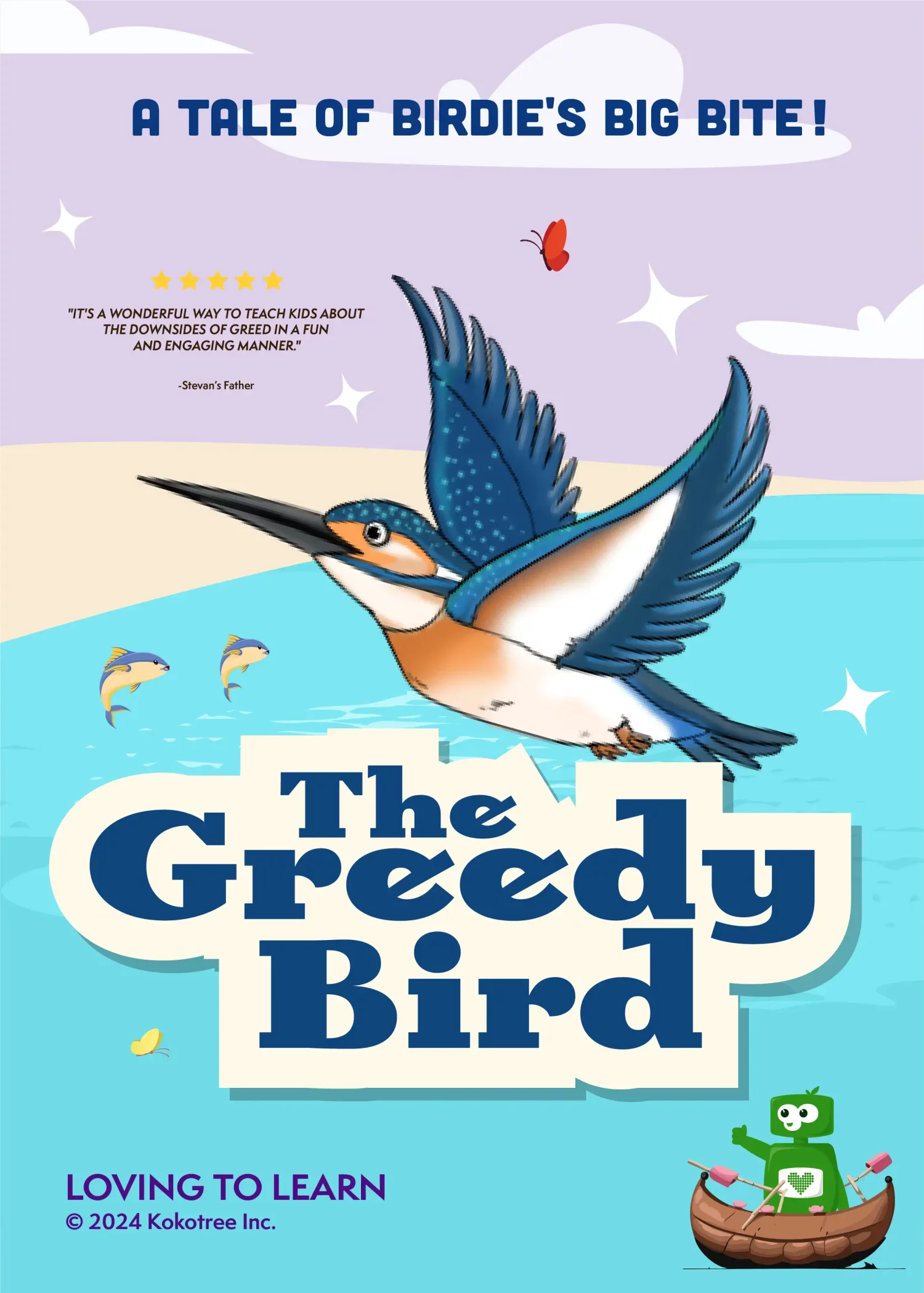
Ruby Rabbit is sad because she lost her toy car after leaving it behind, hoping to get a bigger one. Miss Meera shares a story about a kingfisher who catches a small fish but drops it to chase a bigger one—only to end up with nothing at all. The colorful jungle and river scenes bring this timeless lesson to life.
What your child learns:
Through this engaging fable, children discover that wanting more isn't always better and that appreciating what we have brings contentment. They'll practice connecting story events to real-life situations.
- Understanding cause and effect in decision-making
- Recognizing feelings of gratitude and contentment
- Connecting story lessons to personal experiences
- Identifying consequences of impulsive choices
- Building vocabulary around emotions and values
They'll use these skills when:
- Deciding whether to trade toys with a friend at the playground
- Choosing between keeping a snack now or waiting for something "better"
- Understanding why we say "thank you" for gifts, even small ones
- Learning to appreciate their belongings instead of always wanting new things
The Story (what keeps them watching)
Ruby Rabbit arrives at class upset—she lost her tiny toy car! But here's the twist: she left it on purpose, hoping her parents would buy her a bigger one like her friend Jessica's. When the big cars sold out, her small car was gone too. Miss Meera shares a story about a kingfisher who catches a small fish but drops it to chase a bigger one. The big fish escapes, and the bird goes hungry. Ruby realizes she made the same mistake. The beautiful jungle scenery and the kingfisher's adventure keep little eyes glued to the screen!
How We Teach It (the clever part)
- First 2 minutes: Ruby's problem introduces the concept—she wanted something bigger and lost what she had. Kids immediately connect with losing a favorite toy.
- Minutes 2-5: The kingfisher story shows the same lesson through nature. Children watch the bird make choices and see direct consequences unfold visually.
- Final minute: Ruby connects the story to her own experience, modeling how children can apply lessons to their lives.
Teaching trick: By showing the same lesson twice—once with Ruby's toy and once with the kingfisher's fish—children see the pattern and understand the concept more deeply.
After Watching: Quick Wins to Reinforce Learning
- Mealtime activity: "What's something on your plate you're thankful for today?" (Practices identifying things we appreciate and expressing gratitude out loud)
- Car/travel activity: "Let's play 'I'm thankful for...' and take turns naming things we see!" (Builds gratitude vocabulary and observation skills while passing time)
- Bedtime activity: "What's one toy or book you're really glad you have?" (Encourages reflection on possessions and builds contentment before sleep)
- Anytime activity: "Remember the kingfisher? Let's pretend we're birds who are happy with our small fish!" (Reinforces the story lesson through imaginative play)
When Kids Get Stuck. And How to Help.
- "My child always wants more toys—is that bad?" - Wanting new things is completely normal at this age! Use moments of wanting as opportunities to also practice gratitude for current toys.
- "They didn't understand why the bird was wrong to want the bigger fish." - Try acting it out with snacks or toys. Show them holding one thing, then dropping it to grab another that "disappears."
- "This seems too abstract for my 3-year-old." - Focus on Ruby's concrete story about the toy car. Younger children connect better with the character's experience than the fable.
What Your Child Will Learn
Prerequisites and Building Blocks
Children watching this video benefit from basic story comprehension skills and familiarity with the Kokotree classroom characters. This episode builds on foundational social-emotional concepts like identifying feelings and understanding that actions have consequences. It fits naturally after videos introducing basic emotions and prepares children for more complex decision-making scenarios. No specific academic prerequisites are needed—just readiness to listen to a short story.
Cognitive Development and Teaching Methodology
This video uses nested storytelling—a story within a story—which is developmentally appropriate for ages 3-6 as children begin understanding narrative layers. The visual representation of the kingfisher's choices supports concrete operational thinking, while Ruby's reflection models metacognition. Auditory learners benefit from Miss Meera's narration, visual learners from the animated jungle scenes, and kinesthetic connections come through the physical actions of catching and dropping.
Alignment with Educational Standards
This content aligns with social-emotional learning standards for preschool and kindergarten, specifically around self-regulation and responsible decision-making. It supports kindergarten readiness indicators for listening comprehension, sequencing story events, and identifying cause-effect relationships. Teachers expect entering kindergarteners to demonstrate basic impulse control understanding and the ability to connect story morals to personal behavior—skills this video directly develops.
Extended Learning Opportunities
Pair this video with drawing activities where children illustrate what they're thankful for. The Kokotree app offers related content on making choices and understanding feelings. Extend learning by creating a "gratitude jar" where children add notes about things they appreciate. Simple sorting games with "things I have" versus "things I want" help reinforce the concept through hands-on play.
Transcript Highlights
- "I purposely left my toy car in the park... thinking that if I lost it my parents would buy me a BIG car like that."
- "Now I neither have the big car nor my tiny car. And later I realized that I actually played a lot with my tiny car."
- "Eventually, it could not control its greed and decided to catch the big fish and free the small one."
- "It's okay to want to improve yourself and your situation. But sometimes we can get a little greedy when we should be thankful for what we already have."
Character Development and Story Arc
Ruby Rabbit demonstrates vulnerability by crying in front of friends, modeling that it's okay to express disappointment. Miss Meera shows empathetic teaching by acknowledging Ruby's feelings before offering guidance. The kingfisher serves as a relatable character who makes a mistake and learns from it. Importantly, the story ends with the bird promising to do better—showing growth mindset and that mistakes are learning opportunities, not permanent failures.
Understanding Gratitude and Impulse Control in Early Childhood
Gratitude and impulse control are foundational social-emotional skills that develop significantly between ages 3-6. At this stage, children are naturally egocentric and focused on immediate desires—wanting a bigger toy or more snacks is completely developmentally normal. The challenge isn't eliminating these desires but helping children develop the cognitive tools to pause, evaluate, and appreciate.
This video teaches gratitude through contrast—showing what happens when we don't appreciate what we have. The kingfisher's empty stomach is a concrete, understandable consequence that young minds can grasp. Research in developmental psychology shows that children learn abstract concepts like gratitude best through narrative and visual demonstration rather than direct instruction.
The "bird in hand" concept presented here connects to executive function development—specifically inhibitory control, which is the ability to resist an immediate temptation for a better outcome. Studies show this skill is highly predictive of later academic and social success. By watching the kingfisher fail to control his impulse and experiencing the consequence vicariously, children build neural pathways for their own impulse control.
Importantly, Miss Meera's closing message balances the lesson: wanting improvement isn't wrong, but it should be balanced with appreciation. This nuanced approach prevents children from feeling shame about natural desires while still teaching the value of contentment. The video models healthy emotional processing—Ruby feels sad, expresses it, receives comfort, learns something new, and feels better. This sequence teaches emotional regulation alongside the gratitude lesson.