
What's Letter Q About?
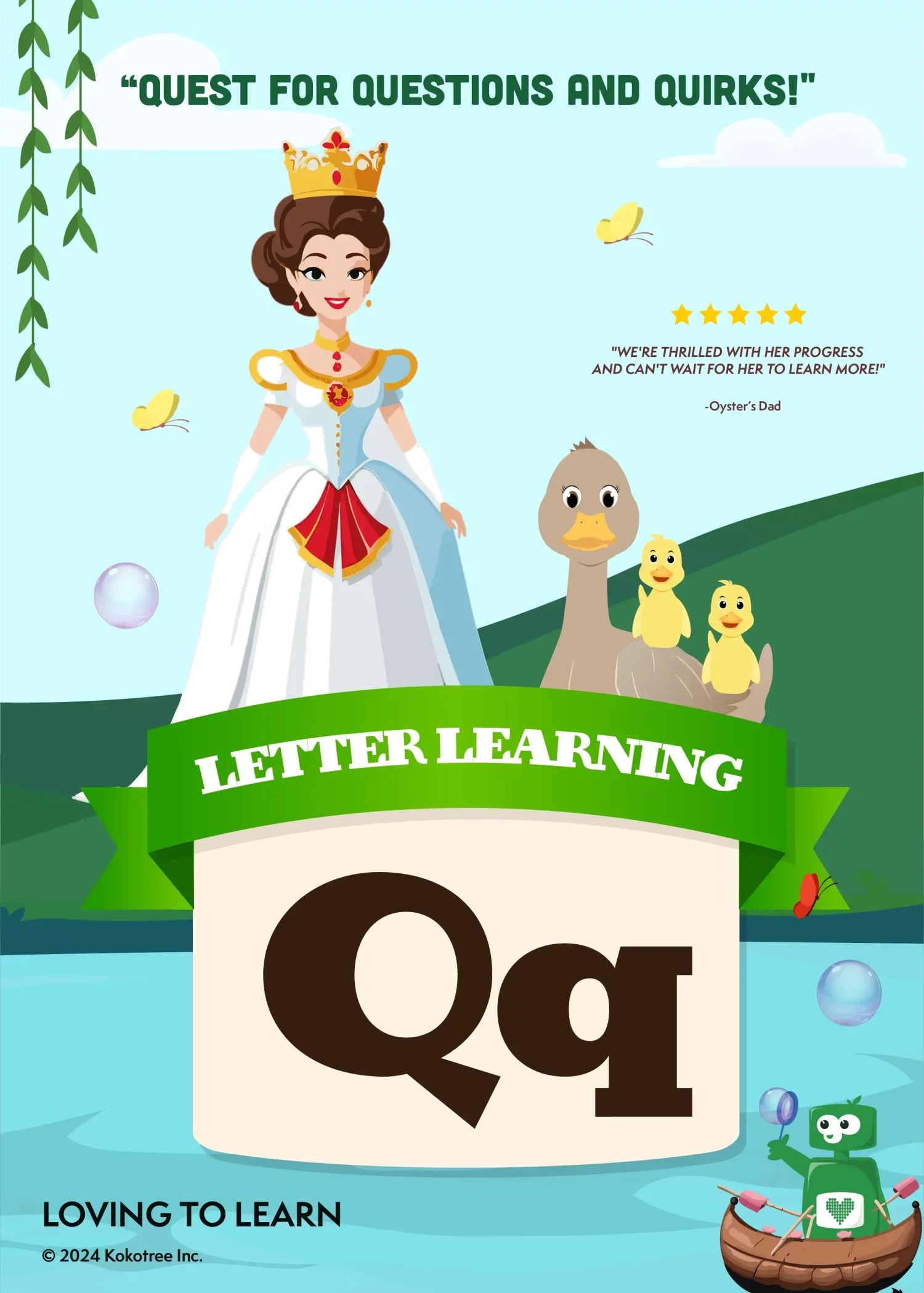
Your little one joins Miss Meera and friends on a nature adventure where baby quails inspire a whole lesson on the Letter Q! They'll master the tricky 'qwah' sound and confidently write both uppercase and lowercase Q.
10 minutes
Ages 3-6
Skill: Letter recognition, phonics, and handwriting
Your kid watches adorable quail chicks inspire a letter learning adventure. You get 10 minutes to enjoy your coffee in peace.
The Kokotree Class spots a mother quail leading her four baby chicks across a sunny field. Miss Meera uses this sweet moment to introduce the Letter Q, playing word games and teaching the unique 'qwah' sound through fun examples like quilt, queen, and quack.
What your child learns:
This video builds essential pre-reading skills by connecting the Letter Q to memorable words and sounds. Children practice identifying the 'qwah' sound in everyday vocabulary while learning proper letter formation for both uppercase and lowercase Q.
- Recognizes the Letter Q in both uppercase and lowercase forms
- Identifies the 'qwah' sound at the beginning of words
- Builds vocabulary with 12 Q words (quail, queue, quiz, quiet, quilt, queen, quack, and more)
- Practices writing uppercase Q (circle with a slanted tail)
- Practices writing lowercase q (circle with a straight line down)
They'll use these skills when:
- Spotting the letter Q on signs, books, or cereal boxes at the grocery store
- Recognizing 'Q' words during story time ("Look, that says queen!")
- Writing their first words and sounding out unfamiliar text
- Playing letter games with friends or siblings
The Story (what keeps them watching)
The Kokotree Class is enjoying a peaceful day by the river when they spot something adorable: a mother quail leading her four baby chicks in a perfect line! Ruby Rabbit wonders why they walk in a queue, and Tiki Tiger notices how quietly they move. Miss Meera reveals these are quadruplets and uses the moment to teach Letter Q. The class plays an exciting picture quiz, guesses Q words like quilt and queen, and even waddles around quacking like ducks! The lesson wraps up with everyone learning to write both versions of the letter.
How We Teach It (the clever part)
- First 3 minutes: Miss Meera introduces the Letter Q naturally through observing quails, teaching vocabulary like 'quadruplets' and 'queue' before revealing the 'qwah' sound pattern.
- Minutes 3-7: An interactive quiz keeps kids engaged as they identify Q words from pictures (question mark, quilt, queen) and sounds (quack!). The class reviews all 12 words together.
- Final 3 minutes: Step-by-step handwriting instruction breaks down both uppercase Q and lowercase q into simple movements kids can follow along with.
Teaching trick: Miss Meera uses the quail family as a memorable anchor—kids connect the abstract Letter Q to real animals they just watched, making the sound and shape stick in their memory.
After Watching: Quick Wins to Reinforce Learning
- Mealtime activity: "Can you find anything on the table that's shaped like the letter Q?" (Practices visual recognition—look for round items with a 'tail' like a spoon handle touching a plate)
- Car/travel activity: "Let's be quiet like the baby quails! Can you whisper words that start with 'qwah'?" (Reinforces the Q sound while practicing vocabulary recall)
- Bedtime activity: "Let's trace a Q on your back—can you guess uppercase or lowercase?" (Builds letter formation awareness through touch)
- Anytime activity: "Quick quiz! Is 'cat' a Q word? What about 'queen'?" (Strengthens phonemic awareness by identifying the 'qwah' sound)
When Kids Get Stuck. And How to Help.
- "My child confuses Q with O when writing." - Totally normal! Both start with a circle. Practice saying "Q has a tail!" while drawing. Point out how the quail's tail feathers stick out, just like the letter.
- "They keep saying 'kuh' instead of 'qwah' for the Q sound." - The Q sound is tricky because it's actually two sounds blended together. Practice with 'quack quack' since kids love making animal sounds—it naturally produces the correct 'qwah.'
- "My child can't remember any Q words on their own." - Q words are rare in everyday language, so this is expected! Keep a cozy quilt visible or play 'queen and king' dress-up to create real-life Q word connections.
What Your Child Will Learn
Prerequisites and Building Blocks
Children benefit most from this video after exposure to earlier alphabet letters, particularly O (since Q builds on the circular shape). Familiarity with basic phonemic awareness—understanding that letters represent sounds—helps children grasp the 'qwah' concept. This video fits mid-to-late in an alphabet sequence, as Q is less common and benefits from established letter-learning routines. Prior videos on letters like P and R provide helpful context for this stage of phonics development.
Cognitive Development and Teaching Methodology
The video leverages observational learning, beginning with real-world context (quail family) before introducing abstract concepts. This concrete-to-abstract progression aligns with preoperational cognitive development in 3-6 year olds. Visual learners benefit from on-screen text highlighting, auditory learners from repeated pronunciation, and kinesthetic learners from the handwriting segment. The interactive quiz format maintains engagement through active participation rather than passive viewing.
Alignment with Educational Standards
This video addresses Common Core Foundational Skills for Reading (RF.K.1d, RF.K.3a) focusing on letter recognition and basic phonics. It supports kindergarten readiness indicators for alphabet knowledge and emergent writing. The handwriting instruction aligns with fine motor development benchmarks, teaching proper letter formation using baseline and midline references that teachers use in classroom instruction.
Extended Learning Opportunities
Pair this video with Letter Q tracing worksheets featuring the words introduced (quail, queen, quilt). The Kokotree app's letter matching games reinforce recognition skills. Parents can create a 'Q collection' by finding household items (quilts, Q-tips) or pictures from magazines. Drawing quails or decorating paper quilts extends learning through art while reinforcing letter-sound connections.
Transcript Highlights
- "You know how twins means two kids, right? Well, quadruplets means four!" - Building vocabulary through familiar concepts
- "The sound of Letter Q is 'qwah'." - Clear, explicit phonics instruction
- "Start at the top and circle all the way to the left, like Uppercase O. Then go toward the bottom and slant right to the baseline." - Step-by-step handwriting guidance
- "The more you practice, the more quality work you can produce." - Encouraging growth mindset through practice
Character Development and Story Arc
The Kokotree Class models ideal learning behaviors throughout. Ruby Rabbit demonstrates curiosity by asking why quails walk in a queue. Gina Giraffe shows enthusiasm and quick thinking during the quiz. Eddie Elephant displays consideration by asking classmates to be quiet. Ronnie Rhino exhibits vocabulary pride, savoring new words like 'quadruplet' and 'quality.' These characters show children that asking questions, participating eagerly, and celebrating new knowledge are positive learning behaviors.
Phonics Deep Dive: The Unique Challenge of Letter Q
The Letter Q presents a fascinating phonics puzzle for young learners. Unlike most consonants that represent a single sound, Q almost always appears with U and creates the blended 'qwah' or 'kw' sound. This digraph behavior makes Q one of the trickiest letters for children to master independently.
Developmentally, children ages 3-6 are building phonemic awareness—the understanding that words are made of individual sounds. The 'qwah' sound challenges this emerging skill because it combines two phonemes (/k/ and /w/) into what sounds like one. Miss Meera's teaching approach wisely emphasizes the complete 'qwah' sound rather than isolating Q, which would produce an unnatural and unhelpful sound.
The video's vocabulary selection strategically reinforces the Q-U partnership. Words like quail, queen, quilt, and quack all follow the standard QU pattern, building reliable expectations. This consistency helps children develop orthographic mapping—the mental process of connecting letter patterns to sounds and meanings.
Handwriting instruction addresses another Q challenge: its visual similarity to O and the number 9. By teaching the 'circle plus tail' method and distinguishing uppercase Q (diagonal tail) from lowercase q (straight descender), children build the visual discrimination skills essential for reading fluency. The lowercase q also prepares children for distinguishing similar letters like p, d, and b—a common challenge in early literacy development.