
What's Up and Down About?
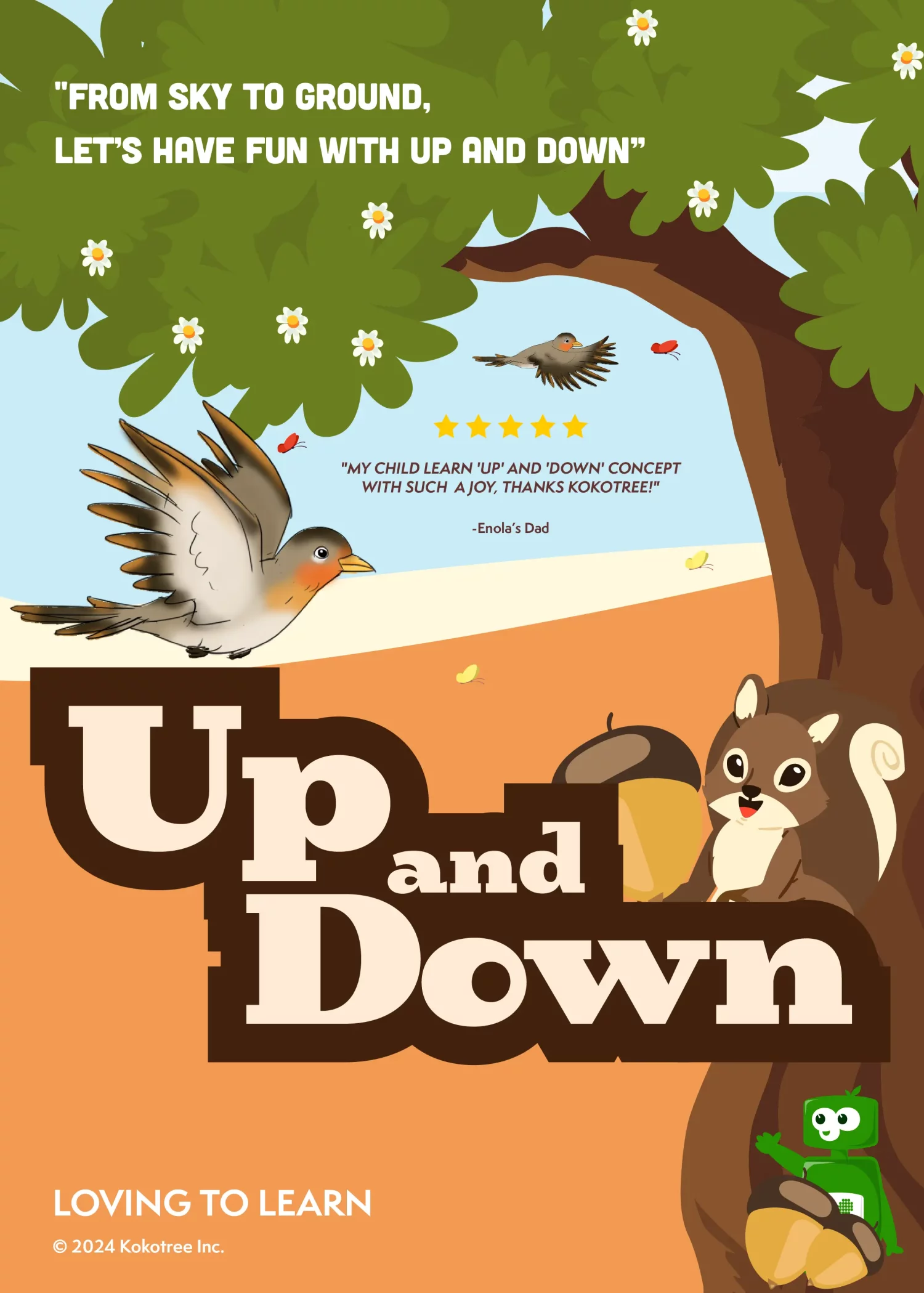
Your little one joins Miss Elizabeth and their favorite animal friends for an interactive adventure exploring the concept of up and down! Through movement games, nature exploration, and creative drawing, they'll master spatial awareness and directional vocabulary.
10 minutes
Ages 2-5
Skill: Understanding positional words and spatial relationships
Your kid watches animals play elevator games and explore nature. You get 10 minutes to enjoy your coffee while it's still warm.
Miss Elizabeth leads the Kokotree Class through a playful "elevator game" where Maddy Monkey stretches up high and crouches down low. Then the whole class heads into the forest to spot things that are up (birds, clouds, sun) and down (grass, rivers, flowers). They finish by drawing their own up-and-down pictures to share.
What your child learns:
This video builds foundational spatial awareness through movement, observation, and creative expression. Children learn that "up" and "down" aren't just words—they're directions they can see, feel, and act out with their whole bodies.
- Identifies objects positioned up high versus down low
- Uses body movements to demonstrate directional concepts
- Observes spatial relationships in nature and everyday settings
- Follows multi-step directional instructions
- Expresses understanding through drawing and verbal sharing
They'll use these skills when:
- Putting toys away on high shelves or low bins
- Following instructions like "look up at the airplane!" or "pick that up off the ground"
- Playing on playground equipment (climbing up, sliding down)
- Describing where things are to friends and family
The Story (what keeps them watching)
Miss Elizabeth turns her morning routine into a hilarious game! She describes waking up, making breakfast, and driving to school—and every time she says "up" or "down," Maddy Monkey has to move! The class giggles as Maddy jumps and crouches faster and faster. Then everyone heads to the forest where they discover up-and-down everywhere: birds flying up, squirrels climbing down, clouds up high, rivers flowing below. The adventure ends with each animal drawing something they spotted—Bobby's kite soaring up, Ronnie and Bobby on a see-saw, and Maddy piloting an airplane (complete with goggles and flying scarf!).
How We Teach It (the clever part)
- First 3 minutes: Miss Elizabeth introduces "up" and "down" through an interactive elevator game. Children watch Maddy respond to directional cues with whole-body movements—stretching tall and crouching low.
- Minutes 4-7: The class explores the forest, identifying up-and-down relationships in nature. Miss Elizabeth uses poetic language to connect concepts: leaves up on trees, grass down below, birds up in the sky, squirrels climbing down.
- Final 3 minutes: Each animal draws and shares their own up-and-down observations, reinforcing learning through creative expression and peer sharing.
Teaching trick: Miss Elizabeth embeds directional words into a relatable morning routine story, so kids hear "up" and "down" used naturally in context—not as isolated vocabulary words. When Maddy moves faster and faster during the "spoon up, spoon down" breakfast scene, the repetition becomes comedy, making the learning stick.
After Watching: Quick Wins to Reinforce Learning
- Mealtime activity: "Can you put your spoon UP to your mouth and then DOWN in your bowl?" (Reinforces the same movement pattern Maddy demonstrated—plus keeps them engaged at the table!)
- Car/travel activity: "I spy something UP high! Can you find the birds/clouds/traffic lights?" (Practices scanning and identifying positional relationships in changing environments)
- Bedtime activity: "Let's pull the blanket UP to your chin! Now let's put your head DOWN on the pillow." (Connects directional words to cozy, calming routines)
- Anytime activity: "Draw something that goes UP and something that stays DOWN—just like the Kokotree kids did!" (Zero-prep creative reinforcement using any paper and crayons you have)
When Kids Get Stuck. And How to Help.
- "My child keeps mixing up 'up' and 'down'" - Totally normal! These are abstract concepts. Try pointing dramatically while saying the words, and use your whole body like Maddy did. Physical movement helps cement the meaning.
- "They understand during the video but forget right after" - Repetition is key at this age. Play the "elevator game" at home—you say up/down, they move. Three days of quick practice usually locks it in.
- "The drawing activity seems too hard for my toddler" - Skip the drawing and just point! Walk around your home asking "Is the light UP or DOWN? Is the rug UP or DOWN?" Verbal identification works just as well for younger learners.
What Your Child Will Learn
Prerequisites and Building Blocks
Children benefit from basic vocabulary recognition and the ability to follow simple one-step instructions before watching. This video builds on foundational body awareness concepts and prepares children for more complex spatial terms like "above," "below," "over," and "under." It serves as an entry point into positional vocabulary, which later supports preposition use in language development and directional understanding in early mathematics and geography.
Cognitive Development and Teaching Methodology
The multi-modal approach—combining auditory instruction, visual demonstration, kinesthetic movement, and creative expression—addresses diverse learning styles simultaneously. At ages 2-5, children learn best through embodied cognition, where physical movement reinforces abstract concepts. The progression from watching Maddy move, to observing nature, to creating their own drawings follows Bloom's taxonomy from recognition to application to creation.
Alignment with Educational Standards
This video supports kindergarten readiness standards for spatial awareness and positional vocabulary. It aligns with Common Core Math standards for geometry (describing positions of objects) and language arts standards for vocabulary acquisition. Early childhood frameworks emphasize understanding spatial relationships as foundational for later mathematical reasoning, reading comprehension of directional text, and physical education.
Extended Learning Opportunities
Pair this video with printable worksheets featuring "circle the object that is UP" activities. The Kokotree app includes interactive games where children tap objects in correct positions. Extend learning with building block towers (stack UP, knock DOWN), ball play (throw UP, roll DOWN), and nature walks identifying birds up high and bugs down low. Reading books about airplanes, trees, or tall buildings reinforces concepts.
Transcript Highlights
- "When I say 'up,' we'll have Maddy put his hands high above his head, stretching tall like Gina Giraffe. And when I say 'down,' he will bend his knees and crouch low to the ground, small like Ruby Rabbit."
- "See, up and down can be not only directions but also actions we do with our whole body. And it can be a lot of fun!"
- "Look up at the cool fluffy white clouds! Calling down to the river so loud."
- "My head is up and my feet are down." (Tiki Tiger's observation)
Character Development and Story Arc
Maddy Monkey models enthusiastic participation and physical engagement, showing children that learning involves the whole body. Bobby Bear's comment about preferring to sit down demonstrates that different preferences are okay. Each character's unique drawing—from Tiki's self-portrait to Eddie's nature scene—shows multiple valid ways to understand and express the same concept, encouraging creative confidence and individual expression.
Spatial Awareness and Positional Language Deep Dive
Understanding "up" and "down" represents one of the earliest spatial concepts children master, typically emerging between ages 2-3 and solidifying by age 5. These foundational positional words serve as building blocks for more complex spatial vocabulary and mathematical reasoning.
From a developmental perspective, children first understand spatial relationships through their own bodies—their head is up, their feet are down. This egocentric spatial awareness gradually expands to include objects in their environment and eventually abstract representations. The video brilliantly follows this developmental progression: starting with Maddy's body movements, expanding to observations in nature, and culminating in symbolic representation through drawing.
Spatial language development directly correlates with later mathematical achievement. Research shows that children with strong positional vocabulary perform better on geometry tasks, measurement activities, and even word problems that require understanding directional relationships. When Tiki observes "my head is up and my feet are down," they're building the cognitive framework for understanding coordinate systems, graphing, and mapping.
The video's nature exploration segment introduces vertical spatial relationships in authentic contexts—birds and clouds versus grass and rivers. This environmental awareness supports early science learning by helping children organize their observations of the natural world. The drawing activity transforms passive observation into active creation, requiring children to mentally represent and reproduce spatial relationships—a key cognitive skill for later academic success in both STEAM subjects and literacy.