
What's Letter S About?
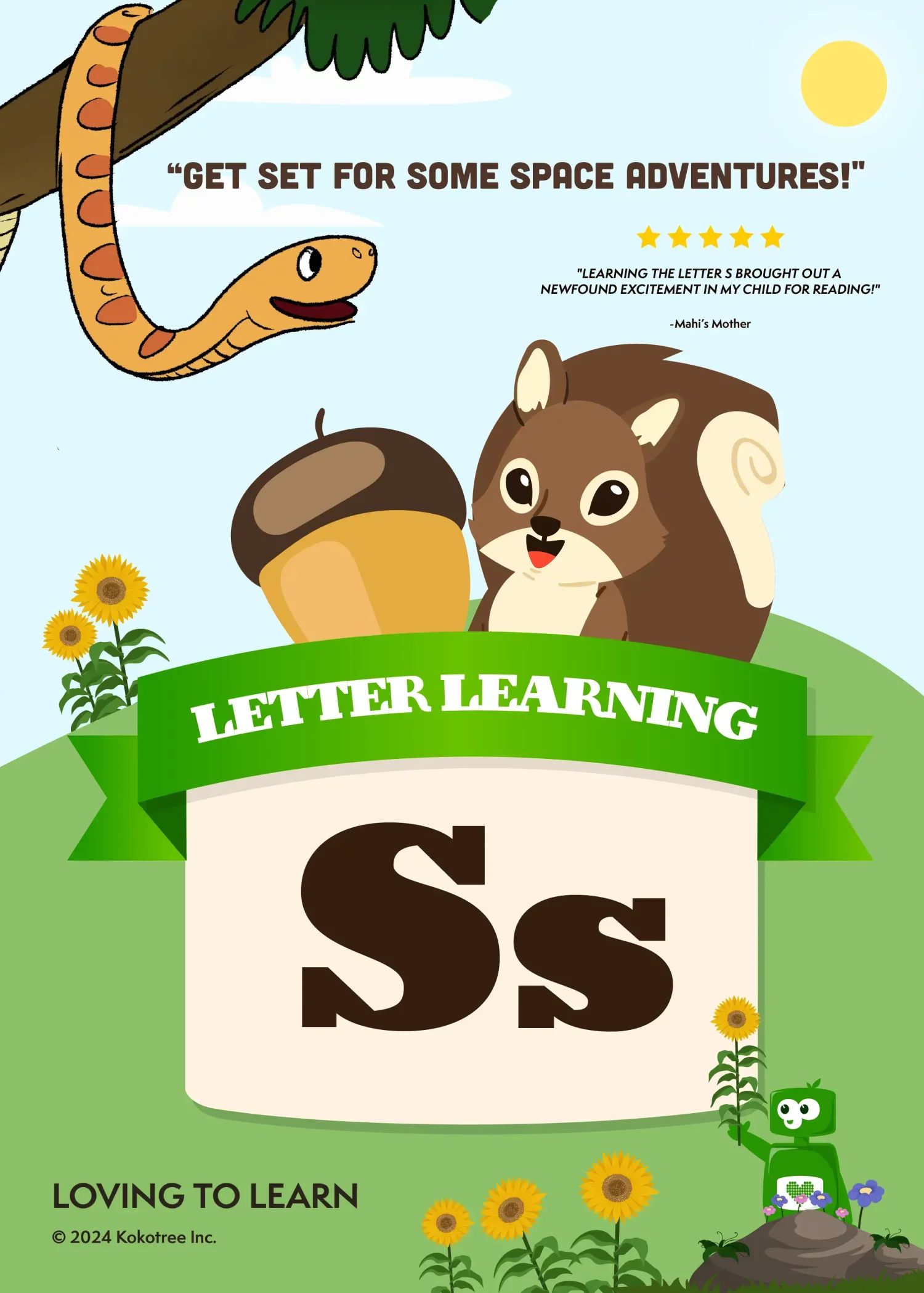
Your little learner joins Miss Meera and friendly animal friends at a sunny riverside beach to master the letter S through storytelling, sound practice, and hands-on tracing. They'll spot the S shape in swimming swans and identify the "suh" sound in over 20 different words!
9 minutes
Ages 3-5
Skill: Letter recognition and phonics
Your kid watches animals discover S sounds everywhere around them. You get 9 minutes to finish that cup of coffee while it's still warm.
The video opens at a cheerful riverside beach where the Kokotree class plays on seesaws and skateboards. Miss Meera spots swans gliding by and realizes their curved necks form the perfect letter S shape. The class gathers around for a story about Snoopy Snake and Sammy Squirrel building a space shuttle—packed with S words for your child to catch.
What your child learns:
This video builds essential pre-reading skills by connecting the letter S to its sound through repetition, storytelling, and real-world examples. Your child practices both listening for sounds and forming the letter with their finger.
- Recognizes uppercase S and lowercase s by sight
- Identifies the "suh" sound at the beginning of words
- Traces the letter S using the swan visualization technique
- Connects letter sounds to 20+ vocabulary words (snake, squirrel, space shuttle, strawberry)
- Distinguishes between uppercase and lowercase letter forms
They'll use these skills when:
- Spotting the letter S on street signs, store names, and cereal boxes
- Sounding out words in early reading books
- Writing their name if it contains the letter S
- Playing "I Spy" games with S-words at the grocery store
The Story (what keeps them watching)
Miss Meera gathers her class after noticing something special about the swans swimming nearby—their graceful necks curve just like the letter S! To help the lesson stick, she tells an adventure story about Snoopy Snake and Sammy Squirrel who dream of building a space shuttle to see Saturn and the stars. They gather supplies (six wheels, silvery sheets, screws) and spend seven days building. Launch day arrives, but oops—they forgot the engine! Instead of being upset, the silly friends laugh it off and enjoy their spinach sandwiches and strawberry shakes under a sandalwood tree. The story is stuffed with S-words, and kids love catching each one.
How We Teach It (the clever part)
- First 2 minutes: Miss Meera introduces the letter S by connecting it to the swans the children can see. Gina guesses the "suh" sound, making kids feel like they can figure it out too.
- Minutes 2-6: The Snoopy Snake and Sammy Squirrel story immerses children in S-words naturally. Words like space shuttle, Saturday, Summer, stars, and strawberry shake appear in context, reinforcing the sound without drilling.
- Final 3 minutes: The class recalls S-words from the story and their surroundings (seesaw! skateboard! sun!). Then Miss Meera teaches letter formation using the swan's shape as a guide—beak to tail—before moving to proper lined practice.
Teaching trick: The swan visualization is brilliant—kids trace from the beak, curve back along the neck, curve forward at the body, and end at the pointed tail. This gives them a memorable mental image every time they write the letter S.
After Watching: Quick Wins to Reinforce Learning
Snack time S-hunt: "What S-words can we find in the kitchen?" Look for spoons, strawberries, salt, sandwiches, or soup. Count how many your child spots and celebrate each "suh" sound they identify.
Car ride sound game: "I spy something that starts with suh!" Take turns finding S-words outside the window—signs, stores, sky, sun. This builds phonemic awareness without any prep.
Bedtime swan trace: Before lights out, trace a big S in the air together. Say "Start at the beak, curve back, curve forward, end at the tail!" Repeat three times for muscle memory.
Anytime body letters: Challenge your child to make the letter S shape with their body—lying on the floor works great! Take a photo and compare it to the swan shape from the video.
When Kids Get Stuck. And How to Help.
"My child keeps confusing S with other curvy letters like C." Totally normal! The swan trick helps because S has TWO curves (back then forward), while C only curves one way. Practice tracing both and compare: "Does a swan have one curve or two?"
"They can say the sound but can't find S-words on their own." Sound isolation takes time. Start with a choice: "Does 'sun' or 'moon' start with suh?" Binary choices build confidence before open-ended hunts.
"The letter formation seems hard—they keep making backwards S." Very common at this age! Remind them: "Start at the TOP, curve BACK first." The swan visual helps because you always start at the beak (top) and the first curve goes toward the swan's back.
What Your Child Will Learn
Prerequisites and Building Blocks
Children watching this video should have basic familiarity with the concept of letters and sounds—understanding that written symbols represent spoken sounds. This video builds on previous letter lessons in the Kokotree alphabet series and reinforces the phonemic awareness foundation. The S lesson connects naturally to earlier vowel and consonant work, preparing children for blending sounds into simple words as they progress through the Budding Sprouts program.
Cognitive Development and Teaching Methodology
The multi-sensory approach in this video aligns perfectly with how 3-5 year olds learn best. Visual learners benefit from the swan-to-letter connection and on-screen word illustrations. Auditory learners absorb the repeated "suh" sound throughout the story. Kinesthetic learners engage through finger-tracing activities. The narrative structure (story about Snoopy and Sammy) leverages children's natural love of stories to embed learning in emotional memory.
Alignment with Educational Standards
This lesson addresses Common Core Foundational Skills RF.K.1d (recognize and name uppercase and lowercase letters) and RF.K.3a (demonstrate basic knowledge of letter-sound correspondences). The video supports kindergarten readiness by building phonemic awareness—a key predictor of reading success. Teachers expect incoming kindergarteners to recognize most letters and their primary sounds; this video directly develops that competency.
Extended Learning Opportunities
Pair this video with Kokotree's Letter S tracing worksheets for fine motor practice. The app's "Sound Safari" game reinforces S-word identification through interactive play. Extend learning by creating an "S Collection"—gathering small objects starting with S (stickers, stamps, small stones) in a special box. Follow up with the Letter T video to continue alphabetic progression.
Transcript Highlights
- Sound introduction: "The sound of letter S is suh...suh...as in swan!" - Clear phoneme isolation with memorable example
- Active listening prompt: "Make sure to listen because many of the words begin with the 'suh' sound. So, stay alert!" - Engages focused attention
- Formation instruction: "Place your index finger at the edge of the beak, now curve back, then curve forward and end at the pointed tail." - Concrete visualization technique
- Skill transfer: "Start below the topline and curve back to the midline, then curve forward and end it a little above the baseline." - Bridges visualization to formal writing
Character Development and Story Arc
Miss Meera models scientific observation and discovery—her "Eureka!" moment shows children that learning happens when we pay attention to the world around us. Gina demonstrates careful observation skills, noticing Miss Meera's hand movements. In the embedded story, Snoopy Snake and Sammy Squirrel model persistence and positive attitudes; when their space shuttle fails to launch, they laugh at their mistake and enjoy the moment anyway—teaching children that setbacks are okay and friendship matters more than perfection.
Phonics and Letter Formation Deep Dive
The letter S presents unique teaching opportunities because of its distinctive serpentine shape—one of the few letters that curves in two directions. This video leverages that visual distinctiveness brilliantly through the swan metaphor, creating what cognitive scientists call a "dual coding" effect: children encode both the verbal label ("letter S") and a vivid visual image (swan's curved neck).
Phonologically, the /s/ sound is a voiceless alveolar fricative—produced by pushing air through a narrow channel between the tongue and the ridge behind the upper teeth. It's one of the earlier consonant sounds children master (typically by age 3-4), making it ideal for explicit instruction at this stage. The video's repeated emphasis on "suh" isolates the phoneme clearly without distorting it.
The story-based approach embeds approximately 25 S-words in meaningful context: snake, squirrel, sandalwood, Saturday, Summer, sun, space shuttle, stars, Saturn, store, six, seats, screws, silvery, sheets, seven, Sunday, spinach, sandwiches, strawberry, shakes, spacesuits, Sunday, snacks, and smile. This density provides massive repetition without feeling like drilling.
The formation instruction follows proper handwriting pedagogy—starting at the top, using consistent directional language ("curve back, curve forward"), and distinguishing between uppercase and lowercase while noting their similarity. The progression from tracing on swans to tracing on lined paper scaffolds the skill appropriately, moving from gross motor to fine motor control.