
What's Letter V About?
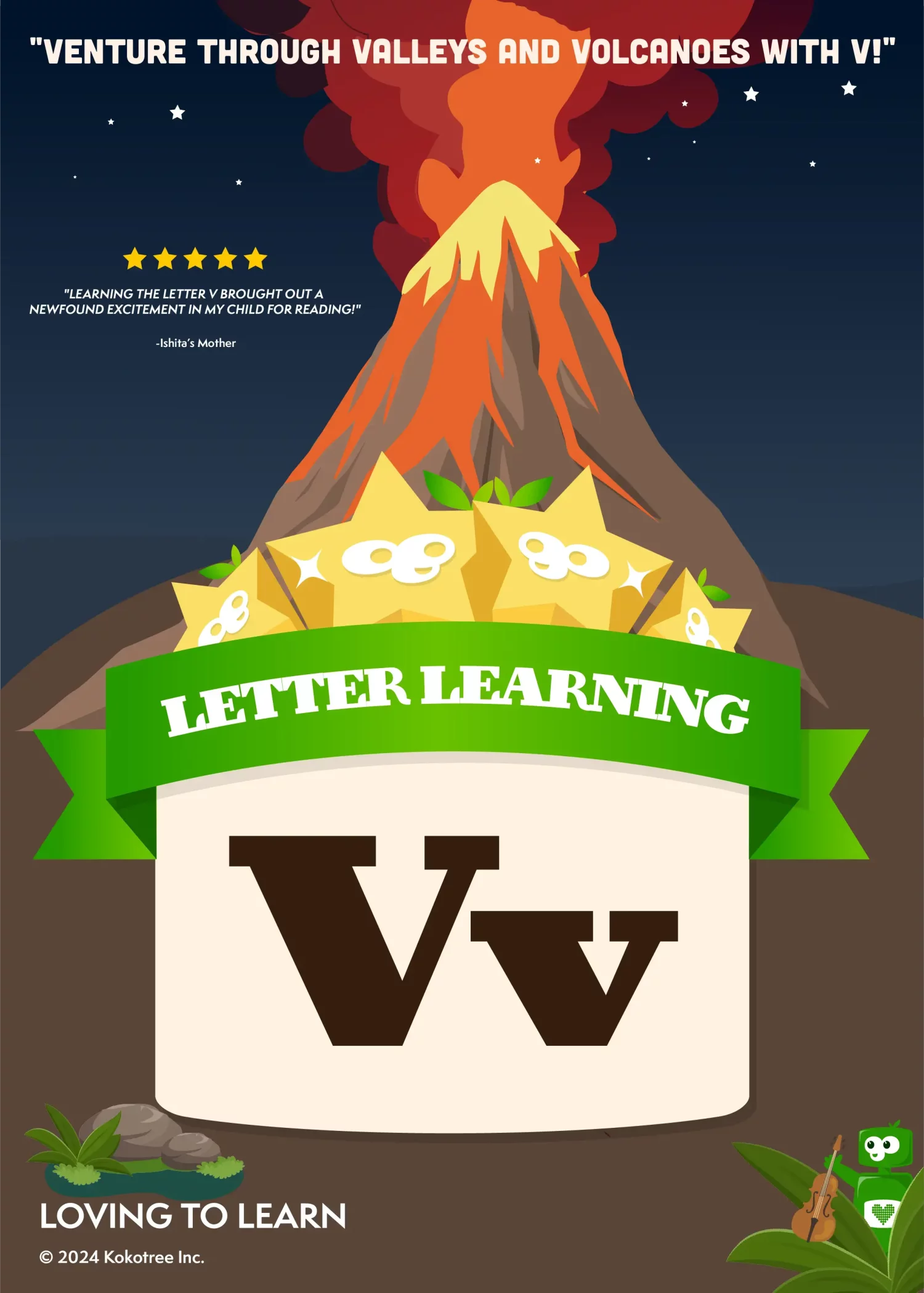
Your little learner joins Miss Meera and friendly animal friends on an outdoor adventure where valleys, volcanoes, and voices all connect to one special letter! They'll master the letter V through real-world discoveries and hands-on writing practice.
9 minutes
Ages 3-6
Skill: Letter recognition, phonics, and handwriting
Your kid watches animal friends discover letter V in nature. You get 9 minutes to enjoy your coffee while it's still warm.
The Kokotree class starts with a fun blindfold game where Ronnie identifies his friends by their voices alone. Miss Meera leads everyone to a ridge overlooking a volcano and valley, using the V-shaped landscape to introduce the letter. The animals practice the "vuh" sound, identify V-words with flashcards, and learn to write both uppercase and lowercase V.
What your child learns:
This video builds foundational literacy skills by connecting the abstract letter V to concrete objects children can see and touch. Through repetition and real-world examples, your child develops phonemic awareness that's essential for reading readiness.
- Recognizes uppercase V and lowercase v by sight
- Produces the "vuh" sound correctly (with teeth-over-lip technique)
- Writes both uppercase and lowercase V with proper stroke order
- Identifies V-words: volcano, valley, voice, violin, van, vase, vegetables
- Connects letters to real-world objects and experiences
They'll use these skills when:
- Spotting the letter V on signs, books, and food packages at the grocery store
- Writing their name if it contains the letter V
- Sounding out new words that start with "vuh" during storytime
- Playing alphabet games with friends or siblings
The Story (what keeps them watching)
The adventure begins with a blindfold game where Ronnie amazes everyone by recognizing his friends just by their voices! Miss Meera uses this clever moment to lead the Kokotree class on a nature walk to discover the letter V. Standing at a ridge, the animals spot a volcano in the distance and notice the V-shaped valley between two hills. The excitement builds as they practice the "vuh" sound, identify objects on flashcards, and learn to write the letter. The grand finale? Everyone shouts their names into the valley and discovers the magic of echoes—their voices bouncing right back!
How We Teach It (the clever part)
- First 3 minutes: The blindfold game hooks attention while secretly introducing the concept of "voice"—setting up the V connection. Miss Meera explains what a volcano is, building vocabulary and curiosity.
- Minutes 3-6: Visual learning takes center stage as the valley's V-shape becomes a memorable anchor. Flashcard activities reinforce V-words (violin, van, vase, vegetables) with clear images and text highlighting.
- Final 3 minutes: Handwriting instruction breaks down stroke order simply: "down to the right, up to the right." The echo activity at the valley creates an unforgettable sensory experience connecting voice, valley, and the letter V.
Teaching trick: Miss Meera teaches the "vuh" sound by showing kids exactly where to put their mouth—"stick out your big front teeth over your bottom lip." This physical cue helps children produce the sound correctly every time.
After Watching: Quick Wins to Reinforce Learning
- Mealtime activity: "Can you find any vegetables that start with V?" Point to items on their plate and practice the "vuh" sound together. (Reinforces vocabulary and phonics)
- Car/travel activity: "Let's count how many vans we see!" Each time you spot one, say "Vuh-vuh-van!" together. (Practices letter-sound connection in real world)
- Bedtime activity: "Draw a V in the air with your finger—down to the right, up to the right!" Do it together in the dark for extra fun. (Reinforces handwriting strokes without paper)
- Anytime activity: "Let's make an echo like the Kokotree class!" Cup hands around mouth and call out words starting with V. Even without a valley, it's silly fun that builds phonics skills.
When Kids Get Stuck. And How to Help.
"My child confuses V with other letters like U or W." Totally normal! The valley visual is your secret weapon. Draw two hills with a V between them, or make a V with two fingers pointing down. Physical anchors help the shape stick.
"They can't seem to make the 'vuh' sound correctly." This sound requires specific mouth positioning that takes practice. Gently remind them: teeth over bottom lip, then add voice. Try saying "vvvvvvery" slowly together, holding that V sound.
"The writing looks wobbly and they get frustrated." At this age, perfect letters aren't the goal—stroke direction is! Celebrate that they're going "down-right, up-right" even if it's messy. Air-writing and finger-tracing build muscle memory before pencil perfection.
What Your Child Will Learn
Prerequisites and Building Blocks
Children watching this video benefit from basic familiarity with the alphabet concept and previous letter exposure. This lesson builds on the Budding Sprouts program's sequential letter introduction, where learners have already encountered letter shapes and sounds. No prior V knowledge is needed—Miss Meera scaffolds from complete introduction through writing mastery. This video connects naturally to lessons on letters U and W, helping children distinguish similar shapes.
Cognitive Development and Teaching Methodology
The video employs multi-sensory learning perfectly suited for preschoolers' developmental stage. Visual learners benefit from the valley-as-V landscape anchor. Auditory learners engage through the "vuh" sound repetition and echo activity. Kinesthetic learners practice through air-writing and tracing. The narrative structure (game → discovery → practice → application) mirrors how young brains build neural pathways, moving from concrete experience to abstract symbol recognition.
Alignment with Educational Standards
This lesson addresses Common Core Foundational Skills for Reading (RF.K.1d, RF.K.3a) covering letter recognition and basic phonics. It supports kindergarten readiness indicators including: recognizing all uppercase and lowercase letters, producing letter sounds, and demonstrating emergent writing skills. The vocabulary expansion (volcano, valley, echo) aligns with language development benchmarks expecting children to learn new words through conversation and media.
Extended Learning Opportunities
Pair this video with Kokotree's letter V tracing worksheets for handwriting reinforcement. The app's V-word matching game extends vocabulary recognition. Parents can create a "V scavenger hunt" around the home, finding items like vases, vegetables, or toy vehicles. Reading books featuring V-words (vehicles, veterinarians, vegetables) reinforces learning. Outdoor activities like visiting a valley or making echoes create memorable real-world connections.
Transcript Highlights
- Teaching letter shape: "Do you see the hills? That cone shaped area between the hills is called a valley. That's how the letter V looks too!"
- Phonics instruction: "Just make sure to stick out your big front teeth over your bottom lip when you say 'vuh'."
- Writing guidance: "We start at the topline and slant right to the baseline. Then slant right up to the top. Down to the right, up to the right!"
- Real-world connection: "The valley returned your voice. It's called an echo."
Character Development and Story Arc
Miss Meera models excellent teaching behaviors—building on student observations (Ronnie's voice recognition), validating concerns (Gina's volcano worry), and encouraging questions (Tiki's curiosity about echoes). The animal students demonstrate collaborative learning, taking turns answering and celebrating each other's successes. Bobby shares personal connection ("My sister plays the violin"), modeling how learners relate new information to their lives. The class shows enthusiasm and persistence through the lesson's progression.
Phonics and Letter Formation Deep Dive
The letter V presents unique phonics opportunities as a voiced labiodental fricative—one of English's more distinctive sounds. Unlike letters where sound production is intuitive, V requires explicit mouth positioning instruction. Miss Meera's technique of placing "big front teeth over your bottom lip" gives children a physical anchor that dramatically improves sound accuracy.
The video's approach to letter formation follows research-backed handwriting instruction principles. By teaching stroke sequence ("down to the right, up to the right") rather than just final appearance, children develop proper motor patterns that transfer to fluent writing. The uppercase-to-lowercase progression is developmentally appropriate, as the identical stroke pattern at different sizes reinforces learning without introducing new movements.
The vocabulary selection (volcano, valley, voice, violin, van, vase, vegetables) strategically spans concrete objects children encounter daily alongside exciting concepts that spark curiosity. This balance ensures immediate applicability while building background knowledge. The echo activity brilliantly transforms abstract phonics into embodied experience—children literally hear the V-sound (voice) bouncing off the V-shape (valley), creating a multi-sensory memory anchor that strengthens letter-sound correspondence.
For emerging readers, this foundation in the letter V supports future decoding of high-frequency words like "very," "have," and "give," making this lesson a crucial building block in literacy development.