
What's The Rooster & The Fox About?
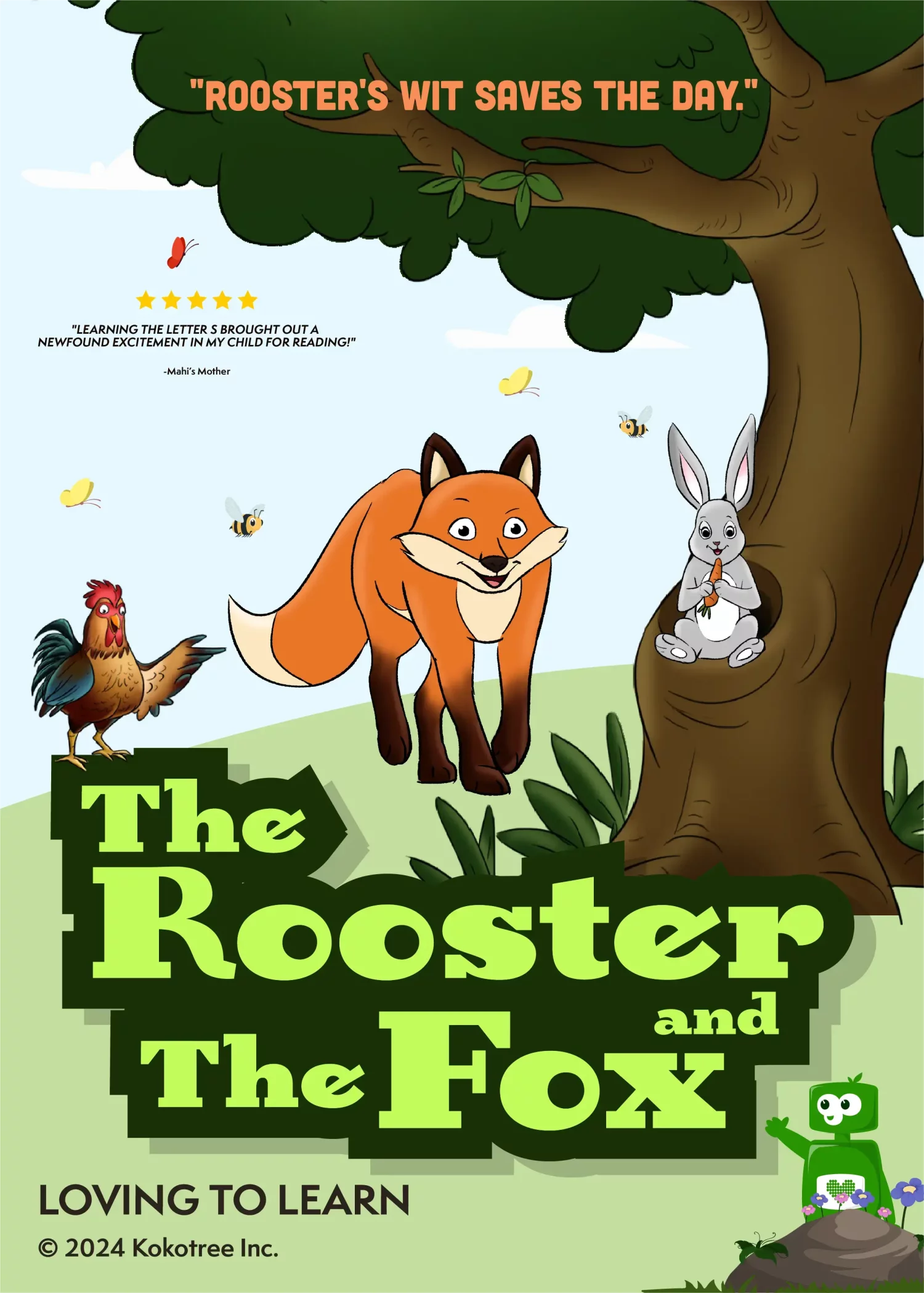
Watch a clever rooster use his thinking skills to outsmart a sneaky fox in this engaging story! Your child will learn that asking questions and thinking carefully before acting keeps them safe and helps them make smart decisions.
8 minutes
Ages 3-6
Skill: Critical Thinking & Problem Solving
Your kid watches a rooster outsmart a tricky fox with clever questions. You get 8 minutes to [drink your coffee while it's actually hot].
Miss Meera gathers the Kokotree class for story time and shares an exciting tale about a hungry fox who tries to trick a rooster into coming down from a tree. The rooster stays calm, asks smart questions, and turns the tables on the fox by mentioning wolves are nearby!
What your child learns:
This story teaches children that thinking before acting is a superpower. They'll see how asking questions helps uncover the truth and how staying calm leads to better decisions.
- Critical thinking and questioning skills
- Recognizing when something doesn't sound right
- Problem-solving under pressure
- Understanding cause and effect in stories
- Listening comprehension and story sequencing
They'll use these skills when:
- Someone at the playground suggests doing something that seems unsafe
- They need to figure out if a story or excuse sounds true
- Making choices about what to do when facing a tricky situation
- Listening to instructions and deciding the best way to follow them
The Story (what keeps them watching)
A hungry fox hasn't eaten in two days and spots a plump rooster up in a tree. Since he can't reach the rooster, the fox invents a story about a "King of the Forest" who declared all animals must live peacefully together. The rooster is suspicious—lions eating grass? That doesn't add up! Instead of falling for the trick, the clever rooster says he sees wolves approaching. The fox panics and runs away, proving the rooster's suspicions were right all along. Tiki and the class celebrate how the rooster's smart thinking saved the day!
How We Teach It (the clever part)
- First 2 minutes: The Kokotree classroom sets the stage with playful banter (Maddy juggling bananas!) before Miss Meera introduces story time, building anticipation and modeling good listening.
- Minutes 2-6: The story unfolds showing the fox's deception and the rooster's thoughtful responses. Children hear the rooster ask logical questions like "Will lions eat only grass?" demonstrating critical thinking in action.
- Final 2 minutes: The resolution shows consequences of the fox's dishonesty and rewards the rooster's careful thinking. Tiki summarizes the lesson, reinforcing that thinking beats trickery.
Teaching trick: The story uses dramatic irony—kids know the fox is lying before the rooster figures it out, which helps them practice spotting untruths and cheering for smart decision-making.
After Watching: Quick Wins to Reinforce Learning
- Mealtime activity: "If someone told you vegetables could make you fly, would you believe them? Why or why not?" (Practices evaluating whether information makes sense)
- Car/travel activity: "Let's play 'True or Silly'—I'll say something and you tell me if it's true or silly!" Try: "Fish live in water" vs "Elephants fit in your pocket." (Builds logical reasoning)
- Bedtime activity: "What questions would YOU ask the fox if you were the rooster?" (Encourages generating thoughtful questions)
- Anytime activity: Retell the story together using stuffed animals. Let your child be the clever rooster! (Reinforces story comprehension and sequencing)
When Kids Get Stuck. And How to Help.
- "My child doesn't understand why the rooster didn't believe the fox." - That's actually great critical thinking practice! Talk about how some things "don't make sense"—like if someone said ice cream was hot. The rooster noticed the fox's story didn't add up.
- "They keep asking what a 'declaration' means." - Perfect opportunity! Explain it simply as "a big announcement" or "an important rule someone makes." Then ask them to make their own silly declaration!
- "This story seems a bit long for my child's attention." - Try watching in two parts—pause when the fox first approaches the tree. Ask "What do you think will happen?" Building anticipation helps maintain engagement.
What Your Child Will Learn
Prerequisites and Building Blocks
Children benefit most from this video if they can follow a simple narrative and understand basic animal characters. This story builds on foundational listening skills developed through earlier Kokotree stories. It advances the learning progression by introducing more complex plot elements—deception, logical questioning, and problem resolution. The video connects to prior exposure to cause-and-effect concepts and prepares children for more nuanced story comprehension and character motivation analysis.
Cognitive Development and Teaching Methodology
This teaching approach leverages narrative transportation—children become emotionally invested in the rooster's safety, making the critical thinking lesson memorable. The story format addresses multiple learning styles: visual learners see the fox's expressions and body language, auditory learners hear tone changes indicating deception, and kinesthetic learners can act out the story afterward. The dramatic structure (problem → tension → resolution) mirrors how young minds naturally process information.
Alignment with Educational Standards
This video supports kindergarten readiness indicators for listening comprehension and critical thinking. It aligns with early literacy standards requiring children to identify story elements (characters, setting, problem, solution) and make predictions. The content supports language development benchmarks for understanding narrative structure and drawing conclusions from text. Teachers expect entering kindergarteners to demonstrate these foundational comprehension skills.
Extended Learning Opportunities
Extend learning with a "True or Tricky" sorting game using picture cards. The Kokotree app offers additional story-based videos that build comprehension skills. Create simple puppets to retell the story, practicing sequencing. Draw pictures showing the beginning, middle, and end. Practice asking "Does that make sense?" throughout daily activities to reinforce the critical thinking habit introduced in this video.
Transcript Highlights
- Teaching logical questioning: "You mean, from now onward, no big animals will ever prey on the small animals? Lions, tigers, and leopards... What about them? Will they eat only grass?"
- Modeling suspicion of inconsistency: "The rooster was innocent but sensible. He knew that this declaration could not be true. He didn't trust the fox's intentions."
- Demonstrating clever problem-solving: "I can see wolves coming though! It will be good to share this news with them and we can all get along peacefully."
- Summarizing the lesson: "The fox thought he was clever, but the rooster outsmarted him!"
Character Development and Story Arc
The rooster models exemplary learning behaviors throughout the story. Despite initial fear, he stays calm and uses logical thinking rather than panicking. He demonstrates healthy skepticism by asking probing questions instead of accepting information blindly. The fox serves as a contrast—showing that shortcuts and trickery backfire. Miss Meera and Tiki bookend the story, modeling how to discuss and reflect on narratives, teaching children that stories contain valuable lessons worth discussing.
Critical Thinking and Problem-Solving Deep Dive
Critical thinking is one of the most valuable cognitive skills children can develop, and this story introduces it through accessible, age-appropriate storytelling. At ages 3-6, children are naturally developing what psychologists call "theory of mind"—the understanding that others can have different thoughts, intentions, and knowledge than themselves. This story capitalizes on that developmental milestone.
The rooster demonstrates several key critical thinking strategies that form the foundation of logical reasoning. First, he evaluates claims against existing knowledge—he knows predators eat other animals, so the fox's "peaceful kingdom" claim contradicts reality. Second, he asks clarifying questions rather than accepting information passively. Third, he tests the fox's sincerity by proposing a scenario (wolves arriving) that would reveal true intentions.
For young children, these abstract concepts become concrete through the story's clear cause-and-effect structure. The fox lies → the rooster questions → the truth emerges → the fox faces consequences. This pattern helps children understand that thoughtful responses lead to better outcomes than impulsive reactions.
Research in early childhood education shows that children who practice evaluating information and asking questions develop stronger academic skills later. They become better readers because they question text meaning, better math students because they check whether answers make sense, and better scientists because they test hypotheses.
Parents can reinforce these skills by playing "detective" games, asking "How do you know?" questions, and praising children when they express healthy skepticism. The goal isn't to create cynical children, but curious, thoughtful ones who approach new information with engaged minds.