
What's Letter Z About?
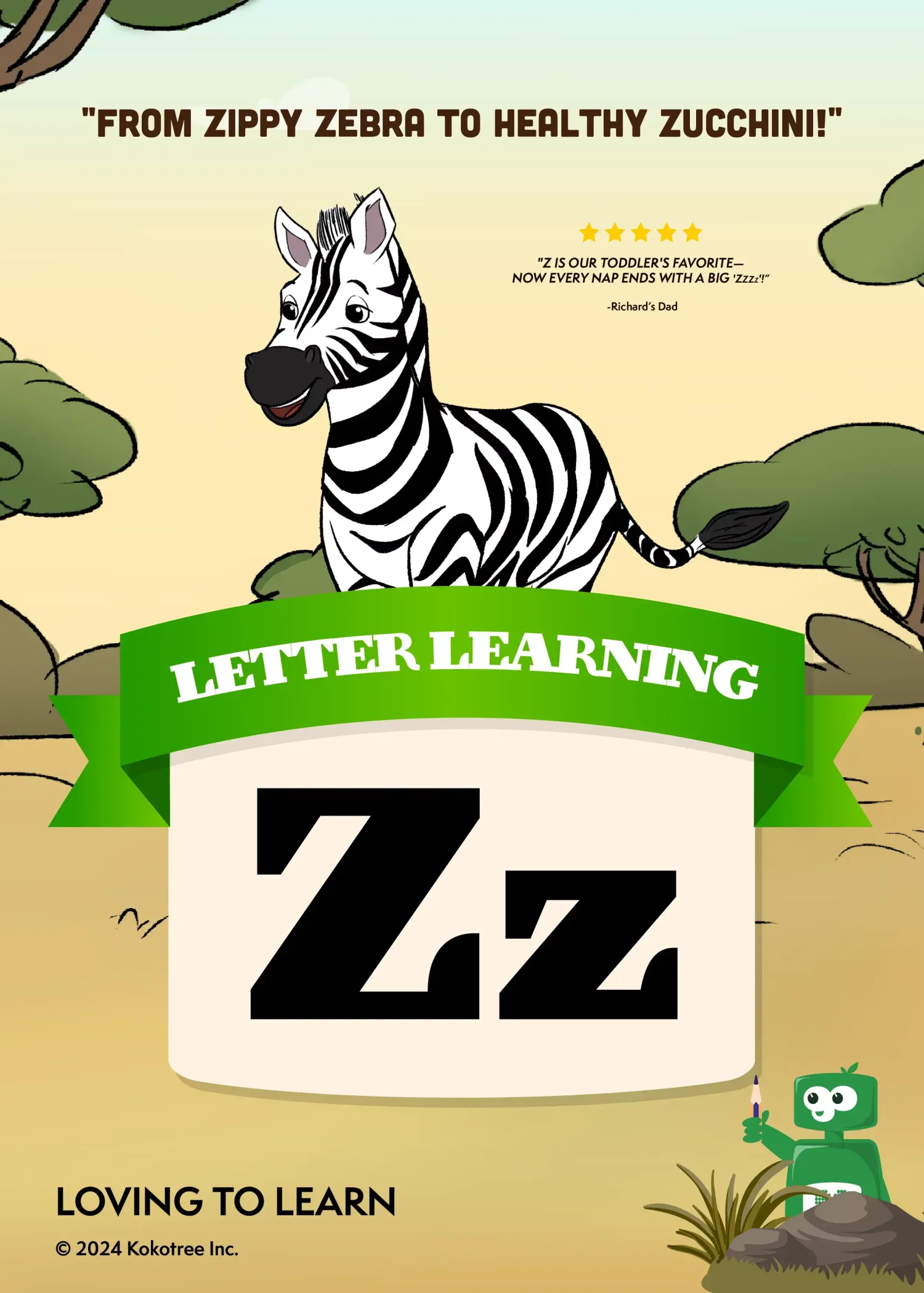
Your little learner completes their alphabet journey by mastering the final letter! They'll discover the buzzing 'zuh' sound, spot Z words everywhere, and trace zigzag shapes with confidence.
10 minutes
Ages 3-6
Skill: Letter recognition, phonics, and handwriting
Your kid watches friendly animals discover the last alphabet letter. You get 10 minutes to enjoy your coffee while it's still warm.
Miss Meera leads the Kokotree Class through a sing-along alphabet review, then shares a delightful story about how the zebra got its name. The class practices the 'zuh' sound together, guesses Z words from fun clues, and learns to write both uppercase Z and lowercase z step-by-step.
What your child learns:
This video reinforces alphabet knowledge while introducing letter Z as the grand finale of the ABCs. Children practice phonemic awareness, build vocabulary, and develop fine motor skills through letter formation.
- Recognizes that Z is the 26th and final letter of the alphabet
- Produces the 'zuh' sound correctly and identifies it in words
- Identifies Z words: zebra, zucchini, zipper, zero, zest, zap, zoom
- Writes uppercase Z and lowercase z with proper stroke order
- Connects letter sounds to whole-body movement (walking the Z shape)
They'll use these skills when:
- Zipping up their own jacket and saying "zuh-zuh-zipper!"
- Spotting zebras at the zoo or in picture books
- Writing their first words that contain the letter Z
- Singing the complete ABC song from A to Z with confidence
The Story (what keeps them watching)
The Kokotree Class is counting alphabet letters on the wall, but they can't agree which number P is! Miss Meera saves the day with an ABC sing-along, and Maddy counts along to settle the friendly bet. Once they reach 25 letters, everyone's buzzing to learn the final one. Miss Meera tells a charming tale about a striped animal in Africa who wanted a unique name—and chose "zebra" because Z was different from all the rest! The class then explores the 'zuh' sound, guesses Z words from riddles, and even walks the zigzag letter shape together.
How We Teach It (the clever part)
- First 3 minutes: The class reviews the entire alphabet through song, reinforcing letter sequence and building anticipation for the mysterious 26th letter.
- Minutes 3-6: Miss Meera's zebra origin story introduces letter Z through narrative, making the abstract concept memorable and engaging.
- Final 4 minutes: Children practice the 'zuh' sound, identify Z words through riddles, and learn letter formation through visual demonstration and whole-body movement.
Teaching trick: The video uses a guessing game format ("I look like a cucumber but start with Z") that activates prior knowledge and makes children feel like detectives solving phonics puzzles.
After Watching: Quick Wins to Reinforce Learning
- Mealtime activity: "Can you find anything on your plate that starts with Z?" Even if there's nothing, practice the 'zuh' sound together and talk about zucchini or pizza with zesty toppings.
- Car/travel activity: "Let's play Zip Zap Zoom! Point up, down, front, back while saying each word." This reinforces the Z sound through movement and repetition.
- Bedtime activity: "Trace a Z on my back with your finger—slide right, slant left, slide right!" Take turns being the 'paper' for tactile letter practice.
- Anytime activity: "Walk the letter Z across the room like Maddy did!" Practice zigzagging while saying "across, slant, across" for whole-body learning.
When Kids Get Stuck. And How to Help.
- "My child confuses the Z sound with S" - This is completely normal! The 'zuh' sound has a buzzing vibration in the throat, while 'sss' is just air. Have your child put their hand on their throat to feel the difference—Z buzzes like a bee!
- "They can't remember which direction to slant the Z" - The zigzag motion is tricky! Try saying "right, left, right" as a chant while they trace. Walking the letter with their whole body (like in the video) helps build muscle memory.
- "My child already knows most letters but loses interest" - The story about the zebra choosing its own name adds novelty. Ask them to invent names for imaginary animals using different letters to keep the creative spark alive.
What Your Child Will Learn
Prerequisites and Building Blocks
Children benefit most from this video after exposure to letters A through Y, as it celebrates completing the alphabet sequence. Familiarity with the ABC song helps them appreciate reaching the final letter. This video builds on phonemic awareness foundations—recognizing that letters represent sounds. It connects naturally to previous Kokotree alphabet videos and prepares children for blending sounds into words, a key pre-reading skill.
Cognitive Development and Teaching Methodology
The video employs narrative learning through the zebra origin story, leveraging children's natural love of stories to anchor abstract concepts. Multi-sensory instruction addresses diverse learning styles: auditory learners hear the 'zuh' sound repeatedly, visual learners see letter formation demonstrated, and kinesthetic learners walk the Z shape. The guessing game format activates retrieval practice, strengthening memory pathways more effectively than passive viewing.
Alignment with Educational Standards
This video supports Common Core Foundational Skills for kindergarten, specifically RF.K.1d (recognizing upper and lowercase letters) and RF.K.3a (demonstrating letter-sound correspondence). It addresses Head Start Early Learning Outcomes for literacy, including alphabet knowledge and phonological awareness. The handwriting component aligns with fine motor benchmarks expected for kindergarten readiness, preparing children for formal writing instruction.
Extended Learning Opportunities
Pair this video with Kokotree's letter tracing worksheets for Z practice. The app's alphabet matching games reinforce letter recognition in playful contexts. Extend learning by creating a "Z collection"—gathering toy zebras, finding zippers on clothing, or drawing zigzag patterns. Connect to the shapes curriculum by identifying the diagonal lines within the letter Z, building geometric awareness alongside literacy skills.
Transcript Highlights
- "The sound of the letter Z is like the buzz of a bee. Did you notice?" — Connecting sounds to familiar experiences
- "I am a black animal with white stripes. Who am I?" — Using riddles to activate thinking
- "Start from the top, slide right and slant left to the baseline. Now slide right again." — Clear, sequential handwriting instruction
- "Across to the right, slant down to the left and across to the right again. Just like a zigzag." — Kinesthetic reinforcement through whole-body movement
Character Development and Story Arc
The Kokotree Class models collaborative learning beautifully—when Maddy and Ruby disagree about letter positions, they make a friendly wager and work together to find the answer rather than arguing. Miss Meera demonstrates patience and encouragement, never criticizing wrong guesses. Bobby shows curiosity by asking about "zest," modeling how learners can connect new knowledge to their own experiences. The characters celebrate each other's contributions, reinforcing that learning is a joyful group activity.
Phonics and Letter Formation Deep Dive
The letter Z presents unique learning opportunities as the alphabet's finale. Phonologically, /z/ is a voiced alveolar fricative—meaning the tongue creates friction near the tooth ridge while the vocal cords vibrate. This "buzzing" quality distinguishes it from its voiceless counterpart /s/, which is why Miss Meera emphasizes the bee-like sound. Many children initially substitute /s/ for /z/ because the mouth position is identical; the only difference is voicing.
From a handwriting perspective, Z requires diagonal stroke control that challenges developing fine motor skills. The video's three-step verbal cue ("slide right, slant left, slide right") provides cognitive scaffolding that children can internalize and repeat independently. Research shows that verbal self-instruction during letter formation improves accuracy and retention.
The whole-body "walking the Z" activity applies embodied cognition principles—when children physically move through letter shapes, they create stronger neural pathways than through visual observation alone. This kinesthetic approach particularly benefits children who struggle with traditional pencil-and-paper tasks.
Vocabulary selection (zebra, zipper, zero, zucchini, zest, zap, zoom) strategically includes both common words children encounter daily and slightly advanced terms that expand their lexicon. The riddle format ("I look like a cucumber but start with Z") requires children to hold multiple pieces of information in working memory while searching for matches—excellent practice for the cognitive flexibility needed in reading comprehension.