
What's Over And Under About?
Your little one joins the Kokotree Class for an outdoor adventure learning where things are in space! They'll master two essential position words that help describe everything from birds in the sky to toys under the bed.
6 minutes
Ages 2-5
Skill: Spatial awareness and positional vocabulary
Your kid watches friendly animals explore positions outdoors. You get 6 minutes to enjoy your coffee in peace.
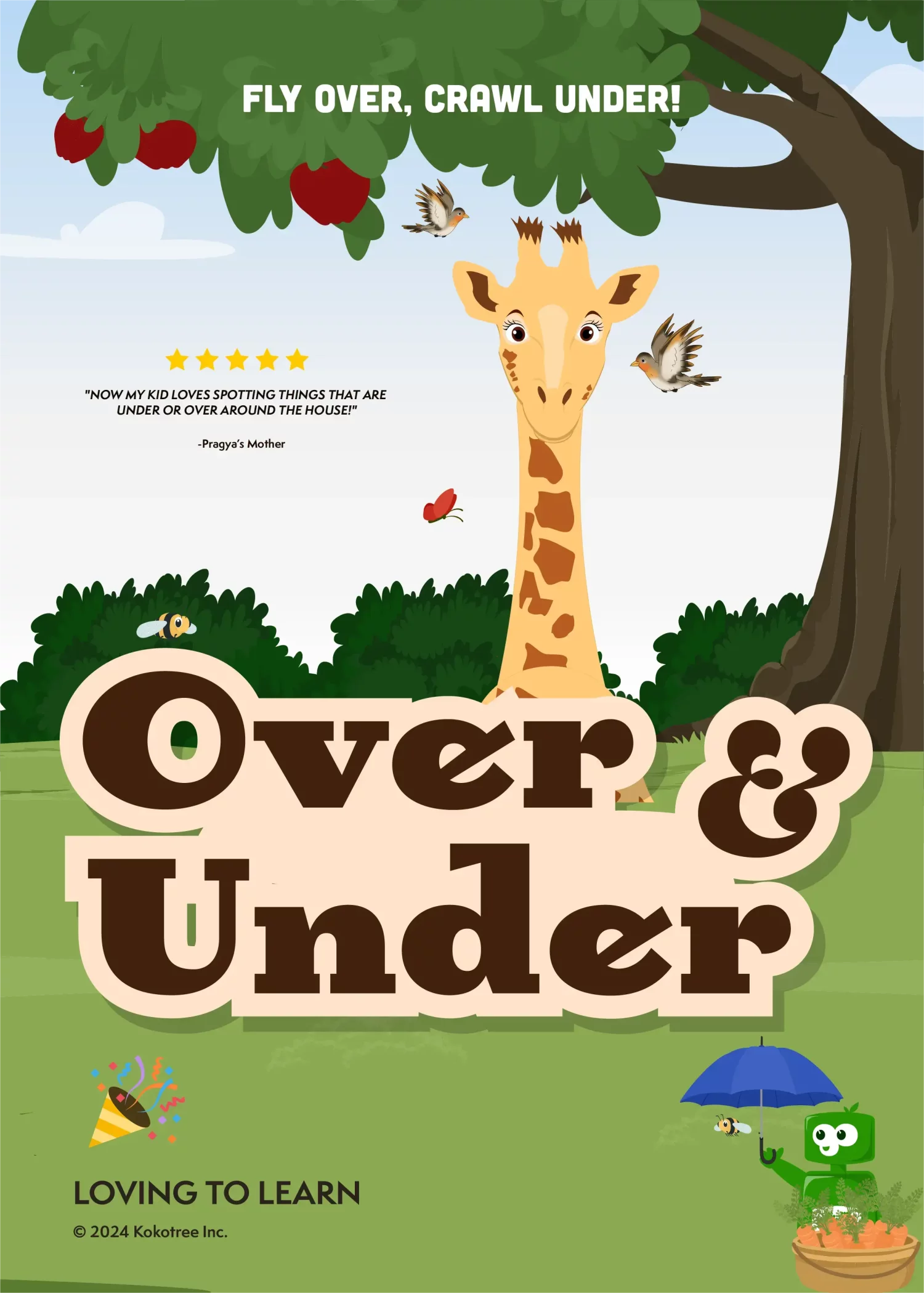
The Kokotree Class plays under an apple tree while birds fly overhead. Miss Elizabeth turns this everyday scene into a learning moment, pointing out what's above and what's below. The class then takes a walk to the river, spotting bridges, boats, and squirrels—all while practicing their new vocabulary.
What your child learns:
This video builds foundational spatial awareness by teaching the concepts of 'over' and 'under.' Children learn to describe both position (where something is) and movement (how something travels). These words become tools for understanding and communicating about the physical world.
- Identifies when objects are positioned above or below other objects
- Uses 'over' to describe things directly above (umbrella over head)
- Uses 'under' to describe things directly below (shoes under bed)
- Recognizes 'over' can show movement (jumping over a rock)
- Applies position words to real-world observations
They'll use these skills when:
- Finding lost toys ('Is it under the couch?')
- Following directions at the playground ('Climb over the bar!')
- Describing what they see on walks ('Look, a plane flying over us!')
- Playing hide-and-seek and explaining where things are hidden
The Story (what keeps them watching)
The Kokotree Class is having a giggly playdate under an apple tree when some hungry birds show up overhead. Miss Elizabeth spots the perfect teaching moment—the birds are OVER the tree, and the kids are UNDER it! The class goes on a mini field trip to the river, where they spot squirrels crossing over a bridge and a boat passing under it. Things get silly when an apple bonks Gina on the head and Maddy holds a banana over his own head to quiz his friends. Learning positions has never been this fun!
How We Teach It (the clever part)
- First 2 minutes: Miss Elizabeth introduces 'over' and 'under' using the birds and tree as a natural visual example. On-screen labels reinforce the vocabulary.
- Minutes 2-4: Each character shares their own examples—umbrellas, mountains, toy cars, beds—showing how these words work in different contexts.
- Final 2 minutes: An interactive game at the river and back at the tree lets kids practice identifying positions, ending with playful moments that cement the learning.
Teaching trick: The video uses on-screen text labels ('OVER' and 'UNDER') that appear right next to the objects being described. This visual pairing helps pre-readers connect the spoken word to both the written word and the spatial concept simultaneously.
After Watching: Quick Wins to Reinforce Learning
- Mealtime activity: "Where is your spoon? Is it over your plate or under your napkin?" Point to items on the table and ask your child to describe their position using over and under.
- Car/travel activity: "I spy something over our heads!" Take turns finding things over the car (sky, clouds, birds) and under (wheels, road, your feet).
- Bedtime activity: "Let's play the blanket game!" Put a stuffed animal over the blanket, then under it. Ask your child to tell you where it is each time.
- Anytime activity: "Can you jump over this pillow?" Create a mini obstacle course using household items for your child to step over or crawl under.
When Kids Get Stuck. And How to Help.
- "My child keeps mixing up over and under." - Totally normal! These are abstract concepts. Try using your hand as a visual—hold it flat and put a toy above it (over) then below it (under). Repetition with the same objects helps.
- "They understand when watching but can't use the words themselves." - Receptive language (understanding) always comes before expressive language (speaking). Keep modeling the words in daily life: 'I'm putting the lid OVER the pot!' They'll start using them when ready.
- "This seems too simple for my child." - Great! That means they're ready for the next step. Challenge them with 'over' showing movement: 'Can you throw the ball over the fence?' or combine with other position words they know.
What Your Child Will Learn
Prerequisites and Building Blocks
Children benefit from basic vocabulary and the ability to follow simple directions before watching. This video builds on foundational concepts like 'up' and 'down,' extending spatial understanding to relational positions between two objects. It prepares learners for more complex prepositions like 'between,' 'beside,' and 'through.' The video fits early in the spatial awareness progression, establishing vocabulary essential for following multi-step directions and understanding more advanced mathematical concepts like geometry.
Cognitive Development and Teaching Methodology
This video leverages concrete, visual examples that align with preoperational stage thinking (ages 2-7). Young children learn spatial concepts best through observable, real-world demonstrations rather than abstract explanations. The methodology addresses visual learners through on-screen labels, auditory learners through repeated verbal examples, and kinesthetic understanding by showing characters physically moving over and under objects. The call-and-response game format activates retrieval practice, strengthening memory formation.
Alignment with Educational Standards
This video addresses Common Core Math Standard K.G.A.1 (describing positions of objects using terms like above, below, beside, in front of, behind, and next to). It also supports Head Start Early Learning Outcomes in Mathematics Knowledge & Skills, specifically spatial sense and geometry. Kindergarten readiness assessments frequently evaluate whether children can follow positional directions—this video directly builds that competency through repeated, contextualized practice.
Extended Learning Opportunities
Pair this video with printable worksheets featuring scenes where children circle objects that are 'over' or 'under' reference points. The Kokotree app includes interactive games where children drag objects to positions above or below targets. Extend learning with building block play—ask children to place blocks over and under each other. Picture books about animals in different positions reinforce vocabulary during reading time.
Transcript Highlights
- "Over and under! These words tell you the location of any object that is directly above you or below you."
- "The birds are flying right above the tree, hence they are flying over the tree."
- "So did you observe that the word 'over' tells you about the position and can also tell you the movement of an object?"
- "Where is the river flowing?" "Under the bridge!"
Character Development and Story Arc
The Kokotree Class models active, curious learning behaviors throughout the video. When Miss Elizabeth asks for examples, each character eagerly contributes their own ideas—demonstrating that learning is participatory, not passive. Bobby shows kindness by inviting Tiki to share his umbrella. Gina demonstrates resilience when an apple bonks her head, laughing it off and turning it into another learning example. Maddy and Ruby show creative thinking by inventing their own quiz game with food items.
Spatial Reasoning and Early Mathematics Deep Dive
Spatial reasoning—the ability to understand and remember the spatial relations among objects—forms a critical foundation for mathematical thinking. Research consistently shows that early spatial skills predict later math achievement, even more strongly than early number knowledge in some studies.
The concepts of 'over' and 'under' belong to a category called 'topological spatial relations,' which describe how objects relate to each other in space. Unlike metric concepts (measuring exact distances), topological concepts focus on relative position—something young children can grasp before they understand measurement.
This video strategically teaches both static position ('the apple is under the tree') and dynamic movement ('I can jump over this rock'). This dual application helps children understand that prepositions aren't just labels—they're tools for describing how the world works and changes.
The progression from observation (noticing birds over the tree) to identification (labeling positions at the river) to application (creating their own examples with food) follows established pedagogical best practices. Children move from passive recognition to active production, which research shows dramatically improves retention.
For parents, understanding that spatial vocabulary directly supports math readiness can reframe 'simple' position words as genuinely important learning. When your child correctly says their toy rolled 'under' the couch, they're exercising the same spatial reasoning they'll later use for geometry, map reading, and understanding mathematical diagrams.