
What's Little Letters About?
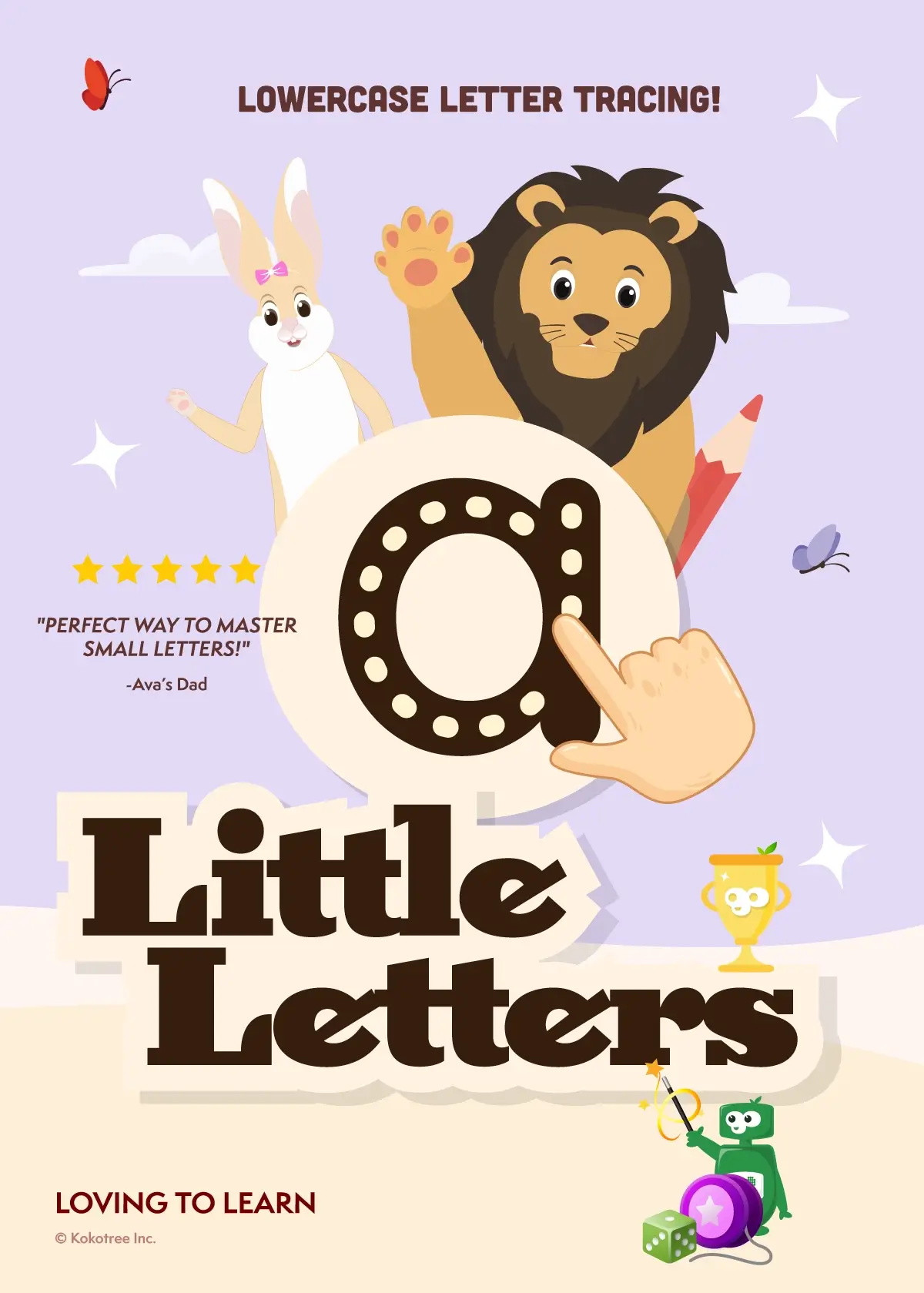
Your child traces lowercase letters from a to z with gentle finger guides, learning the curves, lines, and strokes that form each letter. They're building the exact hand movements needed for confident handwriting.
Interactive Game
Ages 3-5
Skill: Lowercase Letter Formation
Your kid traces lowercase letters with guided paths. You get guilt-free screen time knowing they're learning.
Friendly animal friends from Kokotree guide your child through each letter's shape. Bright visual paths show exactly where to start and which direction to move. Each successful trace brings cheerful encouragement and a sense of accomplishment.
What your child practices:
Little Letters develops the fine motor control and visual-motor coordination essential for handwriting. Your child learns proper letter formation from the start—building good habits that stick.
- Tracing all 26 lowercase letters (a-z) with correct stroke order
- Fine motor control and finger dexterity
- Visual-motor coordination (eyes guiding hands)
- Letter shape recognition and memory
- Pre-writing skills that transfer directly to pencil and paper
They'll use these skills when:
- Writing their name on artwork and school papers
- Copying words from books or labels during play
- Starting kindergarten writing activities with confidence
- Sending cards or notes to grandparents and friends
The Gameplay (what keeps them engaged)
Each letter appears with a clear starting point and guided path. Your child traces with their finger, following the curves and lines at their own pace. Correct movements trigger instant visual sparkles and friendly sounds. Complete a letter and watch it come to life with a mini celebration! The game cycles through all 26 letters, letting kids revisit tricky ones as often as needed. No timers, no pressure—just satisfying practice that feels like play.
How It Teaches (the clever part)
- Immediate feedback: The path lights up as your child traces correctly. Off-track? A gentle visual cue guides them back without frustration.
- Progression: Letters are introduced in a thoughtful sequence, grouping similar shapes (c, o, a) before moving to more complex forms (g, y, q).
- Repetition: Each letter can be practiced unlimited times. Varied encouragement keeps it fresh—different animal friends celebrate each success.
Learning trick: The guided starting dots teach proper stroke order from day one. This prevents the backwards letters and awkward formations that are hard to unlearn later.
Beyond the App: Reinforce the Learning
- Mealtime activity: "Let's draw letters in the air!" Trace lowercase letters together using big arm movements before eating. (Practices letter shapes using gross motor memory)
- Car/travel activity: "I spy something that starts with the letter sound 'mmm'!" Point out letters on signs and connect them to the shapes they traced. (Reinforces letter recognition in real contexts)
- Outdoor activity: "Let's write letters with sticks in the sand or dirt!" Find a patch of dirt or sand and trace letters together. (Transfers digital learning to tactile, sensory experience)
- Anytime activity: "Can you trace the letters on this cereal box?" Use food packaging, book covers, or toy labels for impromptu tracing practice. (Connects letter formation to environmental print)
Common Questions Parents Ask
- "Is tracing on a screen really helping with handwriting?" - Absolutely! Research shows finger tracing builds the same motor pathways used for pencil control. The muscle memory transfers directly to paper—many parents notice smoother letter formation within weeks.
- "How long before my child can write letters on their own?" - Every child develops differently, but most 3-5 year olds show improvement in 2-4 weeks of regular practice. Look for smoother curves and more confident strokes as early signs of progress.
- "What if my child gets frustrated with tricky letters?" - That's completely normal! Letters like 'g' and 'q' challenge everyone at first. The game's gentle guidance prevents frustration, and there's no penalty for trying again. Celebrate effort, not perfection.
What Your Child Will Learn
Prerequisites and Building Blocks
Children benefit most from Little Letters when they can hold and control a finger on a touchscreen and have basic familiarity with the alphabet song or letter names. This game builds on letter recognition activities and prepares children for uppercase formation and eventually pencil-and-paper writing. It fits perfectly after alphabet exposure games and before full handwriting practice, creating a bridge between knowing letters and writing them independently.
Cognitive Development and Game Design
Touch-based tracing aligns perfectly with how 3-5 year olds learn—through direct manipulation and immediate sensory feedback. The large touch targets accommodate developing fine motor skills, while the visual guides reduce cognitive load. This design leverages the "touch to learn" principle, where physical interaction creates stronger neural pathways than passive observation. The self-paced format respects varied attention spans and processing speeds typical of this age.
Alignment with Educational Standards
Little Letters directly supports Common Core Foundational Skills for Kindergarten (L.K.1a: Print all uppercase and lowercase letters) and Head Start Early Learning Outcomes in Literacy. The focus on proper formation meets kindergarten readiness benchmarks where teachers expect children to write recognizable letters. This preparation significantly eases the transition to formal handwriting instruction and classroom writing activities.
Extended Learning Opportunities
Pair Little Letters with Kokotree's alphabet songs and letter recognition videos for multi-sensory learning. Extend practice with finger painting letters, shaving cream writing, or playdough letter forming. The app's phonics content reinforces letter-sound connections, creating a complete early literacy foundation. Consider alternating between uppercase and lowercase practice games for comprehensive letter knowledge.
Game Mechanics Summary
- Child touches the glowing start point to begin each letter
- Finger follows the illuminated path through curves and strokes
- Visual and audio feedback confirms correct tracing in real-time
- Completion triggers celebration animation and advances to next letter
Skill Development Progression
Initial sessions focus on familiarity—children learn the game mechanics and explore letters freely. With practice, tracing becomes smoother and faster, indicating developing motor control. Mastery shows as confident, fluid movements and the ability to anticipate letter shapes before seeing the full guide. Parents can watch for children spontaneously "air writing" letters or attempting them on paper. Consistent practice over 4-6 weeks typically shows marked improvement in formation accuracy.
Lowercase Letter Formation: Building the Foundation for Lifelong Writing
Lowercase letters make up approximately 95% of all written text children will encounter and produce throughout their lives. Mastering these forms early creates automatic writing habits that free cognitive resources for spelling, composition, and creative expression later.
Research in early childhood education shows that proper letter formation—starting at the correct point and moving in the right direction—significantly impacts writing speed and legibility in elementary school. Children who learn correct formation from the start avoid the frustrating process of "unlearning" inefficient habits.
The 3-5 age window is developmentally ideal for this skill. Children's fine motor control is maturing rapidly, and their brains are primed for pattern learning. The tactile feedback of finger tracing creates stronger motor memories than visual observation alone—a principle called "embodied cognition."
Lowercase letters present unique challenges: many look similar (b/d, p/q), some have descenders (g, y, p), and others require lifting and repositioning (i, j, x). Little Letters addresses these challenges by grouping similar letters and providing consistent starting points.
For kindergarten readiness, teachers expect children to form most lowercase letters recognizably, even if imperfectly. Children who enter school with this foundation spend less time on remedial handwriting and more time on actual writing and reading activities. This early confidence with letter formation correlates with stronger overall literacy development through the elementary years.