

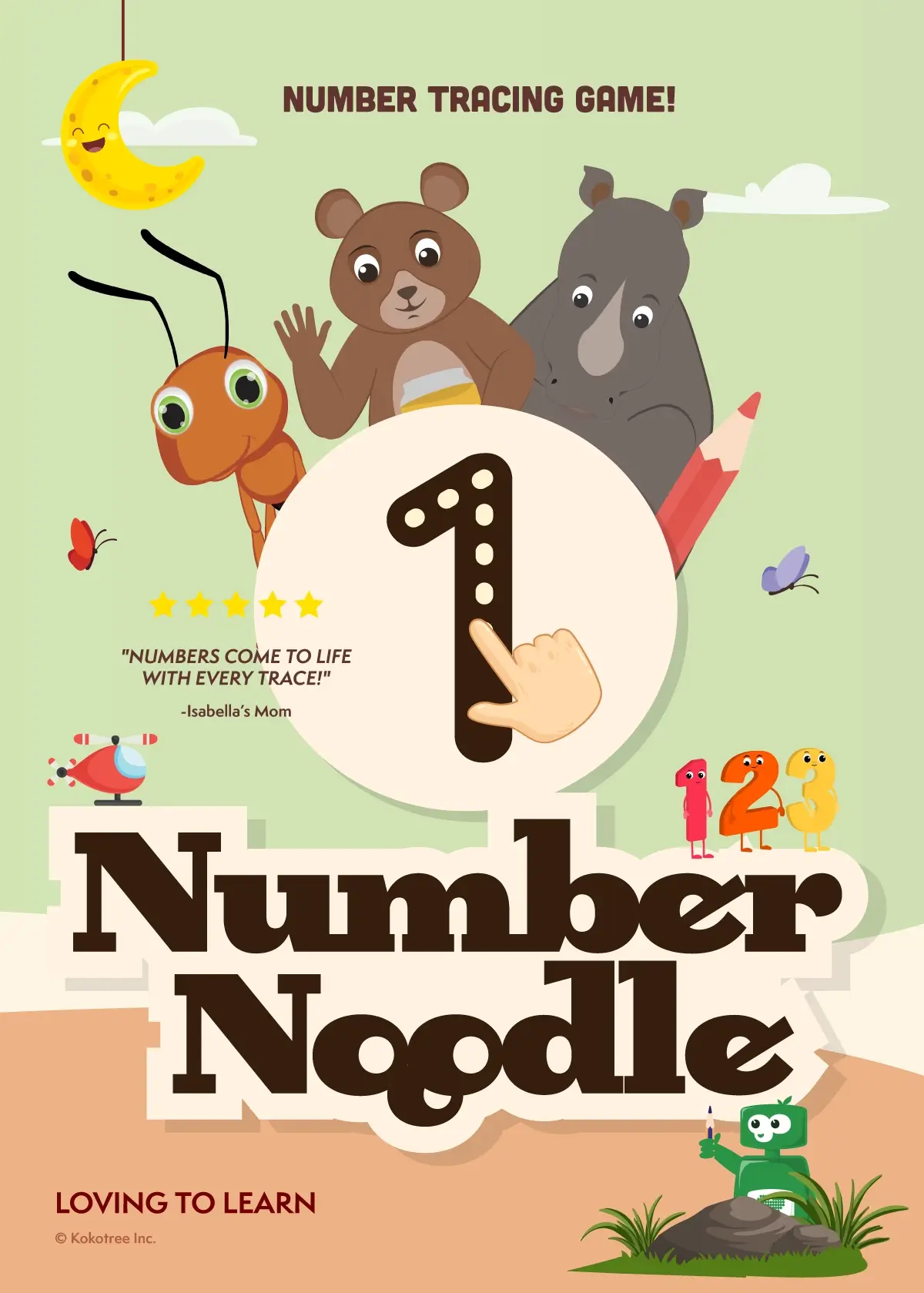
What's Number Noodle About?
Your child traces numbers 0 through 9 with friendly guided paths, developing the hand control and number recognition that form the foundation of early math skills.
Interactive Game
Ages 3-5
Skill: Number Writing & Recognition
Your kid traces numbers with their finger on-screen. You get guilt-free screen time knowing they're learning.
Watch as colorful paths guide tiny fingers through each number's shape. The screen responds to every stroke, giving gentle guidance when needed and celebrating each completed number with encouraging feedback.
What your child practices:
Every tracing session strengthens the connection between seeing a number and knowing how to write it. Your child builds fine motor control while cementing number recognition—two skills that work together for math readiness.
- Forming numbers 0-9 with correct stroke order
- Recognizing number shapes instantly
- Developing pencil-grip muscle control
- Building hand-eye coordination
- Strengthening visual-motor integration
They'll use these skills when:
- Writing their age on birthday cards or drawings
- Recognizing house numbers and prices at the store
- Counting objects and writing the total
- Starting kindergarten math worksheets with confidence
The Gameplay (what keeps them engaged)
Each number appears with a clear tracing path that lights up as your child follows along. Friendly animations celebrate completed numbers, and gentle visual cues redirect off-track fingers without frustration. The game moves at your child's pace—no timers, no pressure. Numbers unlock progressively, giving kids that satisfying "I did it!" moment that makes them want to try the next one. It's the perfect balance of challenge and encouragement that keeps little learners coming back.
How It Teaches (the clever part)
- Immediate feedback: The path lights up green as fingers trace correctly, with gentle nudges guiding strokes back on track
- Progression: Children master easier numbers first (1, 0) before advancing to trickier formations (8, 5)
- Repetition: Multiple tracing rounds per number with varied celebrations keep practice fresh and engaging
Learning trick: The guided path disappears gradually with mastery, building independence while maintaining confidence.
Beyond the App: Reinforce the Learning
- Mealtime activity: "Can you write how many carrots are on your plate?" Use a finger to trace numbers in the air or on the table before eating. (Practices number formation in a fun, low-pressure way)
- Car/travel activity: "Let's find number 5 on signs!" Spot numbers on license plates, buildings, or road signs and trace them on the window. (Reinforces number recognition in the real world)
- Outdoor activity: "Write numbers in the sand or dirt!" Use a stick to practice big number formations outside. (Builds gross motor skills while reinforcing number shapes)
- Anytime activity: "Number hunt around the house!" Find numbers on clocks, remotes, or books and trace them with a finger. (Connects learning to everyday objects)
Common Questions Parents Ask
- "Is tracing on a screen really teaching them to write?" - Yes! Research shows finger tracing builds the same motor pathways as pencil writing. The guided feedback actually helps children learn correct formation before picking up a pencil.
- "How long until my child can write numbers on paper?" - Most children need 2-3 weeks of regular practice before skills transfer to paper. Look for them air-tracing numbers or attempting to write them spontaneously—that's progress!
- "What if my child gets frustrated with harder numbers?" - The game is designed to build confidence with easier numbers first. If frustration happens, take a break and celebrate what they've already mastered. Every child's timeline is different.
What Your Child Will Learn
Prerequisites and Building Blocks
Children benefit most from Number Noodle when they can already count to 10 verbally and have basic finger control for tapping and dragging on screen. This game builds naturally on counting songs and number recognition activities, bridging the gap between knowing numbers exist and being able to write them. It fits perfectly after basic counting mastery and before more complex math concepts like quantity comparison or simple addition.
Cognitive Development and Game Design
Number Noodle uses guided tracing, which aligns perfectly with how 3-5 year olds learn—through direct sensory feedback and repetition. The touch-and-drag mechanic suits developing fine motor skills, while the immediate visual response supports the short feedback loops young brains need. The progressive difficulty respects cognitive load limitations, introducing one number at a time rather than overwhelming working memory.
Alignment with Educational Standards
Number Noodle supports Common Core Kindergarten standard K.CC.A.3 (write numbers 0-20) and Head Start Early Learning Outcomes for mathematics. Preschool teachers expect incoming kindergarteners to recognize and attempt writing single-digit numbers. This game builds the foundational skills assessed in kindergarten readiness screenings, giving children confidence before formal instruction begins.
Extended Learning Opportunities
Pair Number Noodle with Kokotree counting videos to reinforce number meaning alongside formation. Extend learning with playdough number forming, sand tray writing, or large chalk numbers outside. These multi-sensory activities strengthen neural pathways. Look for opportunities to count real objects and write the total, connecting abstract numbers to concrete quantities.
Game Mechanics Summary
- Child traces numbers 0-9 by following an illuminated path on screen
- Touch-and-drag interaction with finger guides showing correct stroke direction
- Real-time visual feedback shows progress along the tracing path
- Celebratory animations and sounds reward completed numbers
Skill Development Progression
Initially, children rely heavily on the guided path and may trace slowly with frequent corrections. With practice, tracing becomes smoother and faster. Mastery looks like confident, quick strokes that follow correct formation without path guidance. Watch for your child spontaneously writing numbers during play, recognizing numbers in the environment, or asking to practice—these signal real skill development and growing confidence.
Early Numeracy and Handwriting Development Deep Dive
Number writing sits at the intersection of two critical developmental domains: early numeracy and fine motor control. Research shows that children who can write numbers demonstrate stronger number sense overall—the physical act of forming a number reinforces its identity in memory.
For children ages 3-5, number formation follows a predictable developmental sequence. Numbers with straight lines (1, 4, 7) typically emerge first, while numbers requiring curved strokes or directional changes (2, 3, 5, 8) develop later. Number Noodle's progression honors this natural sequence, building confidence before introducing complexity.
The connection between handwriting and cognitive development is well-documented. When children trace numbers, they activate motor planning regions, visual processing areas, and memory centers simultaneously. This multi-modal engagement creates stronger, more durable learning than passive observation alone.
For kindergarten readiness, children should recognize all single-digit numbers and attempt to write most of them legibly. Teachers report that children who enter school with basic number writing skills adapt more quickly to math instruction and show greater confidence during early assessments. Number Noodle provides the low-pressure, repetitive practice that builds this foundational skill—turning screen time into genuine school preparation.