
What's More or Less About?
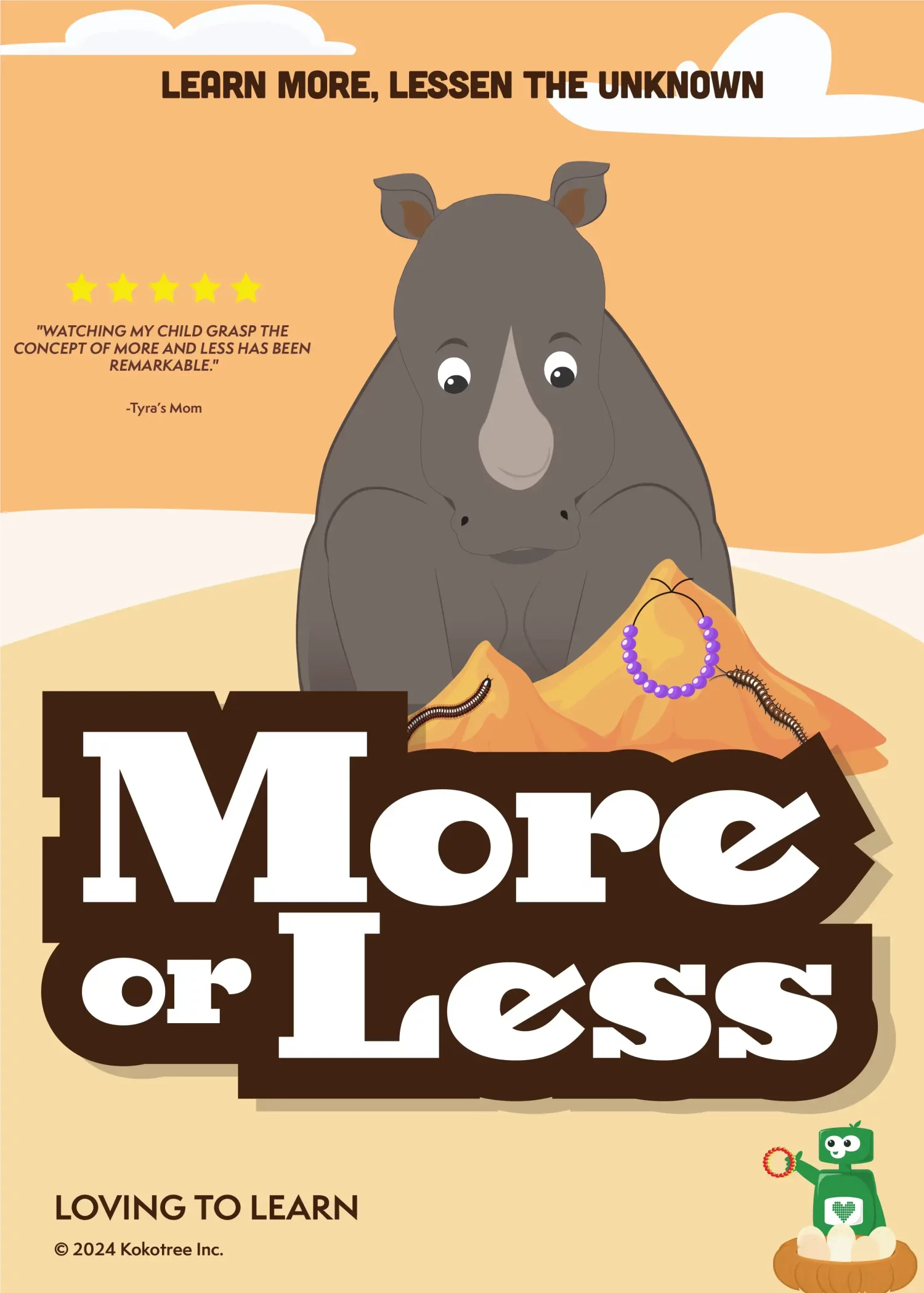
Your little one joins friendly animal friends on a jungle adventure where they discover how to compare quantities—first by making bead bracelets, then by exploring nature! They'll learn to spot which group has more and which has less, using both visual estimation and counting.
7 minutes
Ages 3-5
Skill: Comparing quantities (more vs. less)
Your kid watches animal friends compare beads, sand, and eggs. You get 7 minutes to enjoy your coffee while it's hot.
Mr. Rocko leads the Kokotree class through a bracelet-making activity where kids naturally discover that different wrist sizes need different amounts of beads. Then the adventure moves outdoors where they compare sand mounds, leaves on trees, bug legs, and eggs in bird nests—learning to identify "more" and "less" through both looking and counting.
What your child learns:
This video builds essential pre-math skills by teaching children to compare quantities in two ways: visual estimation ("that pile looks bigger") and precise counting. These comparison skills form the foundation for addition, subtraction, and understanding number relationships.
- Comparing two groups to identify which has more or less
- Using counting as a tool to compare when quantities look similar
- Visual estimation of quantity differences
- Understanding that bigger objects may need more materials
- Applying comparison concepts to real-world observations
They'll use these skills when:
- Dividing snacks fairly between siblings or friends
- Choosing which pile of blocks to play with
- Understanding why their shoes need more laces than their doll's shoes
- Deciding who has more crayons during coloring time
The Story (what keeps them watching)
Mr. Rocko surprises the Kokotree class with a bracelet-making activity! When Bobby the bear needs more beads than Ruby for his bracelet, it sparks a perfect learning moment about why different sizes need different amounts. The class then explores the jungle, comparing sand mounds, leafy trees, centipede and millipede legs, and eggs in bird nests. Some comparisons are obvious just by looking, but when two nests look similar, counting saves the day! The animals practice spotting "more" and "less" everywhere they look.
How We Teach It (the clever part)
First 2 minutes: The bracelet activity introduces the concept naturally—Bobby needs more beads because he has bigger bear hands! Kids see that "more" and "less" aren't about fairness, but about real differences.
Minutes 2-5: Visual comparison practice begins with obvious differences (sand mounds, leafy vs. sparse trees, millipede vs. centipede legs). Children build confidence identifying more and less by sight alone.
Final 2 minutes: The bird nest challenge introduces counting as a comparison tool when visual estimation isn't enough. Mr. Rocko reinforces both methods and encourages practice at home.
Teaching trick: The video deliberately sequences from obvious visual differences to nearly-equal quantities, teaching kids that counting becomes their secret weapon when things look similar.
After Watching: Quick Wins to Reinforce Learning
Mealtime activity: "Who has more peas on their plate?" Put slightly different amounts of food items on plates and let your child compare. They practice visual estimation with a tasty reward.
Car/travel activity: "More or less—red cars or blue cars?" Pick two colors and count cars you pass. Perfect for practicing both counting and comparing while keeping little ones engaged.
Bedtime activity: "Which pile of stuffed animals is bigger?" Create two groups of toys and ask which has more. Let them count to check their guess—just like Mr. Rocko taught!
Anytime activity: "More or less scavenger hunt!" Find two groups of anything (books on shelves, shoes by the door, flowers in the garden) and ask your child to identify which has more. No prep needed—comparisons are everywhere!
When Kids Get Stuck. And How to Help.
"My child just guesses randomly without looking carefully." This is totally normal at first! Slow down and point to each group while asking, "Let's really look—which one seems bigger?" Exaggerate the differences at first, then gradually make them closer as confidence builds.
"They can count but don't connect it to more or less." Bridge the gap by saying, "You counted 5 here and 6 there. Which number is bigger when we count? So which group has MORE?" The connection between number size and quantity takes practice.
"The video seems too easy for my child." Level up by asking "how many more?" instead of just "which has more?" Or introduce three groups and ask which has the most and which has the least. Same concept, bigger challenge!
What Your Child Will Learn
Prerequisites and Building Blocks
Children benefit most from this video if they can count to at least 10 and recognize that numbers represent quantities. This video builds on basic counting skills and introduces comparative thinking—a bridge between simple counting and early addition/subtraction concepts. It fits perfectly after mastering number recognition and before tackling "how many more" problems. The progression from visual estimation to counting-based comparison scaffolds mathematical reasoning.
Cognitive Development and Teaching Methodology
This video leverages concrete-to-abstract learning principles ideal for preschoolers. Children first see obvious physical differences (large vs. small sand mounds), building intuitive understanding before introducing counting as a verification tool. The multi-sensory approach—visual comparisons, verbal counting, and the tactile bracelet context—addresses diverse learning styles. Repeated practice with varied examples strengthens neural pathways for comparative reasoning.
Alignment with Educational Standards
This video addresses Common Core Math Standard K.CC.C.6 (identify whether the number of objects in one group is greater than, less than, or equal to objects in another group) and K.CC.C.7 (compare two numbers). These comparison skills are essential kindergarten readiness indicators. Teachers expect entering kindergarteners to compare groups up to 10 objects—exactly what this video practices through engaging, contextualized examples.
Extended Learning Opportunities
Pair this video with sorting activities where children create "more" and "less" piles of household items. Printable comparison worksheets featuring the Kokotree characters reinforce concepts. The app's counting games complement this video perfectly. Extend learning by creating a "more or less" journal where children draw two groups and circle which has more—building both math and fine motor skills simultaneously.
Transcript Highlights
- "It's great that we can use counting to understand the concept of more or less. But we can also understand the concept of more or less without counting. Would you like to learn how?"
- "Well then, let's count!" (Mr. Rocko's solution when visual comparison isn't clear enough)
- "Five is less than six!" (Bobby demonstrating the counting-to-comparison connection)
- "The more you practice, the better you'll get at it. So find different objects at home, in the park, and anywhere else you feel comfortable."
Character Development and Story Arc
The characters model excellent learning behaviors throughout. When Ruby initially feels upset about Bobby taking more beads, Mr. Rocko gently redirects to logical thinking—different sizes need different amounts. Maddy demonstrates intellectual humility when her guess about having more beads is proven wrong through counting. Bobby shows enthusiasm when he successfully applies counting to comparison. These moments normalize being wrong and celebrate the learning process.
Mathematical Comparison Concepts Deep Dive
Comparison is one of the earliest and most fundamental mathematical operations, predating even addition in cognitive development. This video teaches two distinct comparison strategies that mathematicians call "perceptual subitizing" (instantly recognizing quantity differences visually) and "one-to-one correspondence counting" (systematically counting to compare).
For children ages 3-5, the ability to compare quantities develops in predictable stages. First, children can identify "more" when differences are dramatic (2 vs. 10). Then they develop precision with closer quantities (5 vs. 6), which requires counting. This video brilliantly scaffolds both stages.
The sand mound and tree comparisons leverage children's intuitive understanding of "bigger means more"—a concept called conservation that develops around age 4-5. The bracelet activity introduces a crucial real-world application: sometimes we NEED more of something not because we're greedy, but because of practical requirements (bigger wrists need more beads).
The bird nest scene is pedagogically powerful because it shows when visual estimation fails. When Gina says "they look similar," Mr. Rocko doesn't dismiss her observation—he validates it and introduces counting as the solution. This teaches metacognition: knowing when you need a different strategy.
Research shows that children who master comparison skills early demonstrate stronger mathematical reasoning in elementary school. The vocabulary introduced here—"more," "less," "greater than"—forms the linguistic foundation for algebraic thinking. By practicing with concrete objects (beads, eggs, leaves), children build mental models they'll later apply to abstract number comparison.