
What's Revision of Sleeping, Slanting and Standing Lines About?
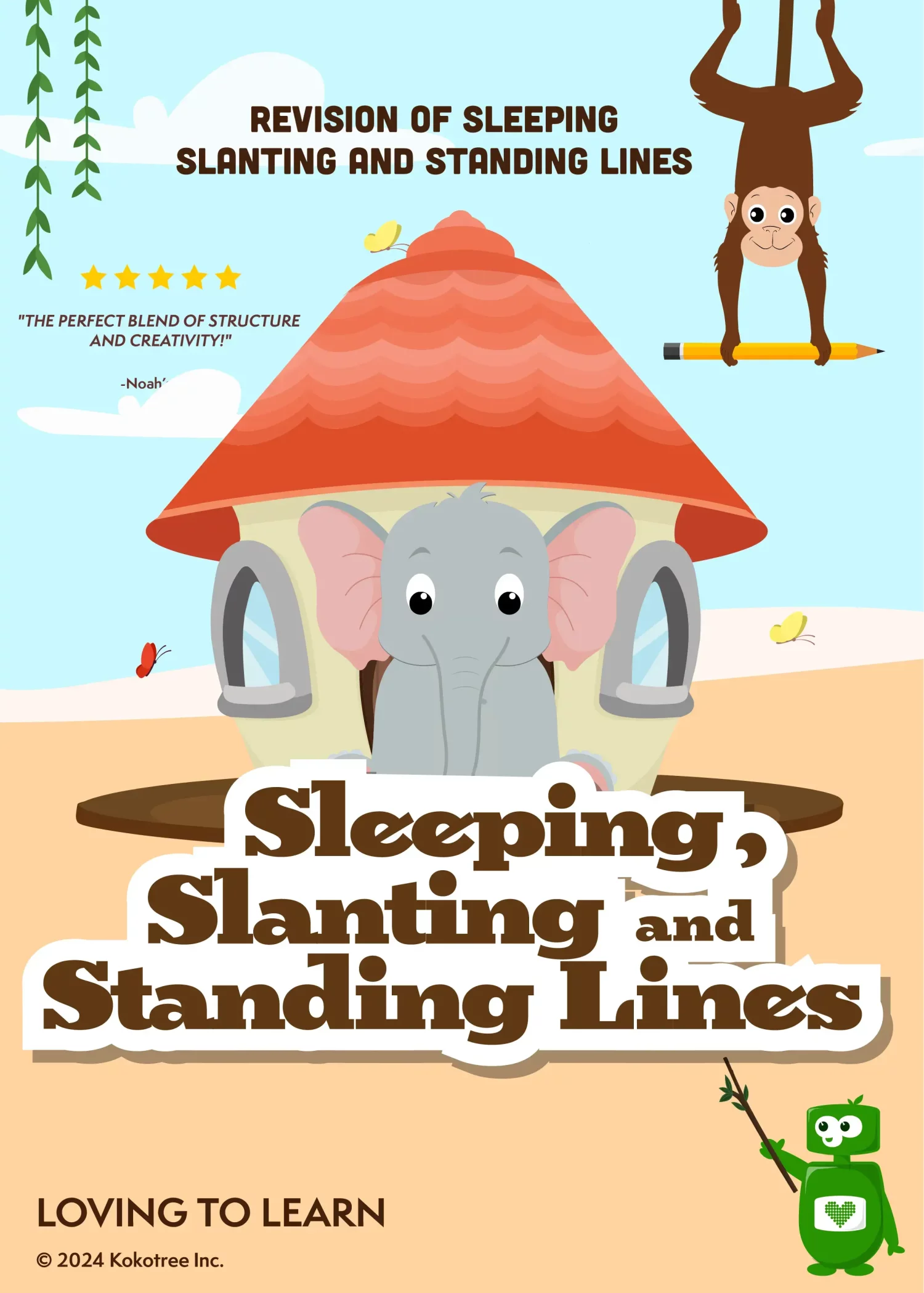
Your little one joins Miss Elizabeth and friends at a sandy riverside beach to practice the three essential line types that form the building blocks of writing. They'll trace lines in the sand and discover how combining them creates everyday objects!
8 minutes
Ages 3-5
Skill: Pre-writing line formation and recognition
Your kid watches animal friends draw lines in beach sand. You get 8 minutes to finish that coffee in peace.
Miss Elizabeth takes the class to a beautiful riverside beach where everyone finds sticks and stones to use as writing tools. The friendly animal characters practice tracing standing lines (vertical), sleeping lines (horizontal), and slanting lines (diagonal) right in the sand. Then comes the creative challenge: draw your favorite object using only these three line types!
What your child learns:
This video reinforces the three fundamental strokes that make up every letter and number your child will eventually write. Through hands-on practice and creative application, kids see how simple lines combine to form meaningful pictures.
- Distinguishes between horizontal, vertical, and diagonal lines
- Traces each line type with proper stroke direction
- Identifies line types within familiar objects (bottles, houses, kites)
- Combines multiple line types to create drawings
- Develops fine motor control for pre-writing readiness
They'll use these skills when:
- Writing their first letters and numbers at school
- Drawing pictures of houses, trees, and objects they see
- Recognizing shapes in books, signs, and everyday items
- Following instructions in art projects and worksheets
The Story (what keeps them watching)
Miss Elizabeth surprises the Kokotree Class with an outdoor lesson at the riverside beach! Armed with sticks and pointed stones, the animal friends practice their line-drawing skills right in the sand. After reviewing standing, sleeping, and slanting lines, Miss Elizabeth issues a creative challenge: draw your favorite object using only these three line types. Ruby draws a carrot juice bottle, Tiki creates mountains, Maddy sketches his hut, Ronnie makes a kite, Gina draws a star, and Bobby traces a book. Each creation gets celebrated as Miss Elizabeth highlights exactly which lines they used!
How We Teach It (the clever part)
- First 2 minutes: Miss Elizabeth reintroduces all three line types with color-coded visual highlights (red for sleeping, blue for standing, yellow and green for slanting), refreshing memory from previous lessons.
- Minutes 2-4: Hands-on practice begins as each animal traces lines in the sand. Characters physically demonstrate the concepts—Maddy stands straight like a standing line, Bobby leans like a slanting line—making abstract concepts concrete.
- Final 4 minutes: Creative application time! Children watch as each character draws a real object and Miss Elizabeth breaks down exactly which lines they used, reinforcing recognition through repetition.
Teaching trick: Color-coding each line type (red, blue, yellow, green) creates instant visual recognition, so when Miss Elizabeth highlights lines in a drawing, kids immediately connect the stroke to its name.
After Watching: Quick Wins to Reinforce Learning
- Mealtime activity: "Can you find a sleeping line on your plate?" Point to the edge of a sandwich, the top of a glass, or a fork handle. Ask them to find standing and slanting lines too!
- Car/travel activity: "I spy a standing line!" Take turns spotting line types in buildings, signs, lamp posts, and trees outside the window. Standing lines are everywhere!
- Bedtime activity: "Let's draw with our fingers!" Trace sleeping, standing, and slanting lines on your child's back and have them guess which one. Then switch roles!
- Anytime activity: "Draw your favorite toy using only three line types!" Grab paper and crayons and challenge them to create like the Kokotree Class did—houses, stars, and simple objects work great.
When Kids Get Stuck. And How to Help.
- "My child keeps mixing up sleeping and standing lines." Totally normal! Use body movements to reinforce: lie down flat for sleeping lines, stand tall with arms up for standing lines. Physical memory sticks better than verbal explanations at this age.
- "They can draw the lines but can't identify them in objects." This takes practice! Start with simple objects like books (standing + sleeping lines only) before moving to complex shapes. Point out lines in their environment throughout the day.
- "The slanting lines are too hard—they come out wobbly." Diagonal strokes are genuinely the trickiest for little hands! Let them practice on larger surfaces first (sidewalk chalk, finger painting) where precision matters less. Wobbly slants still count as wins!
What Your Child Will Learn
Prerequisites and Building Blocks
This revision video assumes children have initial exposure to the three basic line types from earlier Kokotree lessons. Ideal viewers can hold a writing instrument with a basic grip and have practiced simple mark-making. This lesson bridges foundational stroke recognition with creative application, preparing children for letter formation where standing lines become "l" and "t," sleeping lines form "e" and "f," and slanting lines create "v," "w," and "k."
Cognitive Development and Teaching Methodology
The multi-sensory approach—visual color-coding, kinesthetic sand-tracing, and auditory repetition—addresses diverse learning styles simultaneously. Having characters physically embody the lines (Maddy standing straight, Bobby leaning) leverages embodied cognition research showing that physical movement strengthens abstract concept retention. The creative drawing challenge activates higher-order thinking as children must analyze, plan, and synthesize multiple line types.
Alignment with Educational Standards
This video supports Pre-K writing standards requiring children to "use a combination of drawing and writing" and recognize basic shapes and spatial relationships. It aligns with kindergarten readiness indicators for fine motor development and stroke formation. The line identification component addresses early geometry standards for recognizing and describing shapes, while the creative application supports NAEYC guidelines for process-focused art experiences.
Extended Learning Opportunities
Pair this video with Kokotree's line-tracing worksheets featuring dotted sleeping, standing, and slanting lines. The app's drawing games reinforce stroke direction with guided practice. Extend learning with sidewalk chalk activities, finger-painting on large paper, or sandbox play replicating the video's beach setting. Create a "line hunt" scavenger hunt around your home, photographing objects containing each line type.
Transcript Highlights
- "Standing lines... They stand so straight and tall." - Miss Elizabeth uses descriptive language connecting the line's appearance to its name.
- "Goodness gracious! I can see so many sleeping lines here now." - After children lie down, Miss Elizabeth highlights their bodies as sleeping lines, making the abstract concrete.
- "Did you notice that some of you drew slanting lines to the left and others drew slanting lines to the right? Both are correct!" - Validates multiple approaches, building confidence.
- "Isn't it interesting how by joining lines, we could draw such beautiful objects?" - Explicitly connects individual skills to meaningful application.
Character Development and Story Arc
The animal characters model enthusiastic learning behaviors throughout. Bobby demonstrates humor and wordplay ("excellent leaner"), showing that learning can be playful. Each character takes pride in their unique creation—Ruby's carrot juice bottle, Tiki's mountains—modeling how individual expression fits within structured learning. Miss Elizabeth's specific praise ("You're as bright as a star, Gina!") demonstrates growth mindset encouragement that parents can replicate at home.
Pre-Writing Development: The Science Behind Line Formation
The three basic lines—horizontal (sleeping), vertical (standing), and diagonal (slanting)—form the foundational strokes for every letter in the alphabet and every numeral children will write. Developmental research shows children typically master vertical lines first (around age 2), followed by horizontal lines (age 2-3), with diagonal lines emerging last (age 3-4) due to the complex bilateral coordination required.
This video's progression honors that developmental sequence while providing crucial review. The sand-tracing activity offers proprioceptive feedback—children feel resistance as they draw, strengthening the motor pathways needed for pencil control. Large-scale movements in sand naturally precede the fine motor precision required for paper-and-pencil work.
The creative drawing challenge represents a significant cognitive leap: children must mentally decompose familiar objects into component lines, then physically reconstruct them. This analysis-synthesis process develops visual-spatial reasoning essential for later geometry and engineering concepts. When Ronnie draws his kite or Maddy sketches his hut, they're practicing the same decomposition skills architects and designers use.
Color-coding each line type (red for sleeping, blue for standing, yellow and green for slanting) leverages the brain's visual processing system, creating distinct memory traces for each stroke. Research indicates color-association significantly improves recall in young learners, making this technique particularly effective for the revision format.