
What's Phonics Time With K & L About?
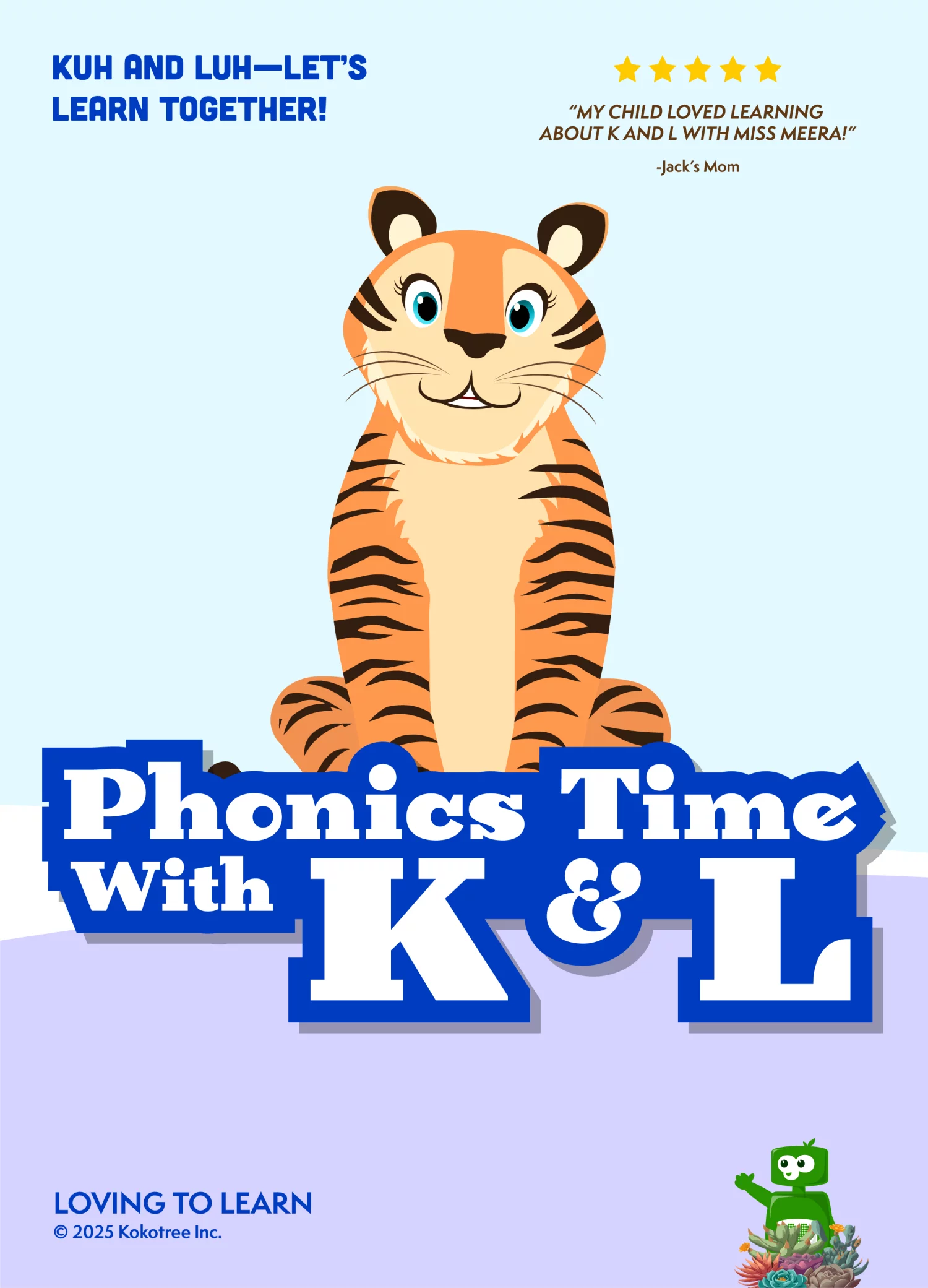
Your little one will master two important letter sounds while joining their favorite animal friends on a playful adventure! They'll confidently hear and identify "kuh" and "luh" sounds in words all around them.
5 minutes
Ages 1-6
Skill: Letter sounds and phonemic awareness
Your kid watches friendly animals discover letter sounds together. You get 5 minutes to sip your coffee in peace.
The Kokotree class works together to rescue a kite stuck in a tree, then settles in with Miss Meera to explore the sounds of letters K and L. A surprise ladybug visitor named Luna helps introduce the letter L in the most delightful way!
What your child learns:
This video builds essential pre-reading skills by teaching children to isolate and identify beginning letter sounds. Through repetition and real-world examples, kids learn to hear "kuh" and "luh" at the start of familiar words.
- Recognizes the "kuh" sound at the beginning of words like king, key, and kangaroo
- Identifies the "luh" sound in words like lamp, leaves, and log
- Practices phonemic awareness by breaking words into sounds
- Builds vocabulary with fun words like kookaburra and kingfisher
- Understands that letters represent specific sounds
They'll use these skills when:
- Sounding out words in picture books at storytime
- Playing "I Spy" games with objects that start with K or L
- Recognizing their own name or friends' names that start with these letters
- Pointing out signs and labels at the grocery store or park
The Story (what keeps them watching)
The episode kicks off with teamwork magic—Maddy Monkey struggles to reach a kite stuck in a tree, but tall Gina Giraffe saves the day! Miss Meera arrives just in time to turn "kite" into a learning moment about the letter K. The class discovers amazing K words like kookaburra (a real bird from Australia!) and kangaroo. Then Bobby Bear makes a tiny friend—a ladybug he names Luna—which perfectly introduces the letter L. Ronnie Rhino even creates clever alliteration: "Luna Ladybug likes lettuce!" Every animal friend contributes words, making learning feel like a group celebration.
How We Teach It (the clever part)
- First 2 minutes: The kite rescue creates natural context for introducing the "kuh" sound, connecting play to learning seamlessly
- Minutes 2-4: Miss Meera models slow sound segmentation ("Kuh...kuh...king") while students practice with increasingly diverse vocabulary
- Final minute: Luna the ladybug provides a memorable character hook for the "luh" sound, with the whole class contributing L words
Teaching trick: Miss Meera stretches out the beginning sound ("Kuh...kuh...key") so children can clearly hear how the letter sound connects to the full word—this phonemic segmentation technique is exactly what reading specialists recommend!
After Watching: Quick Wins to Reinforce Learning
Mealtime activity: "Can you find something on your plate that starts with 'kuh'?" (Think ketchup, carrots with a K sound twist, or just play along!) This reinforces sound-hunting in everyday moments.
Car/travel activity: "Let's look for things outside that start with 'luh'—like leaves, lights, or license plates!" Turns any drive into phonics practice without any prep.
Bedtime activity: "What if we made up a silly name like Luna Ladybug? How about Kenny Kangaroo or Larry Lion?" Playing with alliteration builds phonemic awareness through giggles.
Anytime activity: Go on a "K and L Hunt" around your home. Can they find a lamp? A key? A lock? Every discovery reinforces the connection between sounds and real objects.
When Kids Get Stuck. And How to Help.
"My child mixes up K and L sounds." Totally normal! These sounds are made in different parts of the mouth. Try exaggerating each sound while they watch your lips—"kuh" comes from the back of your throat, "luh" uses your tongue on the roof of your mouth.
"They can hear the sound but can't think of words." That's actually great progress! Sound recognition comes before word generation. Keep pointing out K and L words in books and around the house—they're building a mental word bank.
"This seems too easy/hard for my child." Every child moves at their own pace with phonics. If it's easy, challenge them to find K and L sounds in the middle of words. If it's hard, focus on just one letter at a time and celebrate every attempt.
What Your Child Will Learn
Prerequisites and Building Blocks
Children benefit most from this video if they understand that words are made of individual sounds and have some familiarity with the alphabet. This lesson builds on earlier Kokotree phonics videos covering letters A-J, establishing a sequential approach to letter-sound correspondence. The video reinforces the foundational concept that each letter represents a specific sound, preparing children for blending sounds into words—the next step in the reading progression.
Cognitive Development and Teaching Methodology
This video employs explicit phonics instruction ideal for ages 3-6, when children's phonological awareness is rapidly developing. Miss Meera uses systematic sound segmentation ("Kuh...kuh...king"), which research shows strengthens neural pathways for reading. The multi-sensory approach—hearing sounds, seeing letters, and connecting to familiar objects—addresses visual, auditory, and contextual learning styles simultaneously, maximizing retention across different learner types.
Alignment with Educational Standards
This lesson aligns with Common Core Foundational Skills RF.K.3 (knowing letter-sound correspondences) and RF.K.2 (demonstrating phonological awareness). It supports kindergarten readiness benchmarks requiring children to identify beginning sounds in words. The vocabulary expansion (kookaburra, kingfisher) also addresses language development standards, building the robust vocabulary teachers expect from kindergarten-ready learners.
Extended Learning Opportunities
Pair this video with Kokotree's letter tracing activities for K and L to add a kinesthetic component. The app's "Sound Safari" game reinforces beginning sound identification through interactive play. Parents can extend learning with simple sorting games—gathering household objects and categorizing them by beginning sound. Creating a "K and L" collage from magazine pictures transforms screen learning into hands-on creativity.
Transcript Highlights
- Explicit sound instruction: "The sound of the Letter K is 'kuh'!"
- Guided practice with segmentation: "Kuh...kuh...king. Kuh...kuh...kid. Kuh...kuh...kingfisher."
- Student-generated examples: "A key!" "Kokotree! Like the name of our class!" "I love karate moves! I can hear 'kuh' in karate."
- Alliteration modeling: "Luna Ladybug likes lettuce! That was perfect alliteration!"
Character Development and Story Arc
The opening scene beautifully models collaborative problem-solving—each animal contributes their unique abilities (Gina's height, everyone's encouragement) to rescue the kite. Throughout the lesson, characters demonstrate growth mindset by enthusiastically attempting new words without fear of mistakes. Bobby Bear's curiosity about the ladybug's name shows how questions lead to learning, while Ronnie Rhino's spontaneous alliteration celebrates creative risk-taking in language play.
Phonics and Early Literacy Deep Dive
Phonemic awareness—the ability to hear, identify, and manipulate individual sounds in spoken words—is the single strongest predictor of early reading success. This video targets a critical skill called "onset recognition," helping children isolate the first sound in a word before the vowel.
The letters K and L are strategically paired because they represent distinct sound categories. K is a voiceless velar stop (produced at the back of the mouth with a burst of air), while L is a voiced alveolar lateral (tongue touches the ridge behind upper teeth). Teaching contrasting sounds together helps children develop clearer phonemic categories.
Miss Meera's technique of stretching initial sounds ("Kuh...kuh...king") is called "phoneme elongation" and is supported by decades of reading research. This approach makes the abstract concept of "beginning sounds" concrete and audible. The video's progression from teacher modeling to guided practice to independent student examples follows the "I do, we do, you do" framework proven effective in explicit instruction.
The introduction of vocabulary like "kookaburra" and "kingfisher" serves dual purposes: it expands children's lexicon while demonstrating that phonics rules apply to all words, even unfamiliar ones. The alliteration example ("Luna Ladybug likes lettuce") introduces a literary device while reinforcing the target sound through playful repetition—making the "luh" sound memorable through rhythm and fun.
By connecting sounds to meaningful contexts (kites, ladybugs, familiar objects), this video builds the semantic networks that support both decoding and comprehension as children progress toward independent reading.