
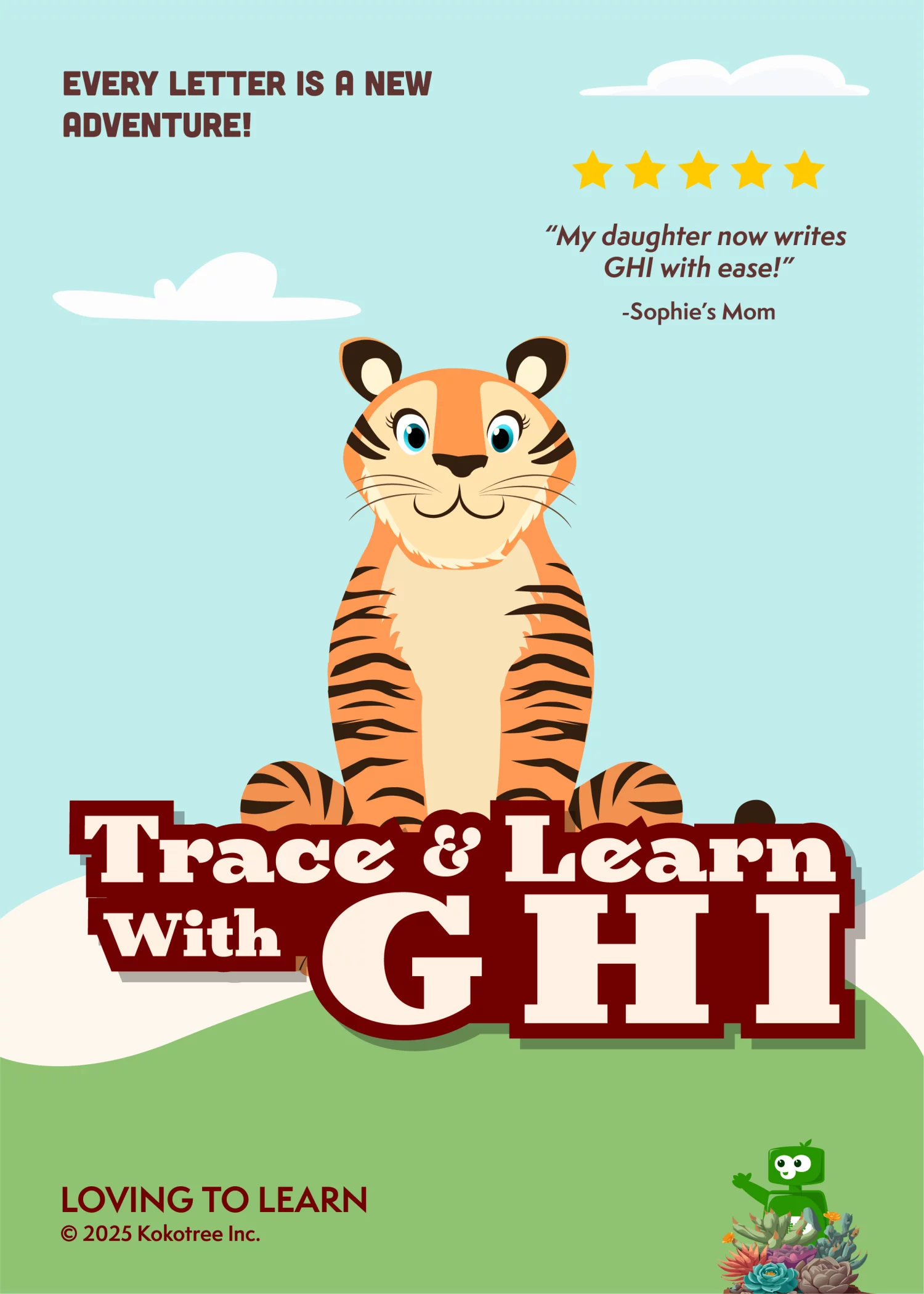
What's Trace & Learn With G, H, & I About?
Your child follows along as Miss Meera breaks down exactly how to form letters G, H, and I—both uppercase and lowercase. By the end, they'll know the strokes needed to write six different letter forms with confidence!
6.5 minutes
Ages 3-6
Skill: Letter formation and handwriting basics
Your kid watches Miss Meera trace letters step-by-step. You get 6 minutes to finish that coffee.
Miss Meera appears on screen with clear letter guides showing the topline, midline, and baseline. She demonstrates each stroke slowly, describing exactly where to start and which direction to move. Each letter gets traced twice so little learners can follow along and internalize the movements.
What your child learns:
This video teaches the specific motor patterns for writing G, H, and I. Children learn to recognize reference lines (topline, midline, baseline) and follow multi-step directions for forming letters correctly.
- Proper stroke order for uppercase and lowercase G
- How to form uppercase H ("two friends holding hands")
- Lowercase h with its up-and-around hump
- Uppercase I with its top and bottom sleeping lines
- Lowercase i with its dot placement
They'll use these skills when:
- Writing their name if it contains G, H, or I
- Practicing letters in preschool or kindergarten
- Labeling their artwork or drawings
- Playing letter-writing games with friends
The Story (what keeps them watching)
Miss Meera warmly welcomes children to learn three new letters. She starts with G, reminding kids how they traced letter C before—that curve comes in handy! The lowercase g gets special attention because it dips below the baseline ("this baby is a little heavy"). Next comes H, which Miss Meera describes as two friends standing and holding hands. Finally, letter I gets its moment with its simple lines and that satisfying dot on the lowercase version. Throughout, Miss Meera encourages practice in sandboxes or notebooks at home.
How We Teach It (the clever part)
- First 2 minutes: Miss Meera introduces uppercase and lowercase G, connecting to prior knowledge of letter C and explaining the unique tail on lowercase g
- Minutes 2-4: Letter H gets broken down with a memorable visual ("two friends holding hands") and the simple chant "down, down, across"
- Final 2.5 minutes: Letter I is taught as the simplest of the three, with clear instructions for line placement and dot positioning
Teaching trick: Miss Meera uses memorable phrases like "sleeping line" for horizontal strokes and compares uppercase H to "two friends holding hands"—these visual anchors help children remember stroke patterns long after the video ends.
After Watching: Quick Wins to Reinforce Learning
Mealtime activity: "Can you trace a G in the air before we eat?" Have your child use their pointer finger to draw uppercase G while you describe the strokes together. Builds muscle memory without any materials needed.
Car/travel activity: "Let's find things shaped like the letter H!" Look for fence posts, goal posts, or ladder rungs that form H shapes. Reinforces letter recognition in the real world.
Bedtime activity: "Trace an I on my back and I'll guess it!" Take turns drawing letters on each other's backs. The tactile sensation reinforces letter formation while winding down.
Anytime activity: "Let's write in the sandbox like Miss Meera said!" Use a finger in sand, salt on a tray, or shaving cream on a table to practice G, H, and I. Sensory writing builds stronger motor pathways.
When Kids Get Stuck. And How to Help.
"My child's lowercase g looks like a 9." Totally normal! The tail direction takes practice. Have them start with the circle first, then add the line going down and curving left. Saying "circle, down, curve" out loud helps.
"They keep forgetting the middle line on H." The visual of "two friends holding hands" is your secret weapon. Draw two stick figures holding hands and show how H captures that moment. Connection made!
"The dot on lowercase i ends up everywhere." Dot placement is tricky for little ones still developing spatial awareness. Try having them write the line first, then lift their finger and "give the i its hat" right above. Patience—this clicks around age 4-5 for most kids.
What Your Child Will Learn
Prerequisites and Building Blocks
Children benefit from prior exposure to letter C (referenced directly in the video) since uppercase G builds on that curved stroke. Familiarity with basic lines—straight down, across, and curved—helps learners follow along. This video fits mid-sequence in alphabet instruction, after A-F mastery. Understanding of baseline, midline, and topline terminology from earlier tracing videos supports comprehension of Miss Meera's directional guidance.
Cognitive Development and Teaching Methodology
The video employs explicit instruction with verbal modeling—ideal for preschoolers who learn through demonstration and repetition. Each letter is traced twice, supporting working memory limitations in young children. Visual-spatial learners benefit from the clear line guides on screen, while auditory learners absorb the step-by-step verbal descriptions. Kinesthetic learning is encouraged through at-home practice suggestions in sandboxes and notebooks.
Alignment with Educational Standards
This content aligns with Common Core Kindergarten standards for print concepts (RF.K.1) and handwriting expectations in most state early learning guidelines. Letter formation instruction supports the "demonstrates emergent writing skills" indicator found in kindergarten readiness assessments. The focus on proper stroke order and directionality prepares children for formal handwriting instruction teachers expect in K-1 classrooms.
Extended Learning Opportunities
Pair this video with printable tracing worksheets for G, H, and I available in the Kokotree app. Follow up with letter recognition games that reinforce these three letters in different fonts and contexts. Extend learning with sensory writing activities—salt trays, finger paint, or sand—that build motor memory. Connect to phonics videos featuring G, H, and I sounds to link letter formation with letter sounds.
Transcript Highlights
- "I hope you remember how we traced letter C, it will help you here." (Building on prior knowledge)
- "Oh this baby is a little heavy, we need one extra line below the baseline to give it support." (Explaining lowercase g's descender)
- "Uppercase H appears as if two friends are standing and holding hands." (Memorable visual anchor)
- "Down, down, across." (Simple chant for H formation)
Character Development and Story Arc
Miss Meera models patient, encouraging teaching throughout the video. She celebrates each small success with "Perfect!" and "Brilliant!" while maintaining high expectations. Her callbacks to previous learning ("I hope you remember letter C") demonstrate how good learners connect new information to what they already know. By suggesting home practice in sandboxes and notebooks, she shows children that learning extends beyond screen time.
Handwriting Development and Fine Motor Skills Deep Dive
Letter formation instruction builds critical pre-writing and fine motor skills essential for academic success. The letters G, H, and I represent three distinct stroke patterns: G combines curves with a horizontal element, H uses only straight lines in multiple directions, and I introduces the concept of adding details (the dot) after completing the main form.
Proper letter formation matters because it builds automaticity—when children don't have to think about how to make letters, they can focus on what they're writing. The video's emphasis on consistent starting points (topline for tall letters, midline for short letters) establishes habits that prevent letter reversals and improve legibility.
The lowercase g presents a unique challenge as a "descender" letter that drops below the baseline. Miss Meera's playful explanation that it's "a little heavy" helps children understand why this letter needs extra space. This conceptual understanding transfers to other descenders like y, p, and q.
Research in occupational therapy suggests that verbal mediation (saying the strokes aloud) significantly improves letter formation in young children. Miss Meera's consistent use of directional language—"circle back around," "slide left," "pull down straight"—gives children an internal script they can use during independent practice. The recommendation to practice in sand or other sensory materials aligns with evidence that multi-sensory approaches strengthen motor learning pathways more effectively than pencil-and-paper practice alone.