
What's Seasons About?
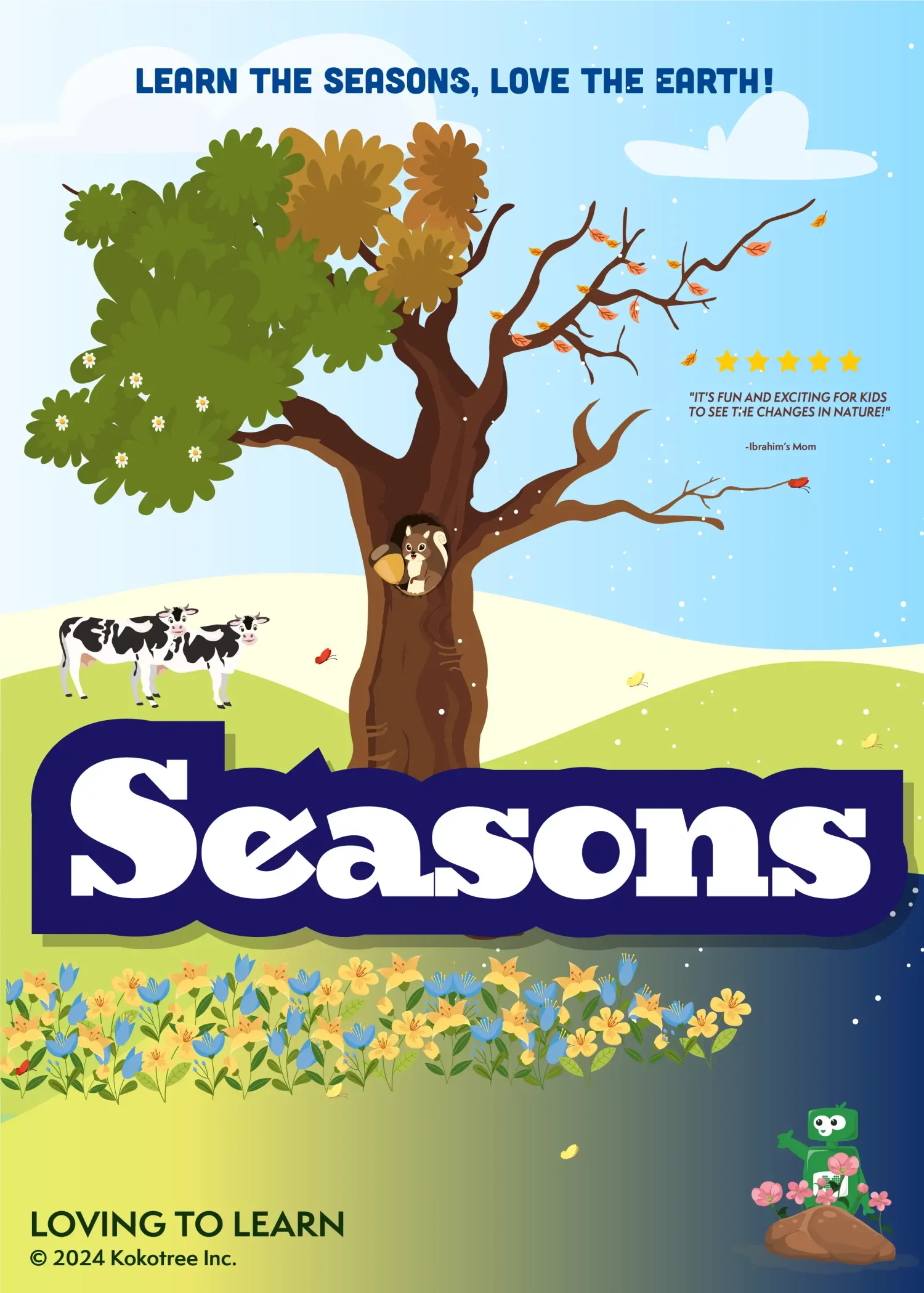
Your little one joins Miss Elizabeth and friends on a year-round adventure through Spring, Summer, Autumn, and Winter! They'll learn to recognize seasonal patterns, name the months, and understand how nature changes throughout the year.
11 minutes
Ages 3-6
Skill: Understanding seasonal cycles and weather patterns
Your kid watches friendly animals discover why seasons change. You get 11 minutes to fold that laundry pile.
Ruby the rabbit is sweating in her favorite woolen cap—but wait, it's getting warm outside! Miss Elizabeth gathers the class to explore why the weather changes and what makes each season special. Kids see beautiful visuals of blooming flowers, sunny beaches, falling leaves, and snowy wonderlands.
What your child learns:
This video teaches children to recognize the four seasons, understand their order, and identify which months belong to each. They'll also discover how plants and animals adapt to seasonal changes.
- Names all four seasons in order: Spring, Summer, Autumn, Winter
- Identifies which months belong to each season
- Recognizes seasonal weather patterns (warm, hot, cool, cold)
- Understands how animals prepare for different seasons
- Connects seasonal changes to everyday activities and clothing choices
They'll use these skills when:
- Picking out clothes in the morning ("It's a Winter month—I need my warm coat!")
- Noticing trees losing leaves at the park and explaining why
- Planning outdoor activities based on the weather
- Talking about upcoming months and what season they'll bring
The Story (what keeps them watching)
Ruby shows up wearing her cozy woolen cap—but she's sweating! The weather has changed, and Miss Elizabeth uses this perfect teaching moment to explore why. The Kokotree Class discovers there are four seasons, not just hot and cold. Through songs, colorful visuals, and fun discussions, they learn what makes Spring magical (flowers and baby animals!), Summer exciting (beach days and popsicles!), Autumn cozy (falling leaves and festivals!), and Winter wonderful (snowmen and hot chocolate!). Bobby loves staying tucked in during Winter, and Ruby dreams of putting her cap on a snowman. By the end, everyone understands nature's yearly cycle.
How We Teach It (the clever part)
- First 3 minutes: Ruby's sweaty cap creates curiosity—why does weather change? The class figures out there must be more than two seasons through guided questioning.
- Minutes 3-8: Each season gets its own spotlight with vivid imagery, specific characteristics, and the months that belong to it. A catchy Spring song reinforces learning.
- Final 3 minutes: Winter wraps up the cycle, and Miss Elizabeth connects it back to Spring—showing kids that seasons repeat every year.
Teaching trick: Miss Elizabeth asks the class to guess each season before revealing it, using clues like "leaves change color" and "it gets hot." This builds prediction skills and keeps kids actively thinking.
After Watching: Quick Wins to Reinforce Learning
- Mealtime activity: "What season are we in right now? What foods do we eat in this season?" (Connects seasonal learning to their daily experience and helps them notice real-world patterns.)
- Car/travel activity: "Look out the window—what clues tell us what season it is?" (Practices observation skills—are trees green, bare, or blooming? Are people wearing coats or shorts?)
- Bedtime activity: "If you could visit any season right now, which would you pick and why?" (Reinforces season characteristics while encouraging expressive language.)
- Anytime activity: Draw a picture together showing one thing from each season—a flower, sun, falling leaf, and snowflake. (Visual reinforcement that seasons have distinct features.)
When Kids Get Stuck. And How to Help.
- "My child keeps mixing up Autumn and Spring." - Both are "in-between" seasons, so confusion is normal! Focus on one key difference: Spring = things growing and blooming, Autumn = things falling and preparing to rest.
- "They can't remember which months go with which season." - Start with just one season they love. Once they master "June, July, August = Summer," add another. Repetition over weeks works better than memorizing all twelve at once.
- "We live somewhere without dramatic seasons—will this confuse them?" - Not at all! Explain that different places experience seasons differently. Focus on the concept that Earth has patterns of warmer and cooler times throughout the year.
What Your Child Will Learn
Prerequisites and Building Blocks
Children benefit from basic weather vocabulary (hot, cold, warm, cool) and familiarity with months of the year before watching. This video builds on foundational concepts from Kokotree's weather and calendar content. It establishes the framework for more advanced earth science topics like why seasons happen and introduces cyclical patterns—a key mathematical concept. Understanding seasons also supports future learning about animal habitats, plant life cycles, and telling time across longer periods.
Cognitive Development and Teaching Methodology
This video leverages concrete-to-abstract learning by starting with Ruby's relatable discomfort (too hot in a winter cap) before introducing seasonal vocabulary. The teaching follows Piaget's preoperational stage principles—using vivid imagery and storytelling rather than abstract explanations. Visual learners see seasonal scenes, auditory learners hear the Spring song and verbal descriptions, and the interactive questioning style ("Can you guess?") engages kinesthetic learners who process through participation.
Alignment with Educational Standards
This content aligns with Next Generation Science Standards (K-ESS2-1) regarding weather patterns and seasonal changes. It supports kindergarten readiness benchmarks for understanding time concepts beyond days and weeks. Head Start Early Learning Outcomes Framework addresses this under "Scientific Reasoning"—observing and describing natural phenomena. Teachers expect entering kindergartners to name seasons and associate basic characteristics with each, making this video excellent preparation.
Extended Learning Opportunities
Pair this video with Kokotree's printable "Four Seasons Sorting" worksheet where children match activities and clothing to seasons. The app's "Weather Watch" game reinforces seasonal concepts through interactive play. Extend learning by creating a simple "Season Journal"—each week, draw what you see outside and discuss which season it represents. Nature walks focusing on seasonal clues (budding flowers, falling leaves) bring screen learning into the real world.
Transcript Highlights
- Teaching through discovery: "Does anyone know how many seasons we experience throughout the year?" followed by guided reasoning—"Do you usually experience too cold or too hot weather throughout the year?"
- Making it memorable: "Winter is the coldest season of the year! It's the season when the days are short and nights are long... REST is the keyword!"
- Connecting to real life: "Squirrels start to store their food for Winter. Birds prepare to fly someplace warmer. Bears eat a lot more to make it through the Winter."
- Reinforcing the cycle: "And the new cycle of Spring, Summer, Autumn, and Winter begins all over again!"
Character Development and Story Arc
Ruby models the learning process beautifully—she starts confused (why am I so hot?) and ends understanding (seasons change!). Her attachment to her woolen cap makes her relatable, and her excitement about Winter shows that learning leads to anticipation and joy. The whole class demonstrates collaborative learning, building on each other's answers. Bobby's enthusiasm for staying "tucked in" and Ruby's snowman-building dreams show children that knowledge connects to fun experiences.
Understanding Seasonal Cycles: A Science Deep Dive
Seasons represent one of the first large-scale natural patterns children can observe and predict. This video introduces cyclical thinking—the understanding that certain events repeat in predictable sequences. This cognitive skill transfers to telling time, understanding life cycles, and eventually grasping concepts like the water cycle.
The video wisely focuses on observable characteristics rather than the complex astronomy behind seasons (Earth's tilt and orbit). For ages 3-6, concrete observations matter most: leaves change color, animals behave differently, weather shifts. These tangible markers help children build mental categories for organizing their world.
By associating months with seasons, children practice temporal reasoning—understanding that time has structure beyond "today" and "tomorrow." This supports calendar skills and helps children anticipate future events ("My birthday is in July—that's Summer!").
The animal behavior segments introduce basic ecology concepts. Children learn that living things respond to environmental changes—squirrels store food, birds migrate, bears eat more. This plants seeds for understanding adaptation and survival, key biological concepts they'll explore in later grades.
The inclusion of both "Autumn" and "Fall" as names for the same season introduces vocabulary flexibility—an important language arts skill. Children learn that the same concept can have multiple labels, preparing them for synonyms and regional language variations they'll encounter in reading.