
What's Letter L About?
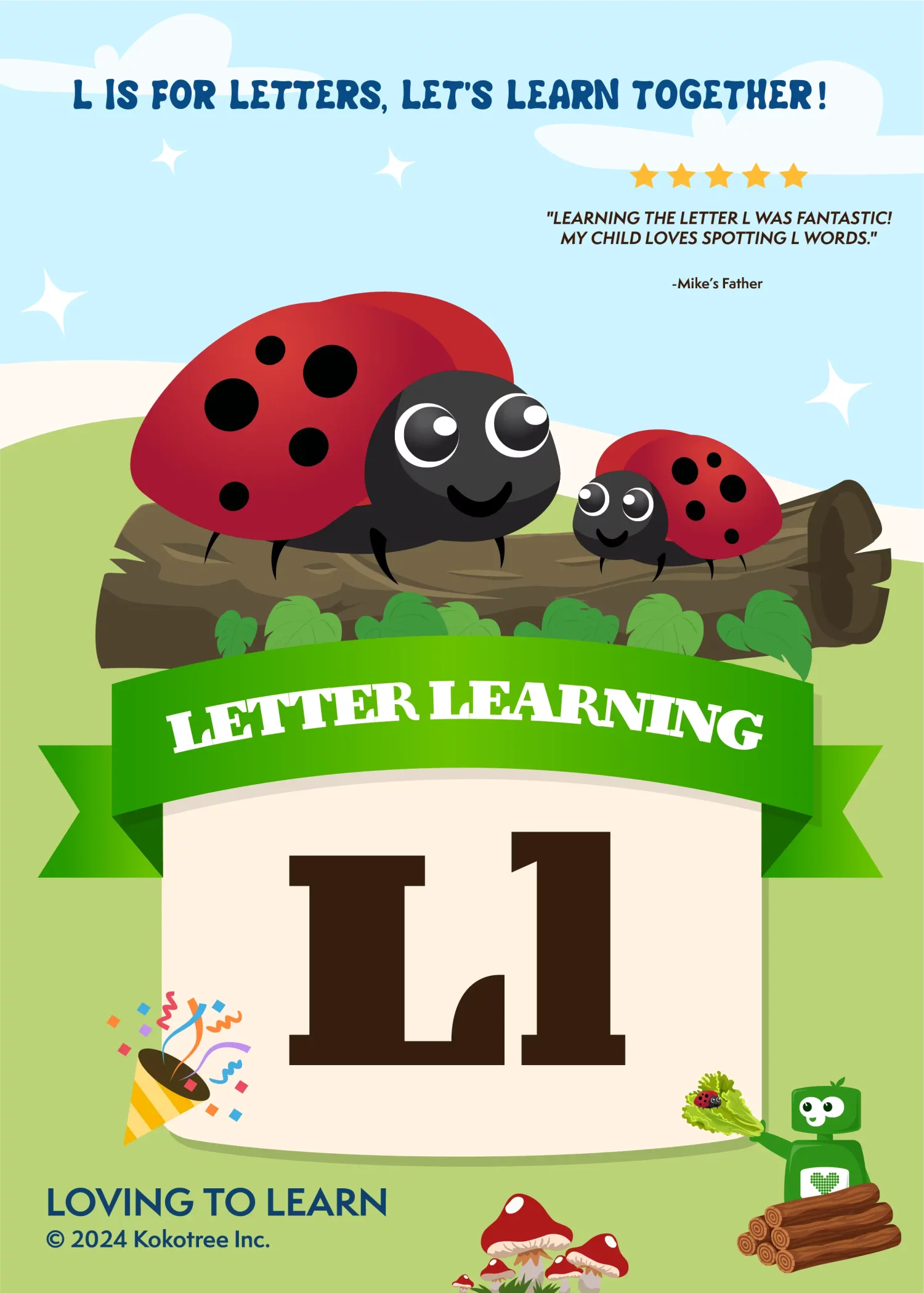
Your little one joins Bobby Bear and friends in a lettuce field where they meet Luna the Ladybug and discover the magical "luh" sound! They'll learn to hear, say, and write the Letter L through an enchanting story about a musical land.
7 minutes
Ages 3-5
Skill: Letter recognition and phonics
Your kid watches friendly animals explore L-words in a lettuce field. You get 7 minutes to finish that cup of coffee.
Bobby Bear discovers a ladybug on some lettuce, and Miss Meera turns it into a letter lesson! The class listens to a story about "La La Land" filled with locks, lamps, ladders, and leaves—all making magical musical sounds. Then they practice writing the letter L in the dirt together.
What your child learns:
This video builds foundational phonics skills by connecting the "luh" sound to familiar objects children see every day. Through storytelling and hands-on letter formation, your child develops both listening comprehension and early writing skills.
- Recognizes the Letter L in uppercase and lowercase forms
- Identifies the "luh" sound at the beginning of words
- Understands alliteration ("Luna Ladybug likes lettuce")
- Practices letter formation with simple stroke directions
- Connects letter sounds to real-world objects
They'll use these skills when:
- Spotting the letter L on signs, books, and food labels at the grocery store
- Sounding out words while reading bedtime stories together
- Writing their name if it contains the letter L
- Playing "I Spy" games and finding L-words around the house
The Story (what keeps them watching)
Bobby Bear finds a friendly ladybug named Luna sitting on lettuce in the field. When Ronnie Rhino accidentally creates alliteration ("Luna Ladybug likes lettuce!"), Miss Meera seizes the teaching moment! She tells the class about La La Land—a magical place where locks tinkle, lamps thunder, and ladder rungs sound like piano keys. The animals identify all the L-words from the story, then learn to write the letter. Maddy Monkey even makes an uppercase L with his legs! It's playful, musical, and packed with "luh" sounds.
How We Teach It (the clever part)
- First 2 minutes: Bobby discovers Luna the Ladybug, and the class naturally notices words starting with "luh"—ladybug, lettuce, Luna. The sound is introduced through discovery, not drilling.
- Minutes 2-5: Miss Meera's La La Land story immerses children in L-words (land, locks, lamps, ladders, leaves, logs, law, lads, legs, leisure, love, lovely). Kids hear the sound repeatedly in context.
- Final 2 minutes: The class recalls L-words together, then learns letter formation step-by-step. Maddy's creative body-letter reinforces the shape.
Teaching trick: The video uses alliteration as a memory hook. "Luna Ladybug likes lettuce" is catchy and repeatable—your child will likely say it unprompted!
After Watching: Quick Wins to Reinforce Learning
- Mealtime activity: "Can you find something on your plate that starts with 'luh'?" (Lettuce, lemon, lasagna—practice connecting sounds to foods they're eating)
- Car/travel activity: "Let's look for L things out the window—lights, leaves, license plates!" (Builds observation skills while reinforcing the letter sound)
- Bedtime activity: "What if your bedroom was in La La Land? What sounds would your lamp make?" (Encourages creative thinking while recalling the story)
- Anytime activity: "Can you make the letter L with your body like Maddy Monkey?" (Kinesthetic learning reinforces letter shape recognition)
When Kids Get Stuck. And How to Help.
- "My child confuses L with I or 1" - Totally normal! Point out that uppercase L has a "foot" at the bottom that sticks out to the right. Practice drawing the "sleeping line" at the base together.
- "They can hear the sound but can't think of L-words" - Start with the video's words: ladybug, lamp, leaf, log. Then look around your home together—light switches, legs, lids. Real objects make it click.
- "Writing the letter is frustrating for them" - Lowercase l is just one straight line—celebrate that win first! For uppercase, try saying "down, then across" as a little chant while they draw.
What Your Child Will Learn
Prerequisites and Building Blocks
Children benefit most from this video if they understand that words are made of sounds and can identify a few letters already. This Letter L episode builds on general alphabet awareness and complements other letter videos in the Budding Sprouts program. It's ideal after children have been introduced to simpler letters and are ready to connect sounds to symbols. The alliteration concept ("Luna Ladybug likes lettuce") introduces early phonological awareness that prepares children for blending and segmenting words.
Cognitive Development and Teaching Methodology
This video applies multisensory learning principles perfect for ages 3-5. Auditory learners benefit from repeated "luh" sounds throughout the story. Visual learners see letter formation demonstrated step-by-step. Kinesthetic learners engage when Maddy makes the letter with his body. The narrative structure (discovery → story → recall → practice) follows how young brains encode information—emotional engagement first, then repetition, then application. The 7-minute length respects preschool attention spans.
Alignment with Educational Standards
This video addresses Common Core Foundational Skills for kindergarten readiness, specifically RF.K.1d (recognizing letters) and RF.K.3a (letter-sound correspondence). It supports Head Start Early Learning Outcomes in Literacy Knowledge, including phonological awareness and alphabet knowledge. The letter formation instruction aligns with handwriting readiness benchmarks, teaching proper stroke sequence (top-to-bottom, left-to-right) that teachers expect when children enter formal schooling.
Extended Learning Opportunities
Pair this video with Kokotree's letter tracing activities for hands-on practice. Print uppercase and lowercase L worksheets for finger-tracing with crayons. Explore other phonics videos featuring beginning sounds to build a complete letter library. Create a simple "L scavenger hunt" at home—find and photograph items starting with L. The Kokotree app's interactive games reinforce letter recognition through play-based repetition that extends learning beyond passive watching.
Transcript Highlights
- Sound introduction: "Children, do you know that the letter L sound is 'luh'... 'luh'?"
- Real-world connection: "Like the 'luh' in Luna and 'luh' in ladybug!"
- Letter formation instruction: "Start at the topline and make a line down to the baseline. Then go to the bottom and slide right to make a small sleeping line."
- Kinesthetic reinforcement: "Yes, I can see you have formed the Letter L with your legs. You're so creative!"
Character Development and Story Arc
Bobby Bear models curiosity when he gently greets the ladybug and asks questions ("How do you know it's a lady?"). This shows children it's okay not to know everything. Ronnie Rhino accidentally discovers alliteration, demonstrating that learning happens through play. Maddy Monkey's creative leg-letter shows initiative and thinking outside the box. Miss Meera consistently validates attempts ("Well done!" "You're so creative!"), modeling the encouraging feedback that builds confidence in young learners.
Phonics and Early Literacy Deep Dive
The Letter L holds special importance in early phonics instruction because it's a continuous consonant—the "luh" sound can be stretched and held, making it easier for young children to isolate and identify than stop consonants like B or T. This video leverages that phonetic property by having characters elongate the sound: "Luh...luh...land."
Alliteration, introduced naturally through "Luna Ladybug likes lettuce," is a powerful phonological awareness tool. Research shows that children who recognize alliteration develop stronger decoding skills later. The brain notices patterns, and repeated initial sounds create memorable "hooks" that help children recall letter-sound relationships.
The La La Land story serves a specific pedagogical purpose: contextual vocabulary exposure. Children hear L-words (lock, lamp, ladder, leaves, log, law, lads, legs, leisure, love) embedded in meaningful narrative rather than isolated lists. This contextualized learning improves retention because the brain stores words with their associated imagery and emotions.
Letter formation instruction follows developmental handwriting research. Starting at the topline and moving downward establishes proper directionality. The term "sleeping line" for the horizontal stroke uses child-friendly language that creates a visual memory aid. Practicing both uppercase and lowercase together helps children understand these are the same letter in different forms—a concept called letter constancy that's essential for reading fluency.
The video's progression from sound recognition to word identification to letter writing mirrors the natural literacy development sequence, building skills in the order children's brains are ready to receive them.