
What's Shape Quest About?
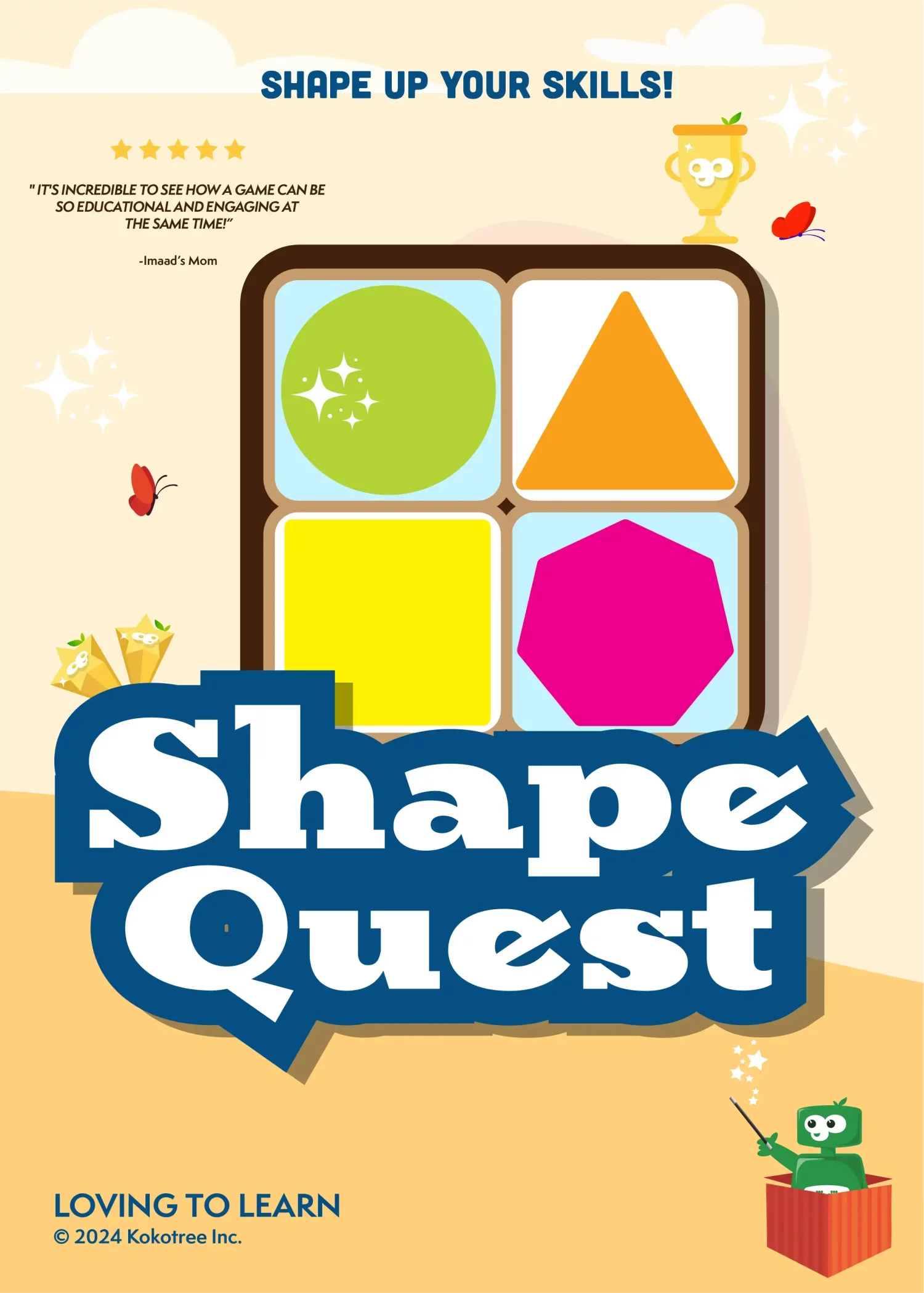
Your little explorer flips cards to find matching shapes while exercising their memory muscles. This clever combination builds shape recognition AND working memory—two essential skills for math and reading readiness.
Interactive Game
Ages 2-5
Skill: Shape Recognition & Memory
Your kid matches hidden shapes using memory and focus. You get guilt-free screen time knowing they're learning.
Friendly animal characters guide your child through a colorful world where shapes are hiding under cards. Tap to reveal a shape, remember where it is, then find its match! Each successful pair celebrates with cheerful animations that keep little learners motivated.
What your child practices:
Every round exercises visual memory while reinforcing shape names and attributes. Your child learns to hold information in mind, scan for matches, and make connections—foundational cognitive skills that transfer to reading, math, and everyday problem-solving.
- Identifying circles, squares, triangles, rectangles, and more
- Holding shape locations in working memory
- Developing concentration and focused attention
- Building visual discrimination skills
- Practicing patience and strategic thinking
They'll use these skills when:
- Sorting toys, blocks, or snacks by shape at home
- Following multi-step directions from caregivers
- Recognizing letters and numbers (which are just shapes!)
- Getting ready for kindergarten pattern and geometry activities
The Gameplay (what keeps them engaged)
Shape Quest uses the classic memory match format kids love—but with a learning twist. Children tap cards to reveal colorful shapes, then must remember locations to find matching pairs. Correct matches trigger delightful celebrations from Kokotree animal friends, while gentle encouragement keeps them trying after misses. The game starts simple with fewer cards and basic shapes, then gradually introduces more cards and complex shapes as skills grow. This "just right" challenge keeps kids in the sweet spot where learning happens—engaged but not frustrated.
How It Teaches (the clever part)
- Immediate feedback: Matched pairs burst with stars and cheerful sounds; mismatched cards gently flip back, reinforcing memory without penalty
- Progression: Starts with 4 cards and basic shapes, advancing to more cards and varied shapes as mastery builds
- Repetition: Randomized shape placement means every game feels fresh while practicing the same core skills
Learning trick: By pairing shape recognition with memory recall, children process shape information more deeply than simple flashcards—they're not just seeing shapes, they're actively thinking about them.
Beyond the App: Reinforce the Learning
Mealtime activity: "Shape hunt on your plate!" Point to foods and ask what shape they see—a round grape, a square cracker, a triangular cheese wedge. (Practices shape identification in real objects)
Car/travel activity: "I spy a shape!" Take turns spotting shapes through the window—circular wheels, rectangular signs, triangular rooftops. (Builds shape recognition in the environment)
Outdoor activity: "Shape scavenger hunt!" Find natural shapes outside—round stones, leaf shapes, square sidewalk sections. Collect or point to each discovery. (Connects shapes to the natural world)
Anytime activity: "Memory tray game!" Place 3-4 shaped objects on a tray, let your child look, cover them, remove one. Can they remember what's missing? (Practices the same working memory skills as the game)
Common Questions Parents Ask
"Is a matching game really teaching anything?" - Absolutely! Memory matching is one of the most research-backed ways to build working memory, which predicts academic success better than IQ. Your child is literally exercising their brain's "mental workspace."
"How long until my child gets better at remembering?" - Most children show noticeable memory improvement within 2-3 weeks of regular play. You might notice them remembering where toys are kept or recalling story details more easily.
"What if my child gets frustrated when they can't find matches?" - Start with the easiest level and celebrate effort, not just success. Saying "Great remembering!" even after a miss helps build persistence. The game's gentle design keeps frustration low while building resilience.
What Your Child Will Learn
Prerequisites and Building Blocks
Children benefit most from Shape Quest when they can already identify 2-3 basic shapes by name and understand simple game mechanics like tapping and taking turns. This game builds on foundational shape exposure from books, blocks, and everyday objects. It bridges passive shape recognition toward active recall and comparison—a key step before sorting, pattern work, and early geometry concepts in kindergarten.
Cognitive Development and Game Design
Memory matching perfectly suits ages 2-5 because it leverages developing working memory capacity while keeping cognitive load manageable. The tap-to-reveal mechanic matches fine motor abilities at this stage—no complex dragging required. Visual-spatial processing peaks during this period, making shape-location pairing especially effective. Short game rounds respect limited attention spans while building sustained focus incrementally.
Alignment with Educational Standards
Shape Quest addresses Head Start Early Learning Outcomes Framework domains in Mathematics (geometry and spatial sense) and Approaches to Learning (attention and memory). It supports Common Core Kindergarten standards K.G.A.2 (correctly naming shapes) and K.G.B.4 (analyzing and comparing shapes). Teachers expect incoming kindergartners to recognize basic shapes and demonstrate emerging working memory—both practiced here.
Extended Learning Opportunities
Pair Shape Quest with Kokotree's shape-focused videos featuring friendly animal characters exploring shapes in nature. Extend learning with shape sorting toys, tangram puzzles, and shape-themed books. Building with blocks reinforces 3D shape understanding. Drawing shapes in sand, shaving cream, or with finger paints adds sensory dimensions to shape learning while developing pre-writing motor skills.
Game Mechanics Summary
- Child taps cards to reveal hidden shapes underneath
- Must remember shape locations to find matching pairs
- Successful matches clear cards and trigger celebration animations
- Incorrect matches flip cards back, encouraging retry and memory reinforcement
Skill Development Progression
Early play focuses on basic shape matching with few cards—children may rely on luck initially. With practice, deliberate memory strategies emerge: children pause to study revealed shapes, verbalize shape names, and systematically search. Mastery shows as faster completion times, fewer mismatches, and success at higher difficulty levels. Parents may notice improved memory in daily life—remembering where items belong or recalling story sequences.
Working Memory and Shape Recognition: The Foundation for Learning
Working memory—the ability to hold and manipulate information in mind—is one of the strongest predictors of academic success across subjects. Research shows working memory capacity at age 5 predicts reading and math achievement years later. Shape Quest directly exercises this crucial cognitive skill in an age-appropriate, engaging format.
For children ages 2-5, working memory is rapidly developing but limited. Most preschoolers can hold 2-3 items in mind simultaneously. Shape Quest respects this by starting with manageable card counts, then gradually expanding as capacity grows. This "zone of proximal development" approach ensures children are challenged but not overwhelmed.
Simultaneously, shape recognition forms the visual foundation for letter and number learning. Letters are essentially combinations of lines and curves—shapes! Children who confidently distinguish circles from ovals and squares from rectangles transfer this discrimination skill to telling "b" from "d" or "6" from "9." The game reinforces shape vocabulary (naming shapes aloud during play) alongside visual recognition.
The memory-matching format is particularly powerful because it requires deeper processing than passive viewing. To succeed, children must encode the shape (What is it?), store its location (Where was it?), and retrieve both pieces of information when searching for matches. This multi-step cognitive process strengthens neural pathways more effectively than simple shape identification alone.
By kindergarten entry, children are expected to name basic shapes, compare shapes, and demonstrate emerging working memory for classroom instructions. Shape Quest builds both skills simultaneously, giving your child a genuine cognitive advantage—all through play they genuinely enjoy.