
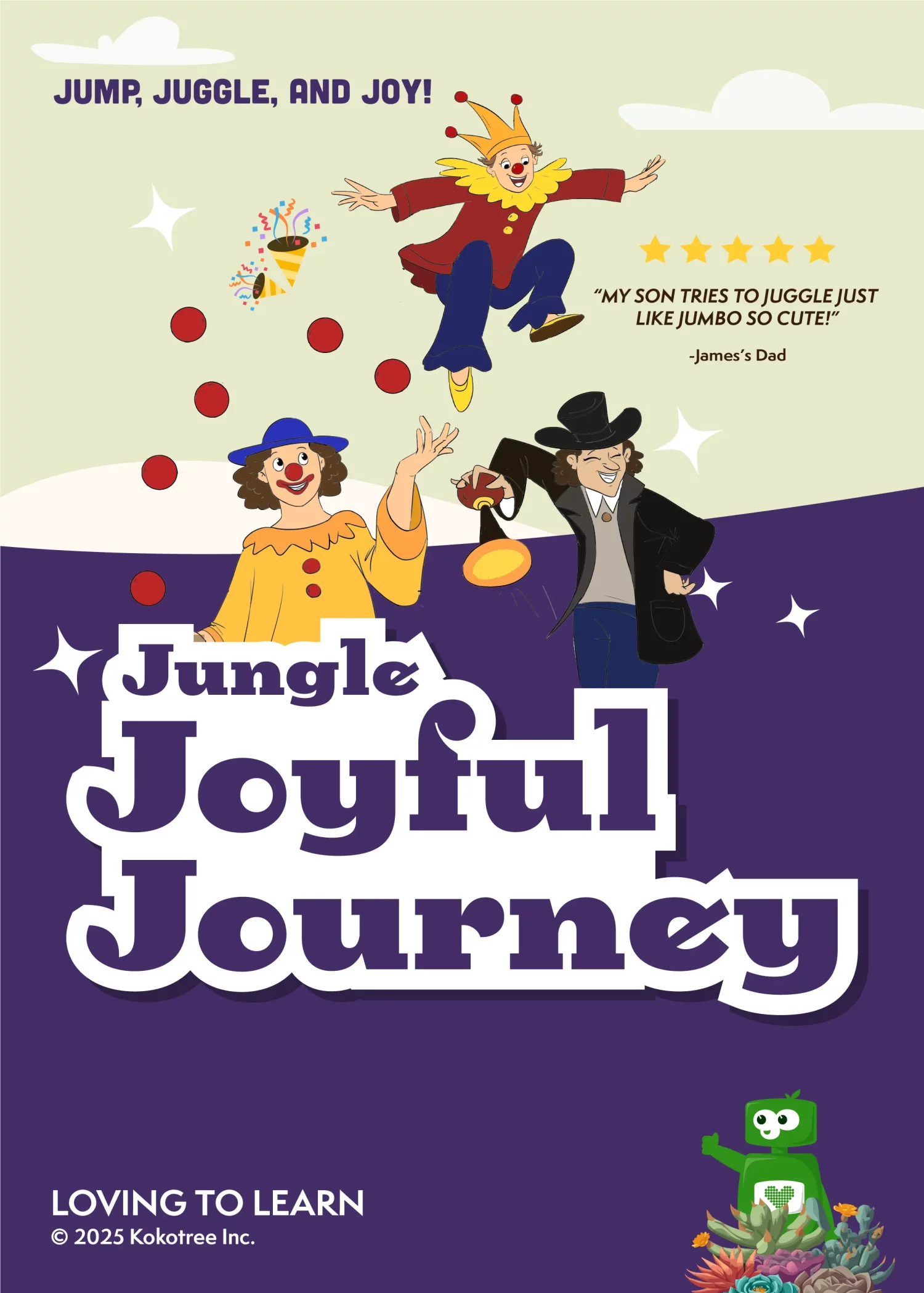
What's The Joyful Journey About?
Your little one joins Miss Meera for an exciting story packed with letter J words—from juggling jokers to jungle adventures! After watching, they'll recognize the J sound and eagerly point out J words in everyday life.
3 minutes
Ages 3-5
Skill: Letter J recognition and phonics
Your kid watches three jokers make a jungle laugh with J-words. You get 3 minutes to finish that cup of coffee.
Miss Meera tells an engaging story about Jumbo, Jumper, and Junior—three jokers who live in Jolly House and decide to bring laughter to the jungle. Colorful scenes show them driving their jeep, meeting jackrabbits and jaybirds, and making even the jackals giggle. Bobby Bear tries juggling, and Ruby Rabbit wishes for more joyful days.
What your child learns:
This video immerses children in the letter J through storytelling, helping them hear and recognize the J sound in context. By the end, they'll connect the sound to familiar words and start noticing it everywhere.
- Recognizes the letter J and its sound
- Identifies J words: joker, juggle, jump, jeep, jungle, jaybird, jackrabbit
- Builds vocabulary through story context
- Develops listening comprehension skills
- Connects letter sounds to real objects and actions
They'll use these skills when:
- Spotting the J on a jar of jam or jelly at breakfast
- Pointing out a jeep or jet while riding in the car
- Jumping during playtime and saying "J is for jump!"
- Recognizing their friend's name starts with J (like Jack or Jasmine)
The Story (what keeps them watching)
Meet the Three Jokers—Jumbo the juggler, Jumper the high-flyer, and Junior the joke-teller! They live in Jolly House near a jungle and decide to go on a brave journey to make all the animals laugh. Even when scary jackals appear, these courageous jokers perform their act. The whole jungle ends up giggling! Bobby Bear gets inspired to try juggling (spoiler: it's harder than it looks!), and everyone ends with jolly good wishes. It's a feel-good adventure stuffed with J sounds from start to finish.
How We Teach It (the clever part)
- First minute: Miss Meera introduces the story and establishes J words naturally—jokers, Jolly House, Jumbo, Jumper, Junior, juggled, jump, jester, jokes.
- Minutes 1-2: The adventure builds with more J vocabulary—journey, jungle, jeep, jackrabbits, jaybirds, jackals, jaguars—all woven into exciting story moments.
- Final minute: The story resolves with joyful repetition, then Bobby Bear and Ruby Rabbit reinforce key J words (juggle, jokers, joyous, jolly) through their reactions.
Teaching trick: The video uses alliteration naturally within the story ("Jumbo juggled," "Jumper could jump") so children hear the J sound repeated in memorable, action-packed phrases rather than isolated drills.
After Watching: Quick Wins to Reinforce Learning
- Mealtime activity: "Can you find something on the table that starts with J?" (Look for juice, jam, or jelly—they'll love being word detectives at breakfast or lunch!)
- Car/travel activity: "Let's jump our fingers every time we see something that starts with J!" (Watch for jeeps, jets in the sky, or signs with J—turns any drive into a letter hunt.)
- Bedtime activity: "What J words can you remember from the jokers' story?" (Recalling jungle, jeep, and jackrabbit reinforces memory and the J sound before sleep.)
- Anytime activity: "Can you jump like Jumper? Can you pretend to juggle like Jumbo?" (Acting out J words connects the sound to their body and makes learning stick.)
When Kids Get Stuck. And How to Help.
- "My child confuses J with G sounds" - Totally normal! Both are made in similar mouth positions. Exaggerate the J sound together: "Juh-juh-JUMP!" and feel how your tongue touches the roof of your mouth.
- "They can't remember any J words after watching" - That's okay—repetition is key at this age. Watch again tomorrow and pause to repeat words together. By the third viewing, they'll be shouting them out!
- "The story seems too advanced for my 3-year-old" - Focus on the fun, not perfection! Even if they only catch "jump" and "jungle," that's two J words they didn't know before. Learning builds over time.
What Your Child Will Learn
Prerequisites and Building Blocks
Children watching this video benefit from basic story-listening skills and some familiarity with letter concepts. This video works well after exposure to earlier alphabet letters and pairs beautifully with other phonics content in the Budding Sprouts program. It builds on the understanding that letters have sounds, preparing children for blending and early reading. No prior J knowledge is required—the immersive storytelling approach introduces everything naturally.
Cognitive Development and Teaching Methodology
This video leverages narrative-based learning, which is highly effective for preschoolers whose brains are wired for stories. The embedded repetition of J words within an engaging plot activates both auditory processing and emotional engagement—helping sounds stick in long-term memory. Visual learners see J-word objects on screen, auditory learners hear the repeated sounds, and kinesthetic learners can act out jumping and juggling afterward.
Alignment with Educational Standards
This video supports Common Core Foundational Skills for Reading (RF.K.1d, RF.K.3a) by helping children recognize that letters represent sounds. It aligns with kindergarten readiness indicators for phonemic awareness and letter-sound correspondence. Teachers expect incoming kindergarteners to identify most letter sounds—this video gives children a head start on the letter J through meaningful, contextualized exposure rather than rote memorization.
Extended Learning Opportunities
Pair this video with letter J tracing worksheets or the Kokotree letter recognition games for multi-modal reinforcement. Create a "J word jar" at home where children drop in pictures of J objects they find. Explore related Kokotree videos featuring other letters to build the complete alphabet foundation. A simple scavenger hunt for J items around the house extends screen learning into active exploration.
Transcript Highlights
- "Once upon a time, there was a place called Jolly House." — Introduces the J sound in a memorable location name.
- "Jumbo juggled. Jumper could jump high! And Junior was the jester of the group." — Three characters, three J words, three distinct actions for memory hooks.
- "So they all jumped into their jeep and decided to drive deep into the jungle." — Stacks multiple J words in one vivid sentence.
- "The jaybirds, the jackrabbits, and even the jackals and jaguars all laughed." — Lists J animals for vocabulary expansion.
Character Development and Story Arc
The three jokers model courage and persistence—they're scared of the jungle animals but perform anyway. This demonstrates a growth mindset: trying something even when it feels hard. Bobby Bear's attempt at juggling ("Whoops. Juggling is harder than I thought.") normalizes struggle and shows that new skills take practice. Ruby Rabbit's enthusiasm models joyful engagement with learning. Together, these characters show children that trying, failing, and staying positive are all part of the journey.
Phonics and Letter Recognition Deep Dive
Letter J presents unique learning opportunities in early phonics education. The /j/ sound (a voiced palato-alveolar affricate) is produced when the tongue touches the roof of the mouth and releases with a slight friction—similar to the /ch/ sound but voiced. Children often confuse J with G because both are voiced sounds made in similar mouth positions.
This video addresses this challenge through saturation—children hear the J sound over 30 times in under three minutes, always attached to concrete, visualizable words. Research in phonological awareness shows that children learn letter sounds most effectively when they encounter them in meaningful contexts rather than isolation. The story format creates emotional engagement, which neuroscience research links to stronger memory formation.
The vocabulary selection is intentional: "jump" and "jungle" are high-frequency words children encounter often, while "juggle," "jester," and "jaybird" expand their lexicon. Animal names (jackrabbit, jaguar, jackal) connect to children's natural fascination with creatures. Action words (jump, juggle) invite physical response, engaging the motor cortex and creating body-based memory of the J sound.
By the end, children have built a mental "J category"—a collection of words that share the same initial sound. This categorical thinking is foundational for later phonics work, including rhyming, blending, and eventually decoding unfamiliar words. The video plants seeds for reading readiness while keeping the experience playful and pressure-free.