
What's The Icy Friends in Iceland About?
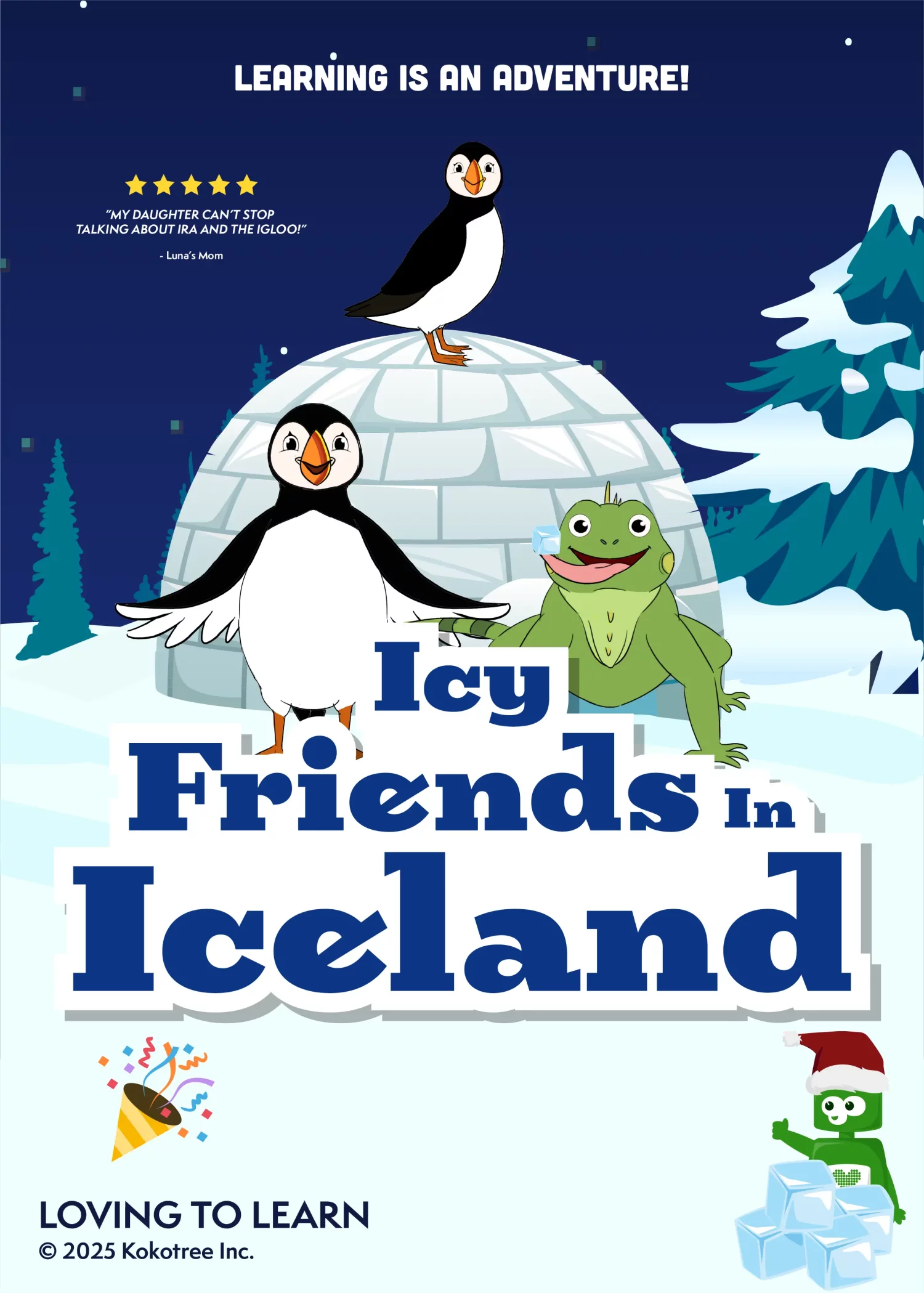
Your little one joins Ira the Iguana on a snowy adventure to Iceland, where she learns to build an igloo with her puffin friends! They'll discover tons of 'I' words while watching animals work together to solve a chilly problem.
2.5 minutes
Ages 3-6
Skill: Letter I recognition and vocabulary building
Your kid watches an iguana and puffins build an igloo together. You get 2.5 minutes to finish that cup of coffee.
Miss Meera tells a cozy story about Ira, an iguana from a warm Caribbean island who visits her puffin friends Isha and Isabelle in snowy Iceland. When Ira gets too cold, the friends work together to build an igloo—and your child hears the letter 'I' pop up everywhere!
What your child learns:
This video sneaks in serious letter recognition through storytelling. Every character name, location, and key action word starts with 'I'—so your child absorbs the letter sound naturally while following an engaging adventure.
- Recognizes the letter 'I' sound in words like igloo, island, Iceland, and iguana
- Builds vocabulary with words like inspect, identify, incredible, and inhabited
- Understands that different animals live in different climates
- Sees teamwork and problem-solving in action
- Learns basic concepts about cold weather and snow
They'll use these skills when:
- Spotting the letter 'I' on signs, books, and cereal boxes at the grocery store
- Talking about weather and asking why some places are cold and others are warm
- Working with siblings or friends to build something together (blocks, blanket forts, sandcastles)
- Sounding out new words and recognizing familiar letter sounds during reading time
The Story (what keeps them watching)
Ira the Iguana lives on a sunny Caribbean island, but she misses her friends Isha and Isabelle—two puffins in Iceland. When Ira visits, she's NOT prepared for the snow! She's freezing! The puffins have a brilliant idea: build an igloo, just like the Inuits do. The three friends inspect the area, identify the right ice, and work intensely together. Before long, they've built a cozy dome with a doorway. They move in, sing songs, and stay warm all winter. Friendship (and teamwork) saves the day!
How We Teach It (the clever part)
- First 45 seconds: Miss Meera introduces the characters—Ira, Isha, and Isabelle—and establishes the setting (island, Iceland). Kids hear multiple 'I' words right away without any pressure to repeat them.
- Minutes 1-2: The problem emerges (Ira is cold!) and the solution unfolds. Words like igloo, Inuits, inspect, identify, incredibly, and intensely appear naturally in the dialogue, reinforcing the 'I' sound through context.
- Final 30 seconds: The friends celebrate their success, and Tiki and Ruby react with excitement. The word "incredible" appears again, bookending the lesson.
Teaching trick: Every single character name starts with 'I' (Ira, Isha, Isabelle), so kids hear the target letter sound repeatedly without it feeling like a drill. The story does the teaching!
After Watching: Quick Wins to Reinforce Learning
- Mealtime activity: "Can you find something on your plate that starts with 'I'?" (If nothing does, ask about ice in their drink or say "Interesting!" about their food. Sneak in 'I' words yourself!)
- Car/travel activity: "Let's play I-Spy with 'I' words! I spy something that's made of ice... or looks icy... or is the color of an igloo!" (Practices connecting the letter sound to real-world objects)
- Bedtime activity: "If you could build an igloo, who would you invite inside?" (Reinforces 'I' vocabulary while encouraging imagination and storytelling)
- Anytime activity: Grab some pillows and blankets and build an "igloo" fort together! Say "We're inspecting the area!" and "This is incredible!" as you build. (Physical play reinforces vocabulary through experience)
When Kids Get Stuck. And How to Help.
- "My child doesn't seem to notice all the 'I' words" - That's actually fine! At this age, absorption happens before demonstration. They're soaking it in even if they can't articulate it yet. Try casually emphasizing 'I' words yourself: "Wasn't that igloo Incredible?"
- "They keep mixing up 'I' with 'E' sounds" - Super common! These vowels sound similar. Point to your mouth when you say each sound—'I' (like "eye") makes your mouth smile wide, while 'E' (like "eat") is more stretched. Make it silly and physical.
- "The vocabulary words seem too advanced (inhabited, intensely)" - Don't worry about full comprehension yet. Exposure to rich vocabulary now builds recognition later. If they ask what a word means, give a quick simple answer: "Inhabited means they moved in and lived there!"
What Your Child Will Learn
Prerequisites and Building Blocks
This video works best for children who have basic familiarity with the alphabet and understand that letters make sounds. It builds on foundational letter recognition skills and connects naturally to other Kokotree phonics content focusing on vowel sounds. Children who have explored letters A through H will find this a perfect next step. The storytelling format supports children still developing listening comprehension while the repetitive 'I' sound exposure prepares them for future blending and early reading skills.
Cognitive Development and Teaching Methodology
The narrative-based approach leverages how preschool brains naturally learn—through story and emotional connection. Rather than isolated drill-and-practice, children encounter the target letter sound embedded in meaningful context, which research shows improves retention. The video addresses visual learners through colorful animation, auditory learners through clear pronunciation and repetition, and even kinesthetic processors who can act out building motions. The problem-solution story structure mirrors how young children naturally process information.
Alignment with Educational Standards
This video supports Common Core Foundational Skills for Kindergarten (RF.K.1, RF.K.3) by building phonemic awareness and letter-sound correspondence. It aligns with Head Start Early Learning Outcomes Framework Language and Literacy goals. The vocabulary exposure (inspect, identify, incredible) supports the word-rich environment recommendations from early literacy research. Teachers expect entering kindergarteners to recognize most letter sounds—this video builds that foundation through contextual, engaging exposure rather than rote memorization.
Extended Learning Opportunities
Pair this video with Kokotree's letter 'I' tracing activities and the "I is for Iguana" printable worksheet. The app's "Letter Sounds" matching game reinforces recognition skills introduced here. Extend learning with ice cube play—freeze small toys in ice and let children "inspect" and "identify" what's inside as it melts. Draw igloos together and label them with a big letter 'I.' Connect to other Kokotree geography and animal videos exploring different climates and habitats.
Transcript Highlights
- "Ira, Isha, and Isabelle all worked together intensely. They inspired each other with their dedication and hard work." — Models collaborative problem-solving vocabulary
- "Let's inspect a spot close to home. And we also need to identify the right kind of ice." — Introduces sophisticated 'I' vocabulary in practical context
- "I am incredibly cold." — Simple, relatable statement using target letter sound
- "Once they had a doorway, they all went in and inhabited the igloo: it was their new home!" — Expands vocabulary while resolving the story
Character Development and Story Arc
Ira demonstrates vulnerability by admitting she's cold and uncomfortable—modeling that it's okay to express needs. Isha shows initiative by proposing the igloo solution, while Isabelle contributes practical thinking ("identify the right kind of ice"). Together, the three friends model collaborative problem-solving: each contributes their strengths, they work "intensely" without giving up, and they celebrate together. This growth mindset approach shows children that challenges (being cold, needing shelter) become opportunities when friends work together.
Phonics and Letter Recognition Deep Dive
The letter 'I' presents unique teaching opportunities because it functions as both a vowel with multiple sounds and a complete word (the pronoun "I"). This video focuses primarily on the long 'I' sound (as in "ice," "Ira," "island") while naturally incorporating the short 'I' sound in words like "in," "it," and "inhabited."
Research in early literacy development shows that children learn letter sounds most effectively when they encounter them in meaningful, memorable contexts rather than isolation. This video employs what educators call "embedded phonics instruction"—the target sound appears naturally throughout an engaging narrative, allowing children to absorb the sound-symbol relationship without conscious effort.
The strategic repetition is carefully designed: character names (Ira, Isha, Isabelle), locations (Iceland, island), objects (igloo, ice), and action words (inspect, identify, inspired, intensely, inhabited, incredible) all reinforce the target sound. This density of 'I' words—over 25 instances in under three minutes—creates what linguists call "enhanced input," giving children multiple exposures without tedious repetition.
The video also introduces the concept that the same letter can appear at the beginning of words (igloo), in the middle (puffins), and carries meaning. For children at the pre-reading stage, this foundational understanding that letters represent consistent sounds is the critical building block for future decoding skills. The story format ensures emotional engagement, which neuroscience research confirms significantly improves memory formation and recall.