
What's Trace and Tower About?
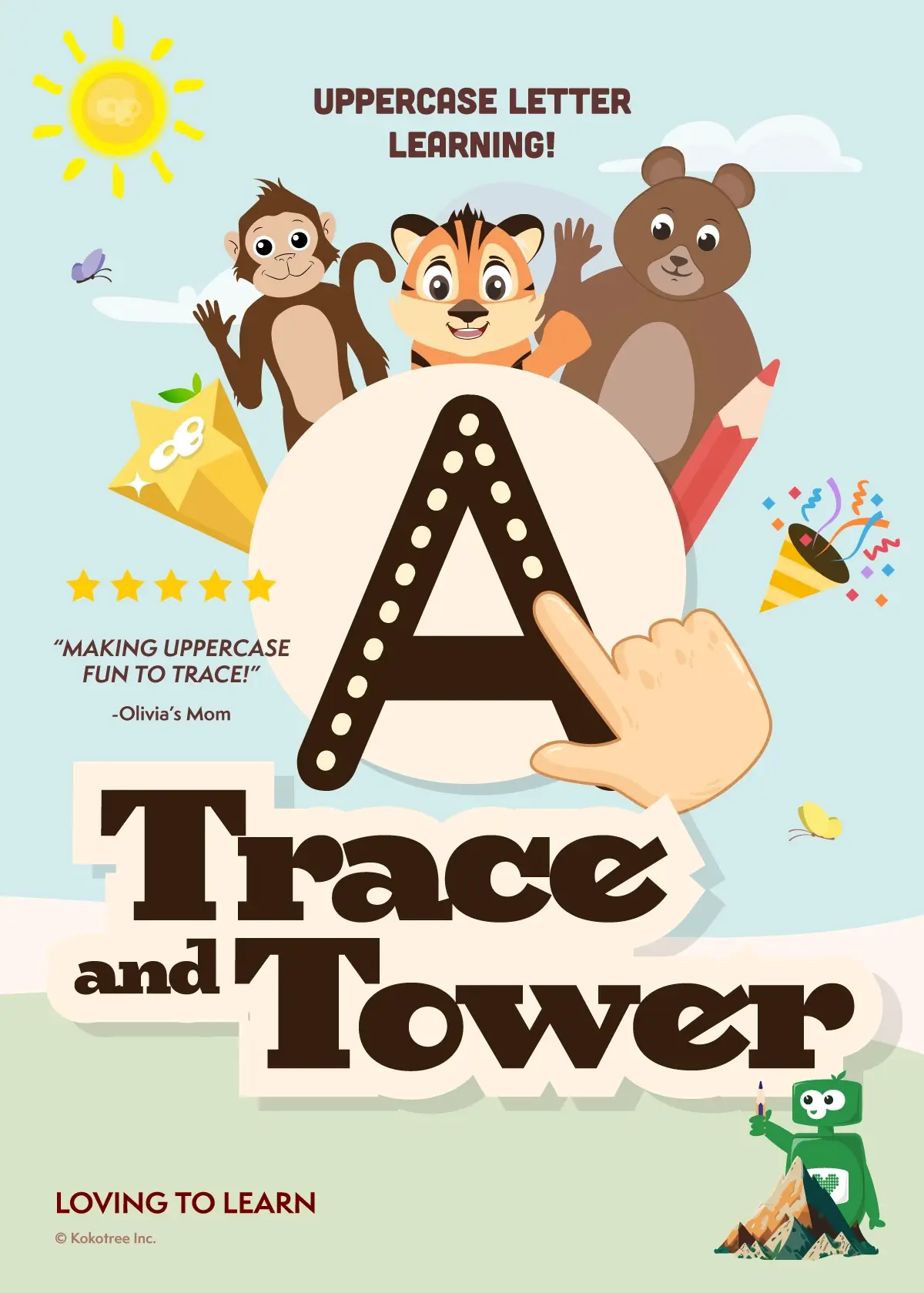
Your child traces uppercase letters A through Z with their finger, building the exact muscle memory and hand control they'll need for real handwriting. It's purposeful practice disguised as play!
Interactive Game
Ages 3-6
Skill: Handwriting Readiness
Your kid traces letters with guided finger paths. You get guilt-free screen time knowing they're learning.
Friendly animal guides show your child exactly where to start and which direction to move their finger. Bright visual cues light up the path, and each successfully traced letter builds toward something exciting—encouraging them to trace again and again.
What your child practices:
Every trace strengthens the fine motor control and visual-motor integration that handwriting demands. They're not just learning what letters look like—they're teaching their hands how to form them.
- Proper letter formation (starting points, stroke direction, stroke order)
- Fine motor control and finger strength
- Hand-eye coordination
- Visual tracking and spatial awareness
- Pre-writing muscle memory
They'll use these skills when:
- Writing their name on artwork or belongings
- Tracing shapes and patterns in preschool worksheets
- Drawing pictures with more controlled lines
- Starting formal handwriting instruction in kindergarten
The Gameplay (what keeps them engaged)
Each letter appears with a clear starting dot and guided path. As your child traces with their finger, the line follows their movement with satisfying visual feedback. Complete a letter correctly and watch it come to life! The "tower" element adds a building mechanic—each mastered letter adds to their creation, giving kids a tangible goal beyond just tracing. Letters progress in a thoughtful sequence, and friendly animal characters celebrate successes, making kids eager to trace "just one more."
How It Teaches (the clever part)
- Immediate feedback: The tracing line changes color when on track, gently redirecting when straying off the guided path
- Progression: Starts with simpler straight-line letters (L, T, I) before introducing curves and diagonals (S, R, Q)
- Repetition: The tower-building reward system motivates multiple practice rounds without feeling repetitive
Learning trick: The guided starting dots teach proper letter formation from day one—no bad habits to unlearn later!
Beyond the App: Reinforce the Learning
- Mealtime activity: "Let's draw letters in the air before we eat!" Use a finger to trace big letters together. (Practices letter formation without needing paper)
- Car/travel activity: "I spy something that starts with the letter T—can you trace a T on the window?" (Connects letter shapes to sounds and real objects)
- Outdoor activity: "Let's write letters with a stick in the sand or dirt!" Find a patch of dirt or sand and practice big letter shapes. (Builds gross motor connection to letter formation)
- Anytime activity: "Can you trace the letters on this cereal box with your finger?" Point out letters in your environment and trace them together. (Reinforces that letters are everywhere)
Common Questions Parents Ask
- "Is tracing on a screen really as good as paper?" - Absolutely! The guided feedback actually helps children learn correct formation faster than unguided paper practice. Once they've built muscle memory here, transferring to pencil and paper is much easier.
- "How long until my child can write letters on their own?" - Most children need weeks or months of tracing practice before independent writing. Look for signs like remembering where to start or tracing faster—these show real progress!
- "What if my child gets frustrated with tricky letters?" - That's completely normal! The game is designed to celebrate effort, not just perfection. Encourage them to try the easier letters first to build confidence before tackling curves and diagonals.
What Your Child Will Learn
Prerequisites and Building Blocks
Children benefit most from Trace and Tower after developing basic finger isolation (pointing with one finger) and the ability to follow simple visual instructions. This game builds naturally on shape-tracing activities and basic drawing experiences. In the Kokotree learning progression, it connects to earlier shape recognition games and prepares children for lowercase letter tracing and eventually independent letter writing. No prior letter knowledge is required—the tracing itself teaches letter shapes.
Cognitive Development and Game Design
The touch-and-drag interaction perfectly suits children ages 3-6, whose fine motor skills are rapidly developing but not yet ready for pencil precision. Large touch targets accommodate still-developing hand control, while the immediate visual feedback leverages young children's need for instant reinforcement. The game applies motor learning principles—guided practice with decreasing support—matching how preschool brains best acquire physical skills through repetition with positive feedback.
Alignment with Educational Standards
Trace and Tower directly supports Common Core Kindergarten standard L.K.1a (print all uppercase letters) and addresses Head Start Early Learning Outcomes Framework goals for fine motor development. Teachers expect kindergarteners to form uppercase letters with reasonable accuracy; this game builds that foundation. It aligns with pre-K writing readiness benchmarks emphasizing proper grip preparation, stroke directionality, and letter formation habits that support later cursive transition.
Extended Learning Opportunities
Pair Trace and Tower with Kokotree videos featuring letter songs and letter-sound connections to reinforce recognition alongside formation. Extend learning with playdough letter-making, finger painting letters, or tracing letters in shaving cream. These tactile experiences strengthen the same neural pathways. Look for opportunities to point out uppercase letters in books, signs, and packaging—connecting traced shapes to real-world print.
Game Mechanics Summary
- Child taps to select a letter, then traces along a guided path using their finger
- Visual cues (dots, arrows, color changes) indicate starting points and direction
- Successful traces trigger celebratory animations and add to a building tower
- Gentle correction feedback guides off-track attempts back to the path
Skill Development Progression
Initial play focuses on following the guided path with any level of accuracy. With practice, children trace faster and more smoothly, needing fewer corrections. Mastery looks like confident, fluid traces with automatic knowledge of where to start and which direction to move. Watch for your child air-tracing letters spontaneously, recognizing letters in the environment, or attempting to write letters independently—these signal the muscle memory is taking hold.
Handwriting Development Deep Dive
Handwriting is one of the most complex fine motor skills children learn, requiring the coordination of over 30 hand and arm muscles working in precise sequence. Research shows that explicit instruction in letter formation—specifically where to start and which direction to move—significantly improves handwriting outcomes compared to unguided practice.
Trace and Tower applies this research by providing consistent starting points and directional guidance for every letter. This prevents the development of inefficient formation habits that can slow writing speed and cause fatigue later. The uppercase focus is developmentally appropriate: uppercase letters use primarily straight lines and simple curves, making them easier for developing hands than the more complex lowercase forms.
Studies in motor learning demonstrate that guided practice with immediate feedback accelerates skill acquisition. The game's visual feedback system—showing children exactly when they're on track—creates the optimal learning conditions that research supports. Additionally, the repetition built into the tower-building mechanic provides the distributed practice that strengthens neural pathways without causing boredom or fatigue.
For school readiness, children who enter kindergarten with proper letter formation habits spend less cognitive energy on the physical act of writing, freeing mental resources for spelling, composition, and idea expression. This foundational skill directly impacts academic confidence and performance across subjects.